
 Utagawa Hiroshige日本, 1797–1858
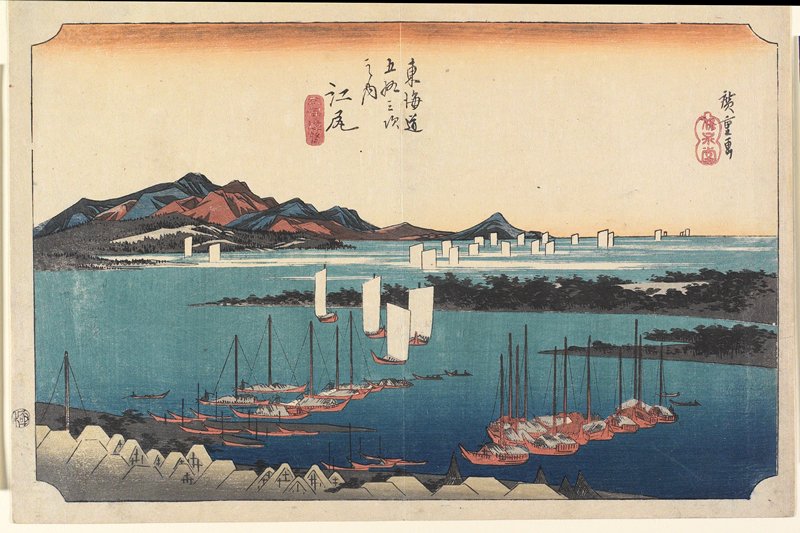
De Onmaya oever
見られますか?
不明
『De Onmaya oever』は今どこに? 所蔵: アムステルダム国立美術館, アムステルダム. 不明.

アムステルダム, オランダ
所蔵者は判明していますが、現在展示中かどうかは不明です。
- 出典
- 美術館
作品について
美術館の言葉で — オランダ語
De rivier de Sumida gezien vanaf de Onmaya oever; in de veerboot links twee prostituees, uit de laagste klasse, werkzaam op de rivieroevers.
アムステルダム国立美術館
作品データ
- 収蔵番号
- RP-P-1956-749
描かれているもの
カタログ収録
出典
- アムステルダム国立美術館
- 画像: アムステルダム国立美術館 — public domain
その頃、Utagawa Hiroshigeの人生では
生涯をすべて見る1856
He becomes a Buddhist monk
In 1856 Hiroshige “retired from the world”, becoming a Buddhist monk; this was the year he began his “One Hundred Famous Views of Edo”.
1856
Luxury editions with the publisher Uoya Eikichi
Working with the publisher Uoya Eikichi, Hiroshige created a series of luxury edition prints using the finest printing techniques: true gradation of color, mica for an iridescent effect, embossing, fabric printing, blind printing and glue printing.
1856–1858
One Hundred Views of Edo: a priest pays up front
His great “One Hundred Famous Views of Edo” was paid for up front by a wealthy Buddhist priest in love with the daughter of the publisher Uoya Eikichi, a former fishmonger. Hiroshige was usually poorly paid per series, yet he remained capable of remarkable art when the conditions were right.
1858
The cholera epidemic in Edo
Hiroshige died aged 62 during the great Edo cholera epidemic of 1858; whether the epidemic killed him is unknown.
1858
A farewell poem and a will that settles his debts
Just before his death Hiroshige left a farewell poem. He was never wealthy: his income amounted to about twice a day labourer's wages, and his will left instructions for the payment of his debts.
1858年10月12日
Died
![Shinano Province, Moon Reflected in the Sarashina Paddy-fields, Mount Kyōdai (Shinano, Sarashina tagoto no tsuki, Kyōdaisan), from the series Famous Places in the Sixty-odd Provinces [of Japan] ([Dai Nihon] Rokujūyoshū meisho zue), Utagawa Hiroshige 歌川広重, Edo period, 1853 (Kaei 6, 8th month)](https://nrs.harvard.edu/urn-3:HUAM:CARP04802_dynmc/full/!2400,2400/0/default.jpg)


![[Kanal mit einem großen Boot und einer Brücke; Canal with a Large Boat and a Bridge; Le paysage au bateau], Rembrandt, 1650](https://diglib.hab.de/varia/haum/rembrandt-v3-4676/max/000001.jpg)
![[Landschaft mit trinkender Kuh; Landscape with a Cow Drinking; L'abreuvoir de la vache], Rembrandt, 1650](https://diglib.hab.de/varia/haum/rembrandt-ab3-0268/max/000001.jpg)
