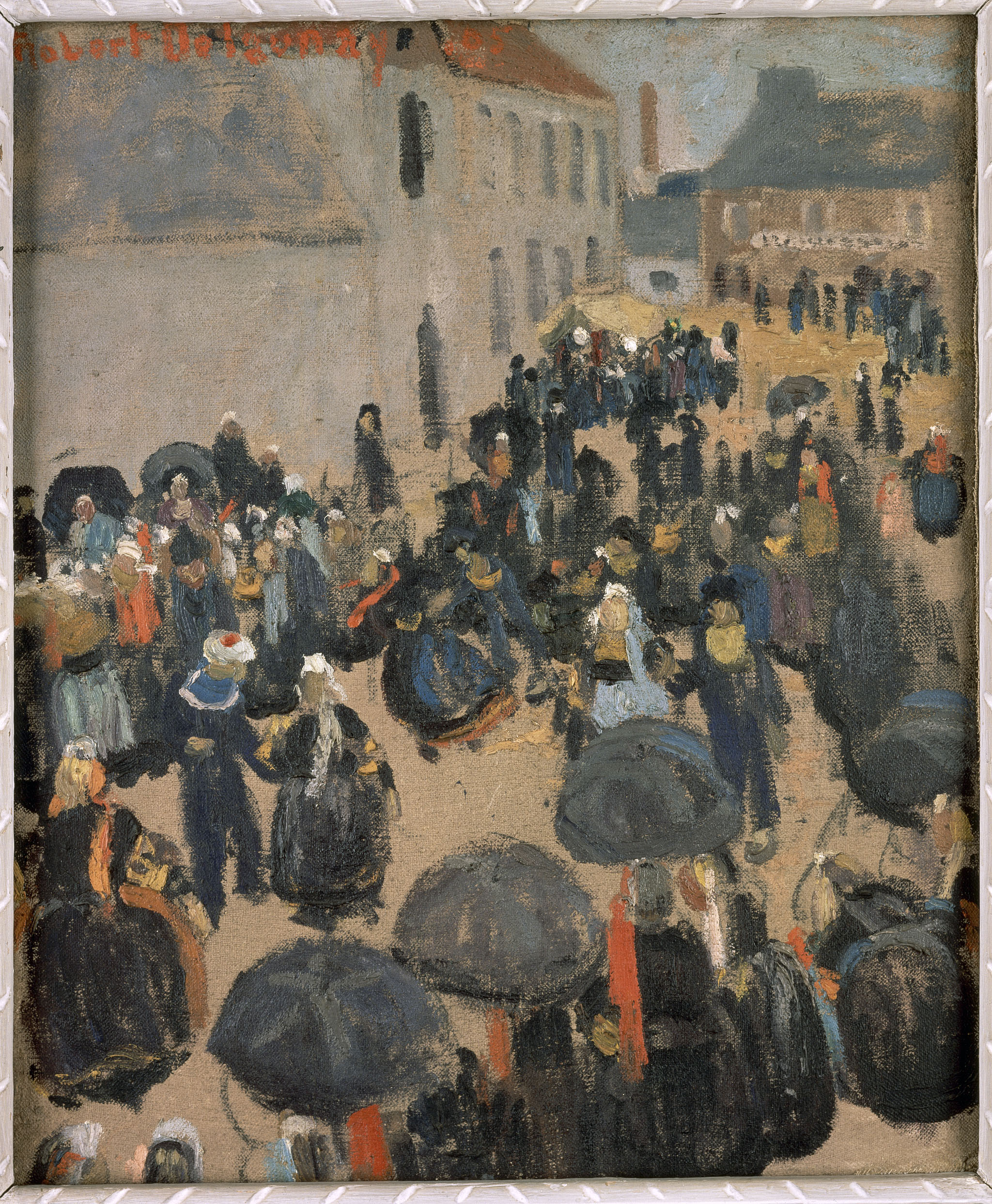
Robert Delaunayフランス, 1885–1941
Champs de Mars: The Red Tower
お目にかかれますか?
はい、お客様をお迎えしています

シカゴ美術館
展示室展示室 392シカゴ, アメリカ合衆国
一般公開されています。裏付けとなる出典は下に記しています。
- 確認
- この状態になった日
- 出典
- 美術館
この絵画について
Robert Delaunay was four years old when the Eiffel Tower was erected in Paris in the public green space known as the Champ de Mars. One of many artists to depict the landmark, Delaunay did a series of Eiffel Tower paintings, of which the Art Institute’s example is among the best known. The artist infused the dynamism of modern life into this image by employing multiple viewpoints, rhythmic fragmentation of form, and strong color contrasts. Delaunay accented the structure’s towering presence by framing it with tall buildings and placing smaller, shorter buildings, seen from above, at its base. The top of the tower seems to soar, its massive structure augmented by winglike clouds and patches of light-filled sky.
続きを読む
The artist first showed this painting in the winter of 1912, at the Galerie Barbazanges in Paris, where Guillaume Apollinaire described the work in a review as “unfinished, whether by design or accident.” Although Delaunay’s intent is not recorded, it is certain that by 1923, when this work was illustrated in the pages of the Bulletin de l’effort modern, it looked as it does today: the artist had repainted portions of the canvas and filled areas of reserve with paint.
This is one of thirty-five works that comprise the Winterbotham Collection. Click here to learn more about the collection.
シカゴ美術館CC BY 4.0
作品データ
- 収蔵番号
- 1959.1
描かれているもの
カタログ収録
出入りの記録
展示中 · 展示室 392
シカゴ美術館 · 2026年9月28日 — 現在 · 確認済み
展示中 · 展示室 391
シカゴ美術館 · 2026年8月19日 — 2026年9月28日 · 確認済み
出典
- シカゴ美術館
- 画像: シカゴ美術館 — © the artist or rights holder
その頃、Robert Delaunayの人生では
生涯をすべて見る1910
Marries Sonia Terk; the founding of Orphism
In 1910 Delaunay married Sonia Terk; together with a few others they founded the Orphism art movement, and the couple settled in a studio apartment in Paris.
1911
Joins the “Blue Rider” at Kandinsky’s invitation
In 1911, at the invitation of Wassily Kandinsky, Delaunay joined the Munich-based Blue Rider (Der Blaue Reiter) group, took part in its first exhibition and sold four works; he was also successful in Germany, Switzerland and Russia.
1912
The move from Cubism to Orphism
From 1912, together with his wife Sonia Terk-Delaunay, Delaunay moved from Cubism to a distinctive manner of abstract painting that Guillaume Apollinaire named Orphism. Unlike Kandinsky and Mondrian, he rejected idealist metaphysics and saw the main task of abstraction as the study of the dynamic qualities of colour.
1912
Break with the Cubists: “the heretic of Cubism”
1912 was a turning point for Delaunay: his paintings, like prisms compared with the Cubism of his fellow artists, provoked great arguments with comrades who banned colour from their palette, and he called himself “the heretic of Cubism”. The first published suggestion that he had broken with the Cubists appeared in James Burkley’s review of the Salon des Indépendants in L’Assiette au Beurre of 23 March 1912.
February 1912
The second Blue Rider exhibition and the Knave of Diamonds
In February 1912 Delaunay exhibited in the second Blaue Reiter exhibition in Munich and in the Knave of Diamonds exhibition in Moscow.
closed 13 March 1912
First major Paris exhibition, Galerie Barbazanges
His first major exhibition in Paris closed on 13 March 1912 after two weeks at the Galerie Barbazanges: organised by the mathematician and actuary Maurice Princet, it showed 46 works, from the Divisionist period of 1906–07 to the Proto-Cubist and Cubist Eiffel Tower paintings of 1909–12. Apollinaire praised the exhibition and saw in Delaunay an artist with a monumental vision of the world.