 Joseph Mallord William TurnerRegno Unito, 1775–1851
Whalers
Si può vedere?
Sì, esposta ora
Dove si trova «Whalers» oggi? Metropolitan Museum of Art, Sala 808, New York. Sì, esposta ora. Verificato 29 settembre 2026.

New York, Stati Uniti
Aperto· fino alle 17:00
Esposta al pubblico.
- Verificato
- Ultimo cambio di stato
- Fonte
- Il museo
Sul dipinto
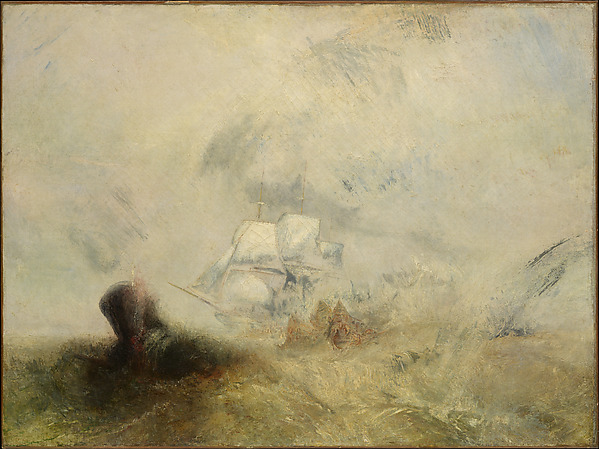
Whalers is an 1845 painting by British artist J. M. W. Turner. Done in oil on canvas, the work depicts a whaling ship and her launches pursuing a whale. Originally created with the hope that collector Elhanan Bicknell would purchase it, the work is currently found in the collection of the Metropolitan Museum of Art. The painting was the centerpiece for the exhibition Turner’s Whaling Pictures at the Metropolitan Museum of Art in 2016.
The painting depicts a wounded sperm whale thrashing in a sea of foam and blood. In the background is a ghostly three-masted whaling vessel. The massive head of a wounded whale is breaking through the sea surface is to the left, its tail is seen in the froth to the right and a small boat is being tossed in the center foreground.
Scheda
- Numero di inventario
- 96.29
Che cosa raffigura
In catalogo
Fonti
- Metropolitan Museum of Art
- Immagine: Metropolitan Museum of Art — Open Access (CC0)
Nella vita di Joseph Mallord William Turner
Tutta la vita1830–1840s
Criticism in the 1830s–1840s and Ruskin’s defence
His innovative works, bordering on abstraction, gave him a reputation for madness: the Victorian public preferred realism and sentimentality, and Queen Victoria refused to knight him. John Ruskin came to his defence, calling him “the greatest artist of all time”.
1840–1844
Last journeys: Venice and Switzerland
On a second trip to Venice (1840) he also visited Trieste and Coburg, and in 1841 and 1844 he made two final trips to Switzerland, in his sixties.
1845–1851
Life as “Mr Booth” in Chelsea
In his seventies he formed a relationship with the widow Sophia Caroline Booth and often stayed with her, under the pseudonym “Mr Booth” or “Admiral Booth”, in her house at 6 Davis’s Place (now Cheyne Walk) in Chelsea, where he died in 1851.