ART WIKI32.963 in sala
MappaCollezioneArtistiMuseiMostreRivista
Accedi

ART WIKI

Dove è appeso il capolavoro, e quando si può entrare.

Collezioni: Art Institute of Chicago, Cleveland Museum of Art, Ermitage, Galleria Tret'jakov, Getty Museum, Harvard Art Museums, Hirshhorn Museum and Sculpture Garden, Metropolitan Museum of Art, Minneapolis Institute of Art, Museo del Louvre, Museo Puškin delle belle arti, Museo russo, Museum of Modern Art, National Gallery of Art, National Museum of Asian Art, National Portrait Gallery, Rijksmuseum, Smithsonian American Art Museum, Statens Museum for Kunst, Victoria and Albert Museum, Villa Getty, Whitney Museum of American Art, Catalogo statale del fondo museale russo (274 musei), Europeana (19 musei), Wikidata (6 musei), Paris Musées (12 musei) e Joconde, la banca dati dei musei del Ministero della Cultura francese (495 musei). Le immagini appartengono ai titolari dei diritti.

Sezioni

  • Mappa
  • Ricerca
  • Collezione
  • Capolavori
  • Esposte ora
  • Artisti

Altro

  • Musei e gallerie
  • Mostre
  • Rivista
  • Da dove vengono i dati
  • Privacy e cookie
HomeMappaCatalogo
  1. Collezione/
  2. Getty Museum/
  3. Waiting (L'Attente)
Waiting (L'Attente), Edgar Degas, about 1882
Edgar Degas, ritrattoEdgar DegasFrancia, 1834–1917

Waiting (L'Attente)

about 1882 · Drawing · 48.3 × 61 cm

Si può ammirare?

Al momento non riceve

GM
Getty Museum

Los Angeles, Stati Uniti

Appartiene alla collezione, ma al momento non è esposta.

Verificato
16 ore fa
Ultimo cambio di stato
7 ott 2026
Fonte
Il museo
Sulla mappaPagina del museo

Sull’opera

A young ballet dancer bends forward to massage her foot, while her somberly dressed older companion sits silently beside her on a bench. They appear to be waiting, perhaps for an audition or its outcome. The two figures are a study in contrasts: The athletic dancer dressed in a dazzling costume reflects the glamour and artifice of the stage, while the shabbily dressed, bent figure represents the drabness of everyday life. Edgar Degas painted modern life; his subjects, including laundresses, milliners, nightclub singers, horse races, and the ballet, reflected contemporary Parisian occupations and diversions. From the 1860s onward, Degas frequented the Paris Opéra, where he made numerous studies of performances, rehearsals, and backstage scenes. Later, he would refine and combine these motifs in his studio, in exercises of daring technical skill and compelling psychological subtlety.

Continua a leggere

Here he demonstrated his complete mastery of the pastel technique. Delicately blended strokes are combined with bold hatching and emphatic slashes; pink, blue, and creamy tones describe the dancer in contrast to the dark, severe form of the older woman.

GMGetty Museum

Scheda

about 1882 · a 48 anni
18341917
Numero di inventario
83.GG.219

In catalogo

Disegni e acquerelliPastelloImpressionismoXIX secoloFrancia

Fonti

  • Getty Museum
  • Immagine: Getty Museum — Open Content

Nel frattempo, nella vita di Edgar Degas

Tutta la vita
  1. autumn 1879 – April 1880

    The prints journal: Degas abruptly withdraws

    In the autumn and winter of 1879–1880 Degas and Cassatt worked closely together on a prints journal; he owned a small printing press. In April 1880 Degas abruptly withdrew, and without his support the project folded.

  2. by 1880

    The end of his financial crisis

    By 1880 Degas had fully overcome his financial crisis and become a respected figure in the Paris art world; the Impressionist exhibitions, which proved commercially useful to him, helped.

  3. 1881

    “The Little Dancer of Fourteen Years” on show

    The nearly life-size wax figure with real hair and a cloth tutu, modelled on Marie van Goethem, provoked a strong reaction: critics found its realism extraordinary, but many denounced the dancer as ugly. It was the only sculpture Degas showed in his lifetime.

  4. 1881

    The pastels “Criminal Physiognomies”

    Degas attended the trial of the young gang members convicted of murder in the Abadie affair, sketchbook in hand, and in 1881 exhibited two pastels, “Criminal Physiognomies”. The drawings reveal his interest in features that some nineteenth-century scientists took as evidence of innate criminality.

  5. by 1882

    His eyesight sharply worsens

    By 1882 Degas's eyesight began to worsen sharply: he turned to pastel and then to sculpture, where he could rely more on touch.
Altre opere di Edgar Degas

Tutte le opere
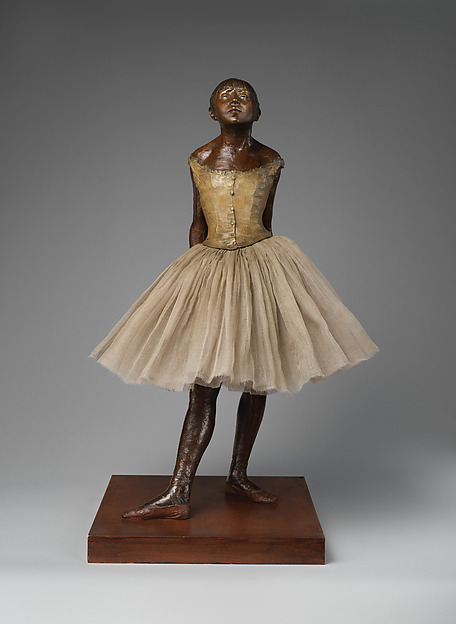
The Little Fourteen-Year-Old Dancer, Edgar Degas, modeled 1881, cast 1922, modern tutu

The Little Fourteen-Year-Old Dancer

modeled 1881, cast 1922, modern tutu · Metropolitan Museum of Art

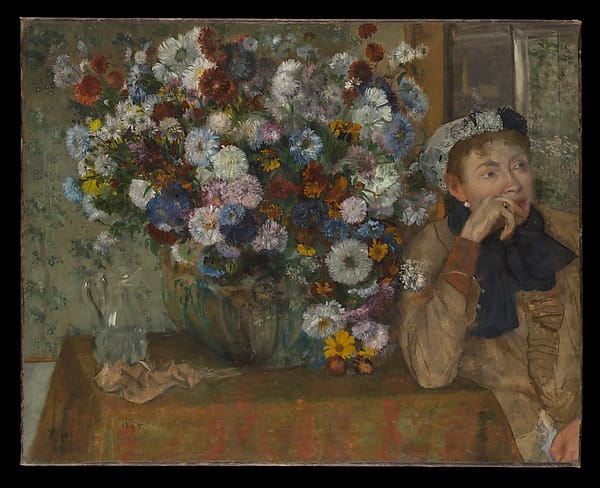
A Woman Seated beside a Vase of Flowers (Madame Paul Valpinçon?), Edgar Degas, 1865

A Woman Seated beside a Vase of Flowers (Madame Paul Valpinçon?)

1865 · Metropolitan Museum of Art

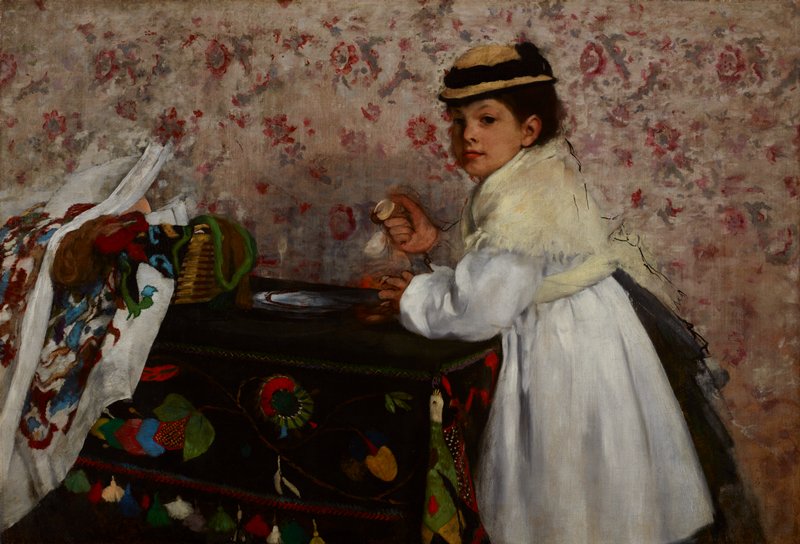
Portrait of Mlle. Hortense Valpinçon, Edgar Degas, c. 1871

Portrait of Mlle. Hortense Valpinçon

c. 1871 · Minneapolis Institute of Art

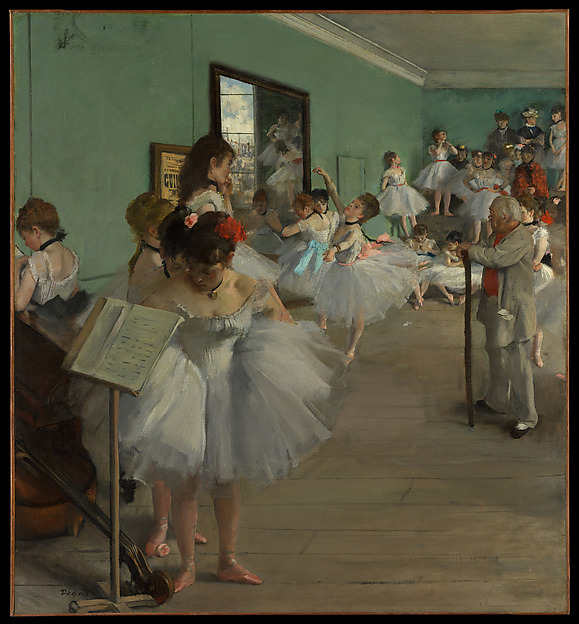
The Dance Class, Edgar Degas, 1874

The Dance Class

1874 · Metropolitan Museum of Art

Woman Having Her Hair Combed, Edgar Degas, ca. 1886–88

Woman Having Her Hair Combed

ca. 1886–88 · Metropolitan Museum of Art

Study in the Nude of Little Dancer Aged Fourteen (Nude Little Dancer), Edgar Degas, original wax c. 1878-1881, cast 1920/1926

Study in the Nude of Little Dancer Aged Fourteen (Nude Little Dancer)

original wax c. 1878-1881, cast 1920/1926 · National Gallery of Art

Horse Galloping on the Right Foot, Edgar Degas, late 1880s

Horse Galloping on the Right Foot

late 1880s · National Gallery of Art

Horse Trotting, the Feet Not Touching the Ground, Edgar Degas, 1870s

Horse Trotting, the Feet Not Touching the Ground

1870s · National Gallery of Art

Sotto lo stesso tetto: Getty Museum

Pagina del museo
Irises, Vincent van Gogh, 1889

Vincent van Gogh

Irises, 1889

The Portal of Rouen Cathedral in Morning Light, Claude Monet, 1894

Claude Monet

The Portal of Rouen Cathedral in Morning Light, 1894

Wheatstacks, Snow Effect, Morning (Meules, Effet de Neige, Le Matin), Claude Monet, 1891

Claude Monet

Wheatstacks, Snow Effect, Morning (Meules, Effet de Neige, Le Matin), 1891

Sunrise (Marine), Claude Monet, 1872 or 1873

Claude Monet

Sunrise (Marine), 1872 or 1873

Still Life with Flowers and Fruit, Claude Monet, 1869

Claude Monet

Still Life with Flowers and Fruit, 1869

Saint Bartholomew, Rembrandt Harmensz. van Rijn, 1661

Rembrandt van Rijn

Saint Bartholomew, 1661

Daniel and Cyrus Before the Idol Bel, Rembrandt Harmensz. van Rijn, 1633

Rembrandt van Rijn

Daniel and Cyrus Before the Idol Bel, 1633

The Abduction of Europa, Rembrandt Harmensz. van Rijn, 1632

Rembrandt van Rijn

Il rapimento di Europa, 1632