From the late 1940s Kline generalizes his figurative subjects into lines and planes that fit together much like the Cubism of the time. Many of his forms derive from the locomotives, stark landscapes and large mechanical shapes of his native coal-mining region of Pennsylvania — sometimes apparent only from the titles of the works.
1948–1950
The turn to black-and-white abstraction
Over the next two years Kline's brushstrokes become completely non-representative, fluid and dynamic, and he begins painting only in black and white: for him the white is just as important as the black. Viewers also see references to Japanese calligraphy in these paintings, through his exchange with the avant-garde group Bokujinkai and its leader Morita Shiryu, although Kline later denied the connection.
16 October – 4 November 1950
First solo show at the Charles Egan Gallery
At the Charles Egan Gallery in New York Kline's first one-man show opens: eleven abstract paintings with very little colour — brown underpainting near the bottom of “Nijinsky” and fleeting hints of green in “Leda”. Afterwards he is dubbed the “black and white artist”, a label by which he sometimes feels restricted.
early 1950s
An affinity with Pierre Soulages
In the early 1950s Kline's work appears very much inspired by the French painter Pierre Soulages, who had exhibited at Betty Parsons' gallery in New York in 1949.
1951
Taking part in the 9th Street Art Exhibition
A year after his first solo show Kline takes part in the 9th Street Art Exhibition.
1952–1961
The Whitney Annuals and Biennials
Kline's work is included in the Whitney Museum of American Art's Annuals and Biennials in 1952, 1953, 1955 and 1961.
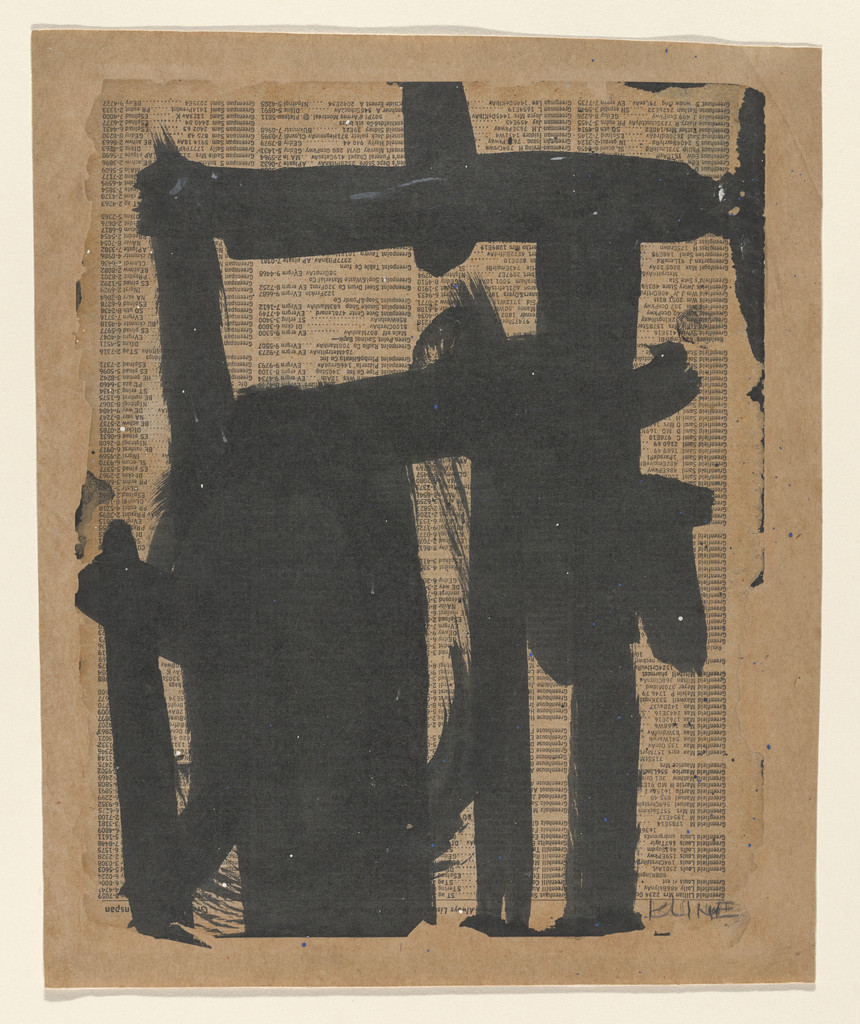


![Untitled [recto], Franz Kline, 1950s](https://api.nga.gov/iiif/f2e53a49-1f2c-4abc-b0fd-771de8e01df6/full/!2400,2400/0/default.jpg)
![Untitled [verso], Franz Kline, 1940s-1950s](https://api.nga.gov/iiif/241da734-c8c4-4f8f-a104-df63cc4e1be1/full/!2400,2400/0/default.jpg)