ART WIKI32.963 in sala
MappaCollezioneArtistiMuseiMostreRivista
Accedi

ART WIKI

Dove è appeso il capolavoro, e quando si può entrare.

Collezioni: Art Institute of Chicago, Cleveland Museum of Art, Ermitage, Galleria Tret'jakov, Getty Museum, Harvard Art Museums, Hirshhorn Museum and Sculpture Garden, Metropolitan Museum of Art, Minneapolis Institute of Art, Museo del Louvre, Museo Puškin delle belle arti, Museo russo, Museum of Modern Art, National Gallery of Art, National Museum of Asian Art, National Portrait Gallery, Rijksmuseum, Smithsonian American Art Museum, Statens Museum for Kunst, Victoria and Albert Museum, Villa Getty, Whitney Museum of American Art, Catalogo statale del fondo museale russo (274 musei), Europeana (19 musei), Wikidata (6 musei), Paris Musées (12 musei) e Joconde, la banca dati dei musei del Ministero della Cultura francese (495 musei). Le immagini appartengono ai titolari dei diritti.

Sezioni

  • Mappa
  • Ricerca
  • Collezione
  • Capolavori
  • Esposte ora
  • Artisti

Altro

  • Musei e gallerie
  • Mostre
  • Rivista
  • Da dove vengono i dati
  • Privacy e cookie
HomeMappaCatalogo
  1. Collezione/
  2. Harvard Art Museums/
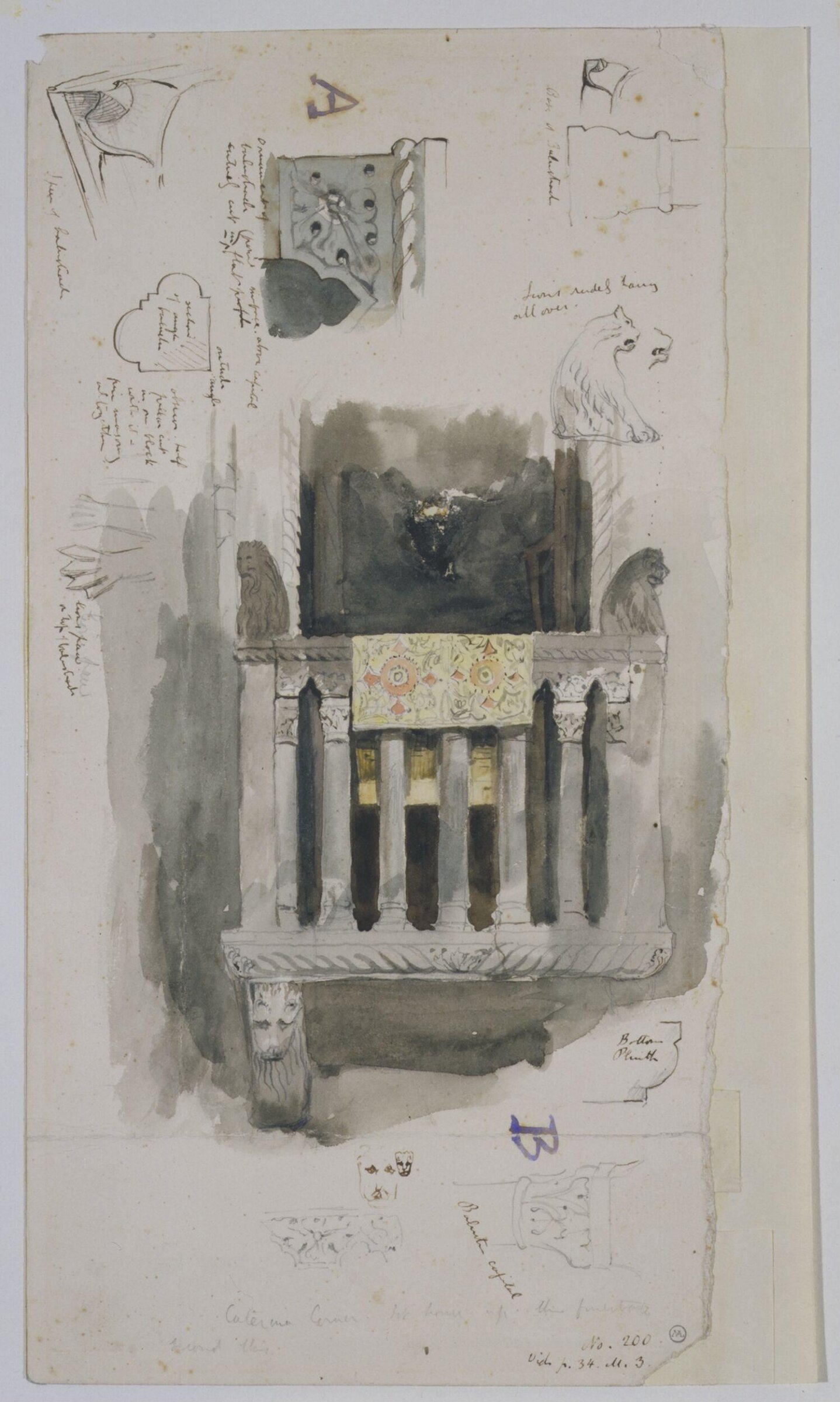
  3. Trunk of a Tree
Trunk of a Tree, John Ruskin, c. 1856
John Ruskin, ritrattoJohn RuskinInghilterra, 1819–1900

Trunk of a Tree

c. 1856 · Drawing

Si può ammirare?

Al momento non riceve

Harvard Art Museums

Cambridge, Stati Uniti

Appartiene alla collezione, ma al momento non è esposta.

Verificato
3 giorni fa
Ultimo cambio di stato
27 set 2026
Fonte
Il museo
Sulla mappaPagina del museo

Scheda

c. 1856
18191900
Numero di inventario
1926.33.154

In catalogo

Disegni e acquerelliGrafiteRealismoXIX secoloRegno Unito

Fonti

  • Harvard Art Museums
  • Immagine: Harvard Art Museums — © President and Fellows of Harvard College

Nel frattempo, nella vita di John Ruskin

Tutta la vita
  1. 1834–1900 · Luogo di lavoro

    Great Britain

  2. 1850s

    Patron of Hunt, Rossetti and Burne-Jones

    Ruskin continues to support Holman Hunt and Rossetti, provides an annuity of £150 in 1855–57 to Rossetti's wife Elizabeth Siddal (and pays for Henry Acland's medical care of her), and gives critical and financial help to John Brett, John William Inchbold and Edward Burne-Jones, whom he calls “Brother Ned”. His father disapproves of such friends — a further cause of tension between them.

  3. April – July 1854

    Effie leaves Ruskin and the marriage is annulled

    Suffering from illness and from fierce quarrels with her husband and his overly protective parents, Effie goes to her own parents in Scotland; she and Millais have fallen in love, and her leaving causes a public scandal. In April 1854 she files a suit of nullity on grounds of non-consummation, which is granted in July; Ruskin does not even mention it in his diary.

  4. 1858

    Turin: Veronese against a dull sermon

    In Turin Ruskin sits through a particularly dull sermon at a Waldensian church and sees Paolo Veronese's “Presentation of the Queen of Sheba” at the Galleria Sabauda; later, in April 1877, he will name this as the start of his “unconversion” from Evangelical Christianity. His faith, long shaken by Biblical and geological scholarship, collapses, and, believing that much of his writing had rested on lies and half-truths, Ruskin goes through a deep personal crisis before returning to Christianity after a long struggle.

  5. 1858

    Meeting Rose La Touche

    In 1858 Ruskin meets Rose La Touche (1848–1875), from an extremely devout Protestant family; during a period of acute religious crisis he falls passionately in love, first with the girl and then with the young woman.

  6. May 1858

    Completes his work on the Turner Bequest

    Having persuaded the National Gallery to let him work on the Turner Bequest — nearly 20,000 works left to the nation by the painter — Ruskin completes the enormous task of cataloguing, framing and conserving them by May 1858. Four hundred watercolours are displayed in cabinets of his own design.
Altre opere di John Ruskin

Tutte le opere
Architectural details from the Sagredo Palace, Venice, John Ruskin, 19th century

Architectural details from the Sagredo Palace, Venice

19th century · Victoria and Albert Museum

View of Amalfi, John Ruskin, 1844

View of Amalfi

1844 · Harvard Art Museums

Fragment of the Alps, John Ruskin, c. 1854-1856

Fragment of the Alps

c. 1854-1856 · Harvard Art Museums

Tree Study, John Ruskin, mid-1850s

Tree Study

mid-1850s · Non esposta · National Gallery of Art

Gezicht op S. Anastasia te Verona, over de Adige, John Ruskin, 1829 - 1900

Gezicht op S. Anastasia te Verona, over de Adige

1829 - 1900 · Rijksmuseum

Bergkam aan het Meer van Genève, John Ruskin, 1829 - 1900

Bergkam aan het Meer van Genève

1829 - 1900 · Rijksmuseum

The Garden of San Miniato near Florence, John Ruskin, 1845

The Garden of San Miniato near Florence

1845 · Non esposta · National Gallery of Art

Tower of the Cathedral at Sens, John Ruskin, c. 1845

Tower of the Cathedral at Sens

c. 1845 · Non esposta · National Gallery of Art

Sotto lo stesso tetto: Harvard Art Museums

Pagina del museo
Glück auf in Deutschland (N:4), Pınar Öğrenci, 2024

Pınar Öğrenci

Glück auf in Deutschland (N:4), 2024

Glück auf in Deutschland (N:10), Pınar Öğrenci, 2024

Pınar Öğrenci

Glück auf in Deutschland (N:10), 2024

Glück auf in Deutschland (N:7b), Pınar Öğrenci, 2024

Pınar Öğrenci

Glück auf in Deutschland (N:7b), 2024

Glück auf in Deutschland (N:6), Pınar Öğrenci, 2024

Pınar Öğrenci

Glück auf in Deutschland (N:6), 2024

Glück auf in Deutschland (N:11), Pınar Öğrenci, 2024

Pınar Öğrenci

Glück auf in Deutschland (N:11), 2024

Dwarpalika (Temple Guardian), Sneha Shrestha, 2023

Sneha Shrestha

Dwarpalika (Temple Guardian), 2023

The Eternal Pond of the Universe, Bingyi 冰逸, 2022-2024

Bingyi 冰逸

The Eternal Pond of the Universe, 2022-2024

Head from a Statue of Ur-Ningirsu, Ruler of Lagash, c. 2113 BCE-2017 BCE

Head from a Statue of Ur-Ningirsu, Ruler of Lagash, c. 2113 BCE-2017 BCE