Utagawa HiroshigeGiappone, 1797–1858
Tonosawa in Hakone
Si può vedere?
Non si sa
Dove si trova «Tonosawa in Hakone» oggi? Collezione: Rijksmuseum, Amsterdam. Non si sa.

Amsterdam, Paesi Bassi
Il proprietario è noto; non si sa se oggi sia esposta.
- Fonte
- Il museo
Sull’opera
Con le parole del museo — in olandese
Gezicht op een herberg aan een rivier waarover een brug; bergen tegen een blauwe lucht op de achtergrond. Tonosawa is van oudsher een plek die wordt bezocht vanwege de vele heet water bronnen (onsen).
Rijksmuseum
Scheda
- Numero di inventario
- RP-P-1956-714
Che cosa raffigura
In catalogo
Fonti
- Rijksmuseum
- Immagine: Rijksmuseum — public domain
Nella vita di Utagawa Hiroshige
Tutta la vita1856
He becomes a Buddhist monk
In 1856 Hiroshige “retired from the world”, becoming a Buddhist monk; this was the year he began his “One Hundred Famous Views of Edo”.
1856
Luxury editions with the publisher Uoya Eikichi
Working with the publisher Uoya Eikichi, Hiroshige created a series of luxury edition prints using the finest printing techniques: true gradation of color, mica for an iridescent effect, embossing, fabric printing, blind printing and glue printing.
1856–1858
One Hundred Views of Edo: a priest pays up front
His great “One Hundred Famous Views of Edo” was paid for up front by a wealthy Buddhist priest in love with the daughter of the publisher Uoya Eikichi, a former fishmonger. Hiroshige was usually poorly paid per series, yet he remained capable of remarkable art when the conditions were right.
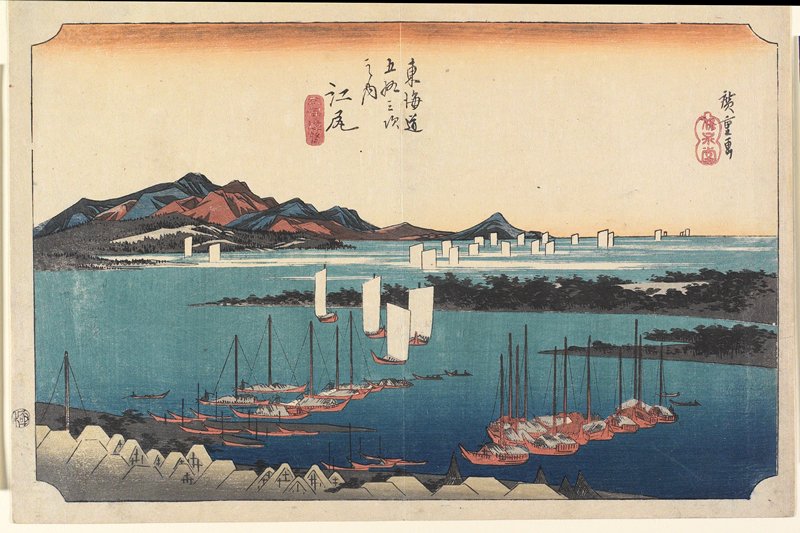
![Shinano Province, Moon Reflected in the Sarashina Paddy-fields, Mount Kyōdai (Shinano, Sarashina tagoto no tsuki, Kyōdaisan), from the series Famous Places in the Sixty-odd Provinces [of Japan] ([Dai Nihon] Rokujūyoshū meisho zue), Utagawa Hiroshige 歌川広重, Edo period, 1853 (Kaei 6, 8th month)](https://nrs.harvard.edu/urn-3:HUAM:CARP04802_dynmc/full/!2400,2400/0/default.jpg)