Time and Death
Si può vedere?
Sì, esposta ora
Dove si trova «Time and Death» oggi? Victoria and Albert Museum, Europe 1600-1815, Room 7, The Sheikha Amna Bint Mohammed Al Thani Gallery, Londra. Sì, esposta ora. Verificato 25 settembre 2026.

Londra, Regno Unito
SalaEurope 1600-1815, Room 7, The Sheikha Amna Bint Mohammed Al Thani Gallery
Chiuso· apre alle 10:00
Esposta al pubblico.
- Verificato
- Ultimo cambio di stato
- Fonte
- Il museo
Sulla scultura
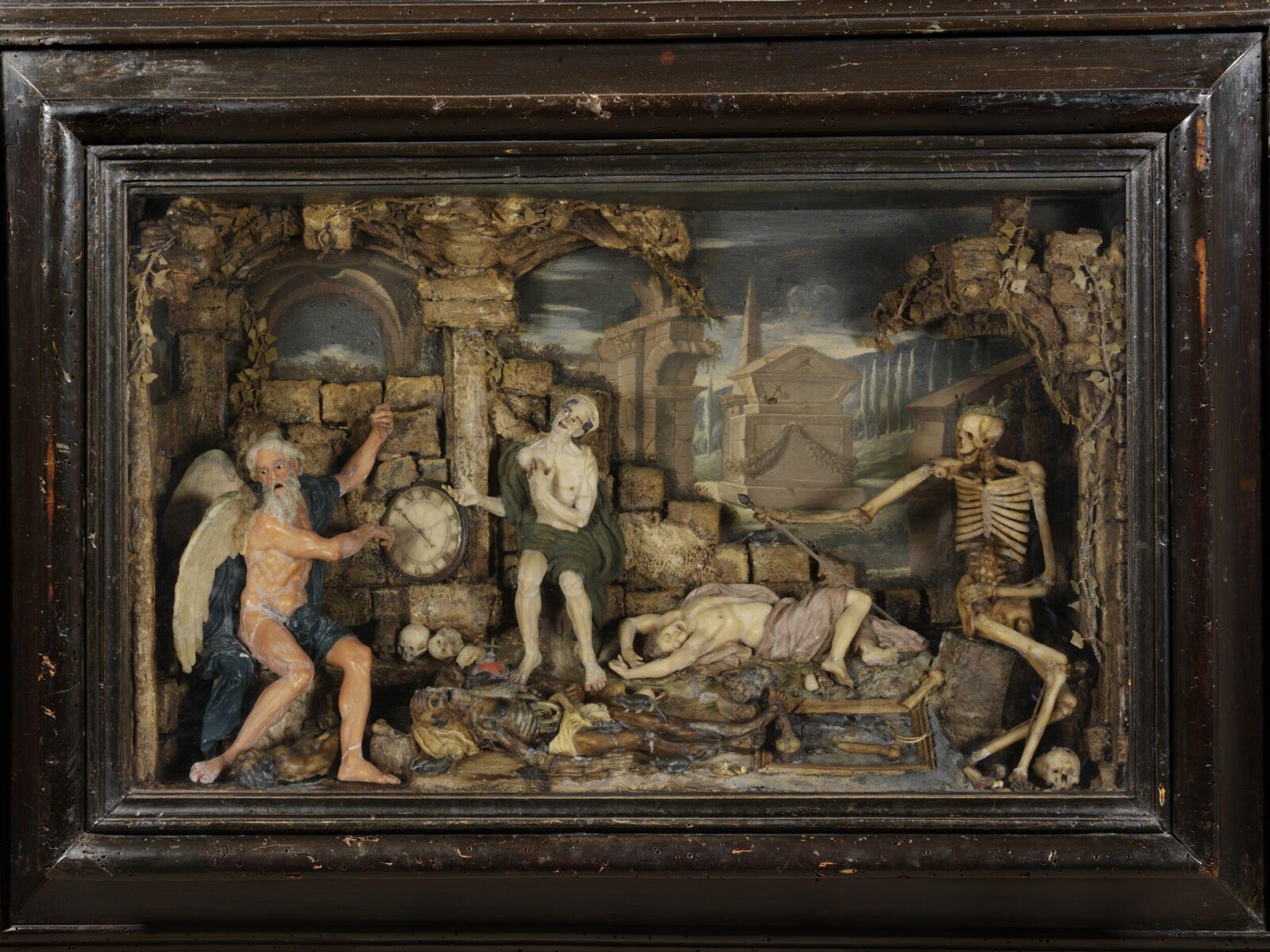
The scene is set in a crumbling graveyard, with the winged figure of Father Time seated on the left pointing to a clock, while a half-draped emaciated figure of a smiling beggar, seated on the other side of the clock, solicits alms; a papal tiara lies at his feet. One small discoloured and decaying corpse lies in front of Time, while another corpse with entrails revealed lies beside him, surrounded by rats, snakes and skulls. A dead youth is stretched out on the right, while on the extreme right the crowned skeletal figure of Death holding a spear looks on. Ivy trails over the surrounding stonework; the sloping ground gives a sense of theatricality to the whole. The painted background depicts decaying funerary monuments.
Leggi
This highly realistic and dramatic wax tableau was a memento mori, intended to inspire thoughts on mortality. Until recently it was attributed to the wax sculptor Gaetano Giulio Zumbo or Zummo (1656-1701), but it has now been convincingly reassigned to Caterina de Julianis. This artist was a Neapolitan nun who specialized in wax modelling. The piece was inspired by Zumbo's works, and the dead youth was in fact based on a figure of a dead bare-breasted woman in one of his wax compositions; because the present work was intended for a church this figure was transformed into a male subject. Coloured wax was the ideal medium for such morbidly realistic scenes, and the artist has been able to convey with astonishing illusionism the textures of stone, flesh and drapery. Wax figures could be formed from moulds, as well as modelled, and so copies and variations of compositions were easily made. A closely similar composition known to be by Caterina de Julianis is in the Chiesa dell'Immacolata in Catanzaro, previously in Bishop Emmanuel Spinelli's palace, and dating from before 1727.
Victoria and Albert Museum
Scheda
- Numero di inventario
- A.3-1966
Che cosa raffigura
In catalogo
Fonti
- Victoria and Albert Museum
- Immagine: Victoria and Albert Museum — © Victoria and Albert Museum, London