The Virgin and Child
Sulla scultura
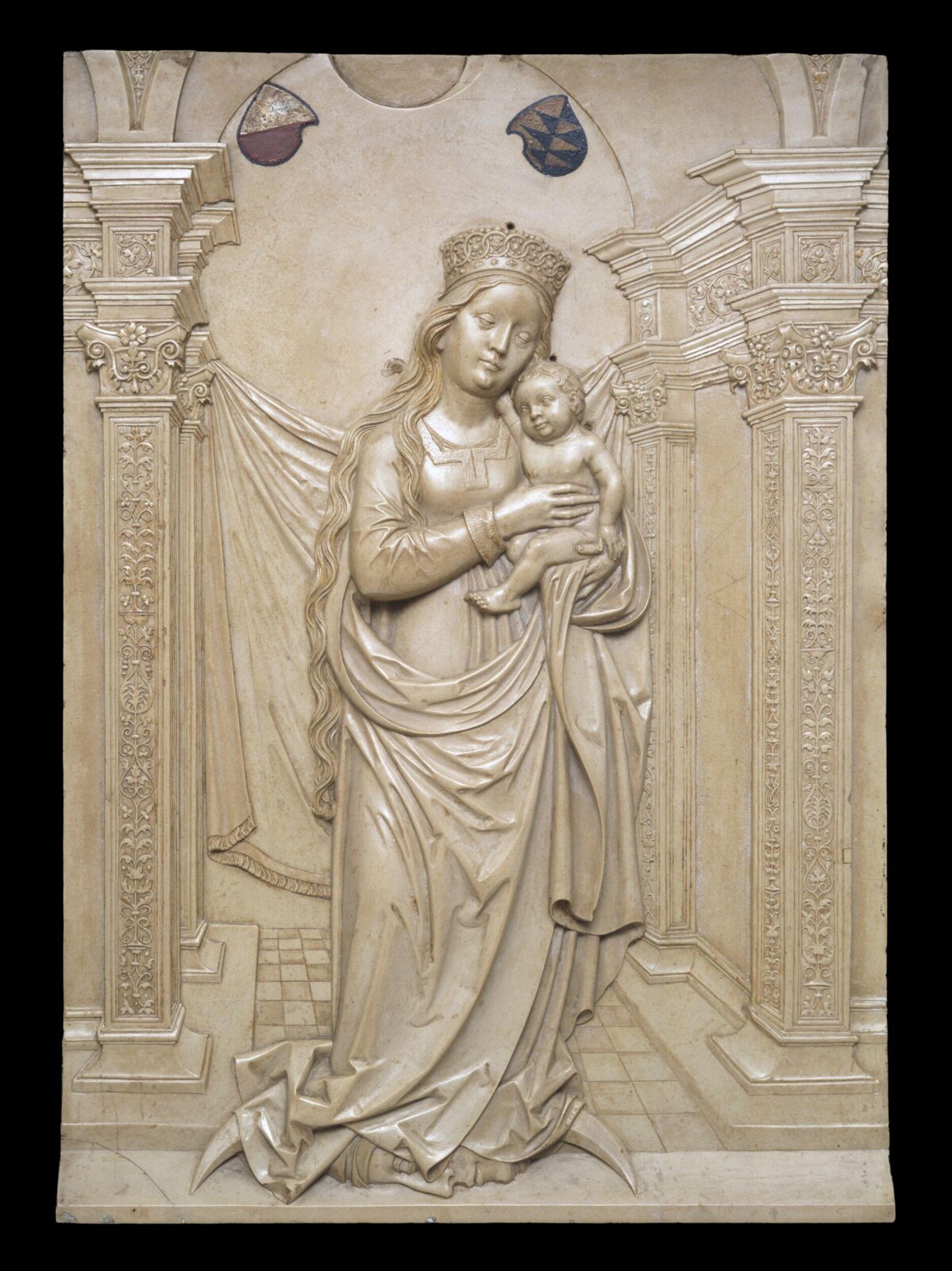
This relief, probably made by Gregor Erhart, depicts the standing Virgin and Child on a crescent moon in a vaulted hall. Four supporting pilasters, richly decorated with raised foliage frame a centralized Italianate hall beneath a semicircular vault.
Continua a leggere
In the early 16th century in Augsburg and Nuremberg a taste for Italianate styles was becoming common. The foundry of the Vischers in Nuremberg completed the tomb of St Sebaldus in 1519 with figures from classical mythology in the new style, called "Newe Fatzon". Because of the size of the Fugger chapel in Augsburg, completed in 1518 (the first building in Renaissance style in Germany) several sculptors, including Sebastian Loscher and Hans Daucher, were required to complete the commission. The common material in Augsburg for reliefs and sculpture in the round was the soft Solnhofen stone, similar in colour to marble. This relief is attributed to Gregor Erhart, trained in the wood carving tradition in his home city of Ulm, who moved to Augsburg in 1494. Erhart's choice of a classical architectural setting is derived from an engraving of 1508 by Hans Burgkmair, who probably visited Italy the year before. The Virgin however is still carved in the late gothic manner.
The present relief, probably a single object, was made for private devotion or formed part of a small altarpiece.
Victoria and Albert Museum


![Te Atua (The Gods) Small Plate [recto], Paul Gauguin, in or after 1895](https://api.nga.gov/iiif/2161a4cc-0d34-4773-9a95-960e228082c5/full/!2400,2400/0/default.jpg)