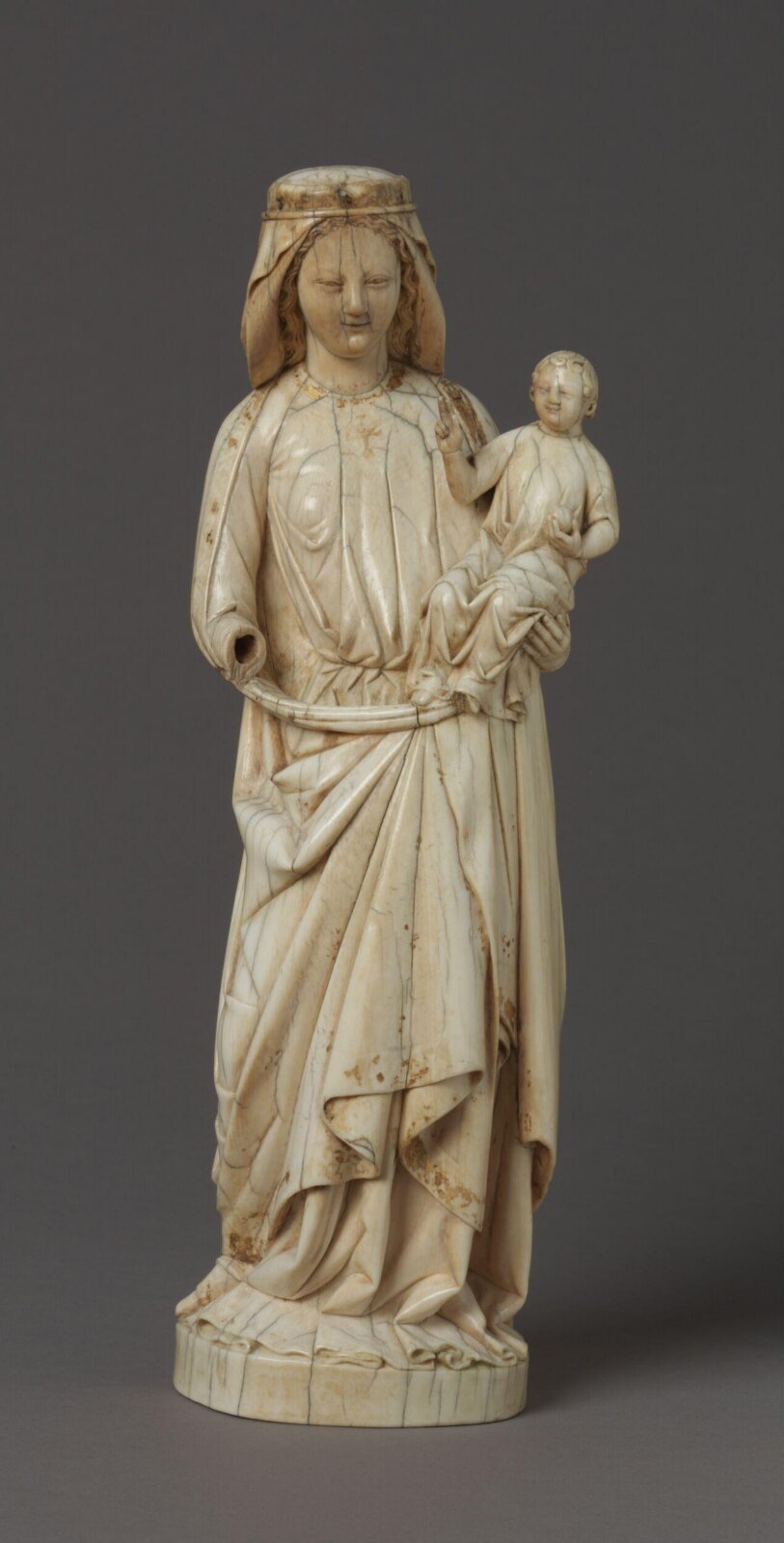
The Virgin and Child
Si può ammirare?
Sì, riceve visite

Esposta al pubblico. Chi lo garantisce è indicato qui sotto.
- Verificato
- Ultimo cambio di stato
- Fonte
- I dati di collezione del museo stesso
About the sculpture
The group is one of the earliest French carvings in ivory representing the Standing Virgin and Child. These first gothic ivories share the same stylistic traits as their monumental counterparts on the portals of cathedrals, and this Virgin has a similar arrangement of the drapery to the famous stone Madonna on the south doorway of the west front of Amiens cathedral, of 1230-35.
There is also a connection of this Virgin and Child to the so-called Davillier Virgin in the Musée du Louvre in Paris. There can be little doubt that the seated Davilliers Virgin is actually by the same craftsman as the V&A ivory. The faces are virtually identical and both figures display the same heavy folds of drapery. But not just that, the treatment of the back of the Virgin's veil, is very particular and distinctive and is displayed in the same way on both figures.
Read on
Three dimensional images of the Virgin and Child were ubiquitous from the twelfth to the fifteenth centuries, produced in a wide range of materials and sizes and testifying the overwhelming devotion to th Virgin. Together with the Crucifixion, statues and statuettes of the Virgin and Child were the pricipal objects of devotion in the Christian Church, and vast numbers were made for ecclesisastical, monastic and private worship.
Victoria and Albert Museum
Scheda
- Numero di inventario
- 209-1867
What it shows
In catalogo
Fonti
- Victoria and Albert Museum: the museum's own open data · acquisita 10 giorni fa
- Immagine: Victoria and Albert Museum — © Victoria and Albert Museum, London