The Russian Cradle
Si può vedere?
Non esposta al momento
Dove si trova «The Russian Cradle» oggi? Collezione: Getty Museum, Los Angeles. Non esposta al momento. Verificato 7 ottobre 2026.
Los Angeles, Stati Uniti
Appartiene alla collezione, ma al momento non è esposta.
- Verificato
- Ultimo cambio di stato
- Fonte
- Il museo
Sul dipinto
In a rural setting, a peasant family sits admiring a baby in a cradle suspended from the branches of a tree. The composition takes its name from the distinctive hanging cradle made of boughs lashed together. Surrounded by goats and sheep, an old woman in a red dress and decorative headscarf holds a distaff and points towards the infant as if telling its fortune. The blue sky with pink-tinged clouds recalls the influence of François Boucher, Jean-Baptiste Le Prince's former teacher. Jean-Baptiste Le Prince served in Saint Petersburg at the court of Catherine the Great between 1760 and 1762. Upon his return to Paris in 1765, he made this painting and thirteen others that he exhibited in the Salon. To an eighteenth-century French audience, this improbable scene would have seemed exotic and picturesque.
Leggi
In reality, Russian peasants were still serfs tied to the land and its owner; it is unlikely that they would have enjoyed the leisure time depicted here. Based on drawings and recollections from the artist's extensive travels throughout Russia, *The Russian Cradle* proved immensely popular and was replicated in drawings, prints, and even as decoration on Sèvres porcelain.
Getty Museum
Scheda
- Numero di inventario
- 72.PA.23
In catalogo
Fonti
- Getty Museum
- Immagine: Getty Museum — Open Content
Nella vita di Jean-Baptiste Le Prince
Tutta la vita1758–1762
Travels in Finland, Lithuania, and Siberia
During his five years in Russia he traveled through Finland, Lithuania, and Siberia (according to some scholars, only as far as Kazan); on the empress's instructions he made sketches of "Russian types."
May 1762
Departure from Russia
He left Russia in May 1762, visiting Livonia on the way.
1763
Return to Paris with Russian Drawings
He returned to Paris in December 1763 with an extensive collection of drawings, which he used as the basis for paintings and prints on Russian themes.
1765
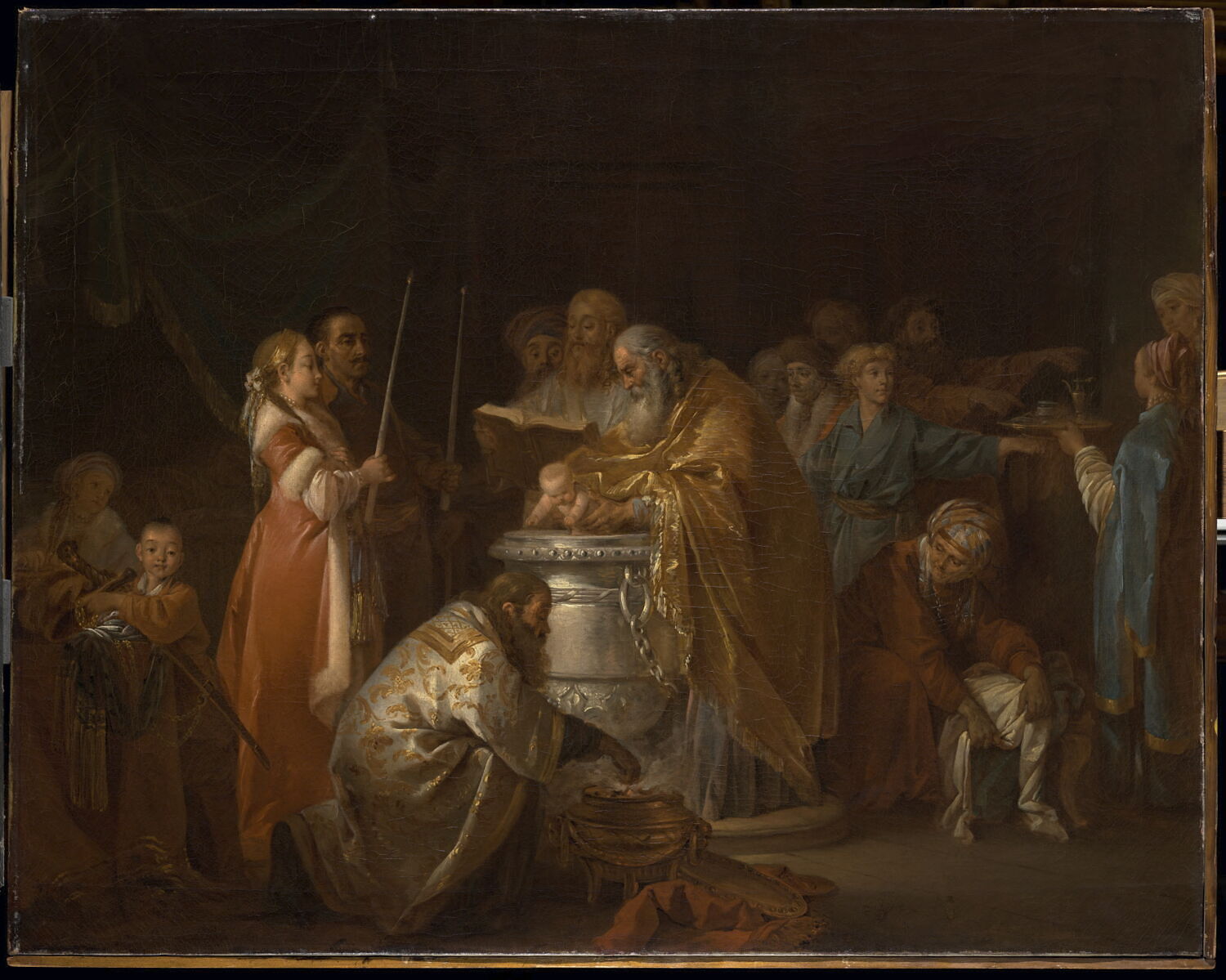
The "Russian Series" at the Salon of 1765
He presented fifteen paintings of scenes from Russian village life at the Salon of 1765, including The Russian Baptism, which earned Diderot's enthusiastic praise, and The Cradle, which he repeated many times.