 Dante Gabriel RossettiInghilterra, 1828–1882
The Raven
Si può ammirare?
Al momento non riceve

Londra, Regno Unito
Appartiene alla collezione, ma al momento non è esposta.
- Verificato
- Ultimo cambio di stato
- Fonte
- Il museo
Sull’opera
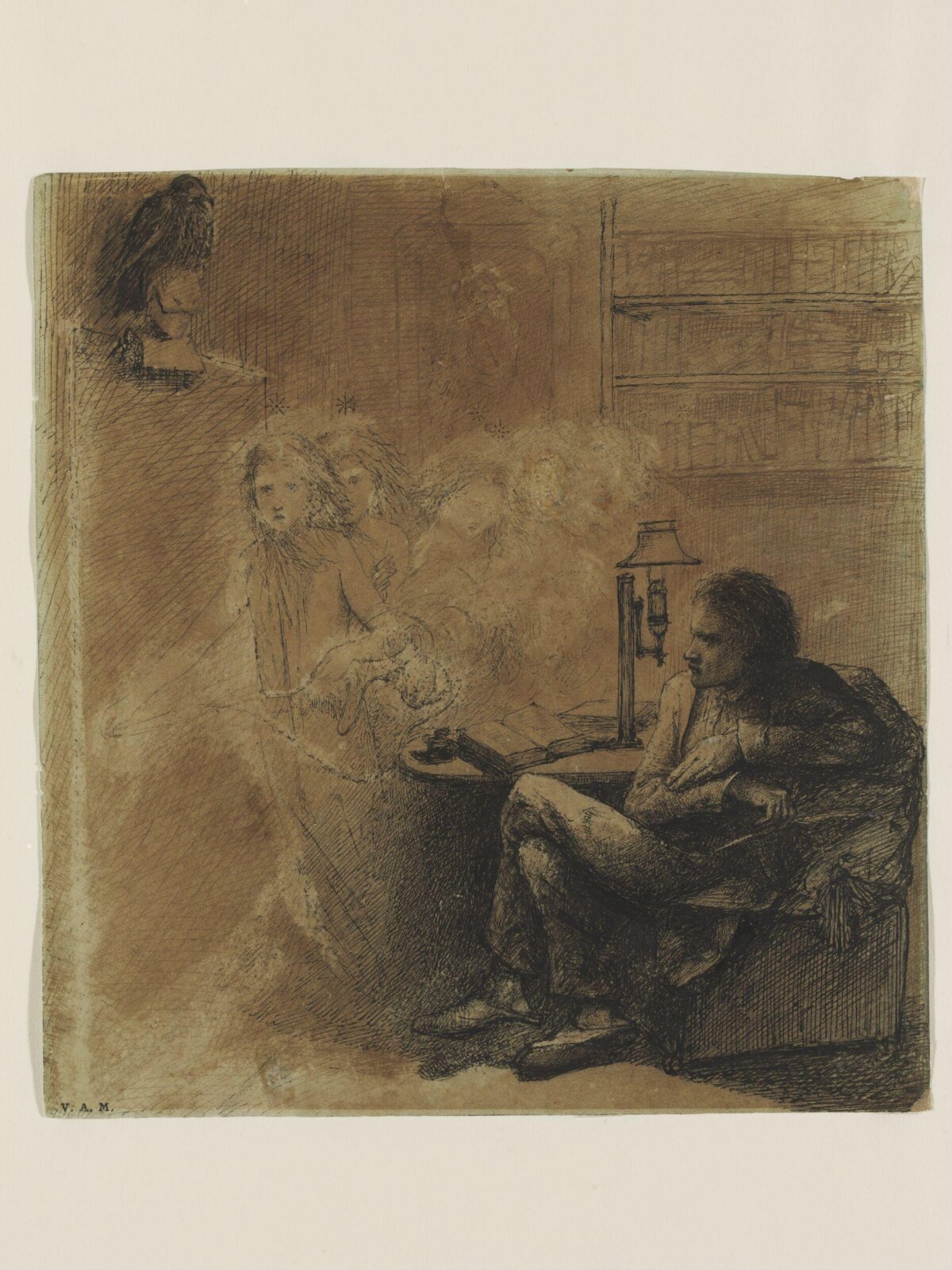
Literature was a key source of inspiration for Pre-Raphaelite artists and they regarded certain writers and poets with the greatest respect. Some, including Shakespeare, Dante, Chaucer, and Goethe, even earned a mention in their list of ‘Immortals’, a canon of prominent figures across religion, visual art, literature, and politics. American writer and poet Edgar Allen Poe, known for his haunting verse, vivid imagery, and fascination with the uncanny, also earned his spot. This drawing is one of four known works by Dante Gabriel Rossetti in response to Poe’s poem 'The Raven'. Completed only a few short years after the poem’s initial publication in the New York Mirror in 1845, this drawing illustrates stanza fourteen of the eerie tale:
Then, methought, the air grew denser,
perfumed from an unseen censer
Swung by Seraphim whose foot-falls
tinkled on the tufted floor.
Leggi
The censer is ‘swung’ by seraphim, celestial beings found in religious texts, particularly in Jewish and Christian traditions. They descend into the room, and the narrator observes the delicate, bell-like sound made by their footsteps, adding to the dreamlike atmosphere. In the foreground, the main subjects—the narrator and the seraphim—dominate the scene, while a faint portrait of the narrator’s lost lover, Lenore, occupies the far wall in the background. Above the door, the raven perches atop a bust of Pallas Athene, bridging the foreground and background elements of the composition.
The work holds an undeniable narrative richness, engaging with a subject that has inspired imaginative and artistic responses from other nineteenth-century artists such as Gustave Doré, Édouard Manet, and John Tenniel. Alongside this, it demonstrates a material resonance through a combination of unique techniques, revealing a deeply tactile creative process for the artist. Rossetti demonstrates exceptional technical skill in depicting the tension between corporeal presence and ethereal absence, evoking a disturbing sense of disquiet. The pale green paper support is coated with a light brown wash.
What initially appears to be a white or lightly toned media applied over delicately rendered spectral figures is actually the result of the artist using a sponge to remove the light brown wash and expose the substrate (Susan Owens, The Art of Drawing: British Masters and Methods Since 1600, London, V&A Publishing, 2013, pp. 130–131). Dense ink lines, rendered with a cross-hatching technique, reflect the man’s physicality. By contrast, the seraphim appear weightless and may be understood as created through an inverse technique: achieved by removing media rather than applying it, a process of erasure—almost alchemical—that visually reveals the spectral. There is yet another removal process applied to the third, fourth, and fifth seraphim, which is considerably more abrasive.
The lack of brown wash is more pronounced, and their facial features are gradually obscured, but they are also highly textured, heavily worked, and scraped out. Scraping was a technique also used in Rossetti’s watercolours, as confirmed by Charles Fairfax Murray, an assistant in the artist’s studio. With the use of backlight, it becomes clear that the paper support is significantly thinned, specifically across the eyes and mouths of the last three seraphim—an effect which mirrors the ephemeral and thin nature of the seraphim themselves. Given how deliberate this effect is, focused on the eyes and mouths of the angels, one might assume it was created using a metal scraper, a tool also used by Rossetti’s contemporary Edward Burne-Jones (Christiana Payne, et al. Pre-Raphaelites: Drawings & Watercolours, Oxford, Ashmolean Museum, 2021, p. 44).
Rossetti’s illustrations to Poe were intensely personal and likely never meant for publication, with this particular drawing being a gift to Irish poet and editor William Allingham. They show a profound regard for Poe’s poetry, which persisted into the very last months of Rossetti’s life. British novelist and playwright Hall Caine, who was a companion to the artist in his final years, recalls how he would recite verses from Poe’s 'The Raven' and reflect on how it influenced his poetic feat, 'The Blessed Damozel'. Written as a reversal of 'The Raven', it changes the perspective: instead of a distraught earthbound narrator mourning a lost lover, Rossetti depicts a heavenly woman longing to be reunited with her lover on earth.
He is quoted as saying: ‘that Poe had done the utmost it was possible to do with the grief of the lover on earth, and so I determined to reverse the conditions, and give utterance to the yearning of the loved one in heaven.’ (T. Hall Caine, Recollections of Dante Gabriel Rossetti, London, Elliot Stock, 1882, p. 284). Such recollections offer an intimate reading of Rossetti’s series of drawings related to 'The Raven'.
Victoria and Albert Museum
Scheda
- Numero di inventario
- E.3415-1922
Che cosa raffigura
In catalogo
Fonti
- Victoria and Albert Museum
- Immagine: Victoria and Albert Museum — © Victoria and Albert Museum, London
Nel frattempo, nella vita di Dante Gabriel Rossetti
Tutta la vita1848
Founding of the Pre-Raphaelite Brotherhood
In 1848 Rossetti, with William Holman Hunt and John Everett Millais, founded the Pre-Raphaelite Brotherhood, aiming to reform English art: to reject the “mechanistic” approach adopted after Raphael and Michelangelo and the formal training introduced by Sir Joshua Reynolds, and to return to the abundant detail, intense colours and complex compositions of Quattrocento Italian and Flemish art. They used pure colours on a white ground and often painted outdoors for maximum authenticity.
1848
Meets Holman Hunt and Millais
In 1848, at the Royal Academy exhibition, Rossetti met William Holman Hunt, who helped him, still insufficiently versed in painting, to finish “The Girlhood of Mary Virgin”; Hunt introduced him to John Everett Millais.
after 1848
A pupil of Ford Madox Brown
After leaving the Royal Academy Rossetti studied under Ford Madox Brown, with whom he retained a close relationship throughout his life.
1850
Meets Elizabeth Siddal
In 1850 Rossetti met the poet Elizabeth Siddal, who became the favourite model of the Pre-Raphaelite painters; over the next decade she was his muse, pupil and passion. She was already ill with tuberculosis, and Rossetti made many sketches of her, some of which later served as studies for paintings.
1850
Criticism of “Ecce Ancilla Domini” and a turn to watercolour
Stung by criticism of his second major painting, “Ecce Ancilla Domini,” exhibited in 1850, and by the increasingly hysterical critical reaction that greeted Pre-Raphaelitism that year, Rossetti turned to watercolours, which could be sold privately; his work later won support from John Ruskin, but Rossetti rarely exhibited thereafter.
early 1850
“The Germ”: “The Blessed Damozel” and a story about an artist
In early 1850, in the first issue of the Brotherhood’s magazine The Germ, Rossetti published his poem “The Blessed Damozel” and a story about a fictional early Italian artist inspired by a vision of a woman who bids him combine the human and the divine in his art.