Edgar DegasFrancia, 1834–1917
Nel negozio di cappelli
The Millinery Shop
Si può ammirare?
Sì, riceve visite

Chicago, Stati Uniti
Esposta al pubblico.
- Verificato
- Ultimo cambio di stato
- Fonte
- Il museo
Sul dipinto
Nel negozio di capelli è un dipinto a pastello (100x111 cm) realizzato nel 1885 circa dal pittore francese Edgar Degas. È conservato nel The Art Institute di Chicago.
In questa opera è rappresentata una giovane donna che esamina un capello, tenendolo fra le mani. I tratti del contorno delle figure non sono bene definiti a causa dell'uso di pastelli a cera.
Con le parole del museo
Of at least fifteen pastels, drawings, and paintings that Edgar Degas created on this subject during the 1880s, The Millinery Shop is the largest and perhaps the most ambitious. As a result of its unusual cropping and tilted perspective, it seems to capture an unedited glimpse of the interior of a small nineteenth-century millinery shop. The identity of the young woman in the painting remains unclear: she may be a shop girl or a customer. In an early version of the composition, the woman is clearly intended to be a customer; she wears a fashionable dress, though her hat—a prerequisite token of bourgeois culture—is absent. In the final painting, however, the woman appears with her mouth pursed, as if around a pin, and her hands gloved, possibly to protect the delicate fabric of the hat she holds. Degas seems to have deliberately left her role as a creator or consumer ambiguous.
Leggi
She is totally absorbed in her activity and, like most of the women in Degas’s paintings, seems unaware of being watched. The bonnets that are displayed on the table next to her like a still life present an analogy to the artist’s creative process: where they are unfinished, so too is the painting.
Art Institute of ChicagoCC BY 4.0
Scheda
Che cosa raffigura
In catalogo
Fonti
- Art Institute of Chicago
- Immagine: Wikimedia Commons — Public domain (PD-Art)
Nel frattempo, nella vita di Edgar Degas
Tutta la vita1877
Friendship with Mary Cassatt
Degas invited Mary Cassatt to show in the third Impressionist exhibition, having admired her portrait “Ida” at the Salon of 1874. He introduced her to pastel and engraving, while she helped him sell paintings and promoted his reputation in the United States.
autumn 1879 – April 1880
The prints journal: Degas abruptly withdraws
In the autumn and winter of 1879–1880 Degas and Cassatt worked closely together on a prints journal; he owned a small printing press. In April 1880 Degas abruptly withdrew, and without his support the project folded.
by 1880
The end of his financial crisis
By 1880 Degas had fully overcome his financial crisis and become a respected figure in the Paris art world; the Impressionist exhibitions, which proved commercially useful to him, helped.
1881
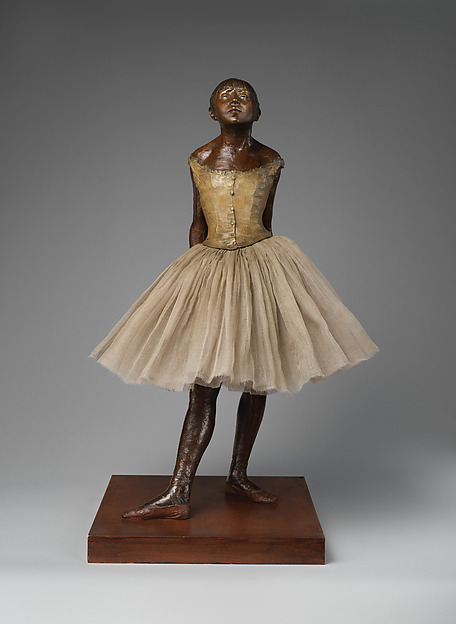
“The Little Dancer of Fourteen Years” on show
The nearly life-size wax figure with real hair and a cloth tutu, modelled on Marie van Goethem, provoked a strong reaction: critics found its realism extraordinary, but many denounced the dancer as ugly. It was the only sculpture Degas showed in his lifetime.
by 1882
His eyesight sharply worsens
By 1882 Degas's eyesight began to worsen sharply: he turned to pastel and then to sculpture, where he could rely more on touch.
1886
The eighth exhibition: pastel nudes, and the end of the group
At the last Impressionist exhibition Degas showed a suite of pastel nudes, which drew more critical writing than anything else in his lifetime, mostly laudatory. The group broke up, partly through rancour over the inclusion of non-Impressionists such as Forain and Raffaëlli.