ART WIKI32.963 in sala
MappaCollezioneArtistiMuseiMostreRivista
Accedi

ART WIKI

Dove è appeso il capolavoro, e quando si può entrare.

Collezioni: Art Institute of Chicago, Cleveland Museum of Art, Ermitage, Galleria Tret'jakov, Getty Museum, Harvard Art Museums, Hirshhorn Museum and Sculpture Garden, Metropolitan Museum of Art, Minneapolis Institute of Art, Museo del Louvre, Museo Puškin delle belle arti, Museo russo, Museum of Modern Art, National Gallery of Art, National Museum of Asian Art, National Portrait Gallery, Rijksmuseum, Smithsonian American Art Museum, Statens Museum for Kunst, Victoria and Albert Museum, Villa Getty, Whitney Museum of American Art, Catalogo statale del fondo museale russo (274 musei), Europeana (19 musei), Wikidata (6 musei), Paris Musées (12 musei) e Joconde, la banca dati dei musei del Ministero della Cultura francese (495 musei). Le immagini appartengono ai titolari dei diritti.

Sezioni

  • Mappa
  • Ricerca
  • Collezione
  • Capolavori
  • Esposte ora
  • Artisti

Altro

  • Musei e gallerie
  • Mostre
  • Rivista
  • Da dove vengono i dati
  • Privacy e cookie
HomeMappaCatalogo
  1. Collezione/
  2. National Gallery of Art/
  3. The Equestrian Monument
The Equestrian Monument, Canaletto, c. 1735/1746
Canaletto, ritrattoCanalettoItalia, 1697–1768

The Equestrian Monument

c. 1735/1746 · Print

Si può ammirare?

Al momento non riceve

National Gallery of Art

Washington, Stati Uniti

Appartiene alla collezione, ma al momento non è esposta.

Verificato
3 giorni fa
Ultimo cambio di stato
19 ago 2026
Fonte
Il museo
Sulla mappaPagina del museo

Scheda

c. 1735/1746
16971768
Numero di inventario
1941.1.190

Che cosa raffigura

EsternoDomesticVeniceMonument

In catalogo

StampeAcquaforteRococòXVIII secoloVenetian

Fonti

  • National Gallery of Art
  • Immagine: National Gallery of Art — Museum open access

Nel frattempo, nella vita di Canaletto

Tutta la vita
  1. 1720–1746 · Luogo di lavoro

    Venice

  2. 1728–1735

    Visentini's etchings after thirty-eight of Canaletto's views

    In 1728–35 Smith arranges for thirty-eight of Canaletto's painted vedute to be reproduced in etchings by Antonio Visentini and published under the title “Urbis Venetiarum Prospectus Celebriores ex Antonii Canal”.

  3. c. 1729 – 1735

    Smith as agent: a “market of taste” for the Venetian veduta

    Joseph Smith — a banker, art dealer and later British consul in Venice — creates a “market of taste” for the Venetian veduta among British aristocrats touring Italy and, as Canaletto's commercial agent from about 1729 to 1735, in effect controls the artist's work to the benefit of them both. Among the young painter's buyers is also the Prince of Liechtenstein.

  4. 1740s

    The War of the Austrian Succession: the British stop coming

    In the 1740s Canaletto's market is disrupted when the War of the Austrian Succession reduces the number of British visitors to Venice. Smith arranges for the publication of a series of etchings of “capricci” (architectural fantasies), but the returns are not high enough.

  5. 1746

    Moving to London because of wars and a collapsing market

    Smith inspires Canaletto to travel to London; because of the wars shaking continental Europe he decides in 1746 to move to England, where he will live for the next ten years.

  6. 1746–1755

    Rumours of an impostor: a newspaper advertisement

    Canaletto's English paintings become repetitive and mechanical, and the critic George Vertue suggests that the man painting under the name “Canaletto” is an impostor — perhaps because his nephew Bernardo Bellotto was also using his uncle's nickname, or, more likely, because unscrupulous dealers passing off copies were anxious to see him return to Venice. To refute the claim the artist invites “any Gentleman”, through a newspaper advertisement, to inspect his latest painting of St James's Park at his studio in Silver Street, but his reputation never fully recovers in his lifetime.
Altre opere di Canaletto

Tutte le opere
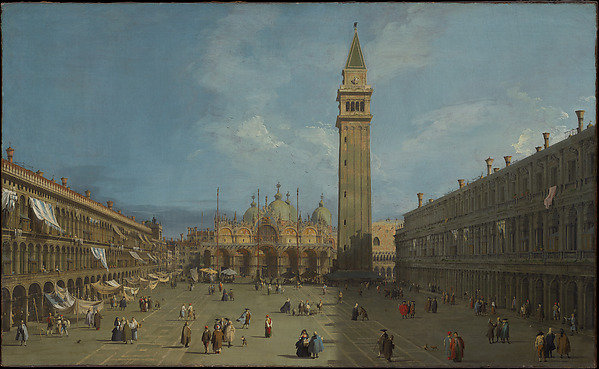
Piazza San Marco, Canaletto, late 1720s

Piazza San Marco

late 1720s · Metropolitan Museum of Art

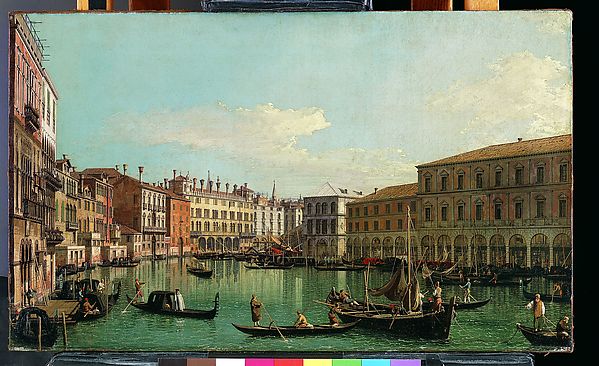
The Grand Canal, Venice, Looking South toward the Rialto Bridge, Canaletto, 1730s

The Grand Canal, Venice, Looking South toward the Rialto Bridge

1730s · Metropolitan Museum of Art

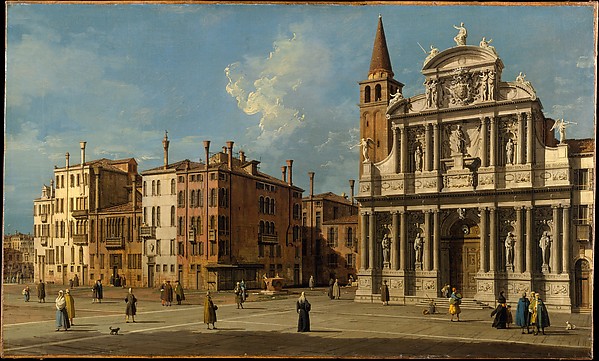
Campo Santa Maria Zobenigo, Venice, Canaletto, 1730s

Campo Santa Maria Zobenigo, Venice

1730s · Metropolitan Museum of Art

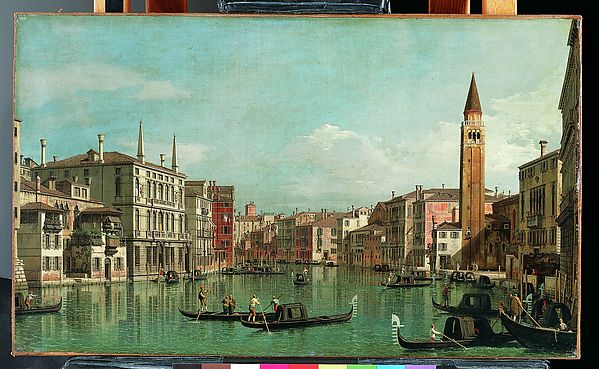
The Grand Canal, Venice, Looking Southeast, with the Campo della Carità to the Right, Canaletto, 1730s

The Grand Canal, Venice, Looking Southeast, with the Campo della Carità to the Right

1730s · Metropolitan Museum of Art

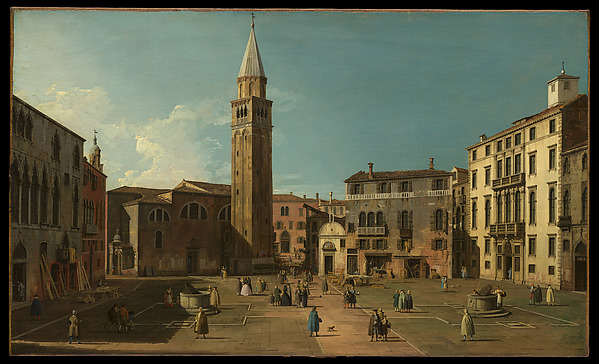
Campo Sant'Angelo, Venice, Canaletto, 1730s

Campo Sant'Angelo, Venice

1730s · Metropolitan Museum of Art

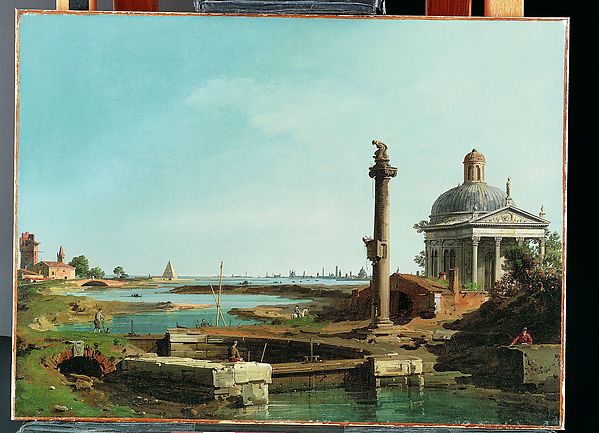
A Lock, a Column, and a Church beside a Lagoon, Canaletto

A Lock, a Column, and a Church beside a Lagoon

Metropolitan Museum of Art

Arrival of the French Ambassador in Venice, Canaletto, 1720s

Arrival of the French Ambassador in Venice

1720s · Ermitage

The Grand Canal in Venice from Palazzo Flangini to Campo San Marcuola, Canaletto, about 1738

The Grand Canal in Venice from Palazzo Flangini to Campo San Marcuola

about 1738 · Getty Museum

Sotto lo stesso tetto: National Gallery of Art

Pagina del museo
Ginevra de' Benci [obverse], Leonardo da Vinci, c. 1474/1478

Leonardo da Vinci

Ritratto di Ginevra de' Benci, c. 1474/1478

Wreath of Laurel, Palm, and Juniper with a Scroll inscribed Virtutem Forma Decorat [reverse], Leonardo da Vinci, c. 1474/1478

Leonardo da Vinci

Wreath of Laurel, Palm, and Juniper with a Scroll inscribed Virtutem Forma Decorat [reverse], c. 1474/1478

Green Wheat Fields, Auvers, Vincent van Gogh, 1890

Vincent van Gogh

Green Wheat Fields, Auvers, 1890

Girl in White, Vincent van Gogh, 1890

Vincent van Gogh

Girl in White, 1890

Roses, Vincent van Gogh, 1890

Vincent van Gogh

Roses, 1890

Self-Portrait, Vincent van Gogh, 1889

Vincent van Gogh

Self-Portrait, 1889

Farmhouse in Provence, Vincent van Gogh, 1888

Vincent van Gogh

Farmhouse in Provence, 1888

La Mousmé, Vincent van Gogh, 1888

Vincent van Gogh

La Mousmé seduta, 1888