Georges SeuratFrancia, 1859–1891
Il circo
The Circus
Si può ammirare?
Non si sa: il museo mantiene il riserbo

Museo d'Orsay
Parigi, Francia
Il proprietario è noto. Se oggi sia esposta, il museo non lo dice, e a indovinare non ci hanno insegnato.
- Ultimo cambio di stato
- 29 set 2026
- Fonte
- I dati di collezione del museo stesso
About the painting
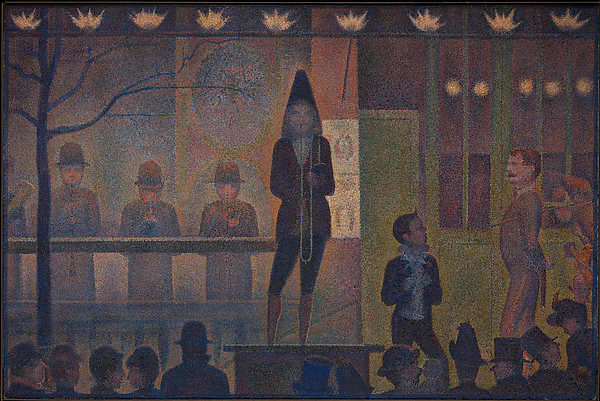
Il circo è un dipinto a olio su tela realizzato (ma lasciato incompiuto) nel 1891 dal pittore francese Seurat.
È conservato nel museo d'Orsay di Parigi. L'opera fu esposta benché non fosse terminata al settimo Salon des Indépendants, durante il periodo dell'esposizione Seurat morì.
Seurat raffigura il circo con il tendone a strisce e l'atmosfera festosa. Si tratta dell'ultima opera del pittore, rimasta incompiuta per via della sua morte. Il quadro sarà acquistato da Paul Signac e poi rivenduto al collezionista americano John Quinn, dietro promessa di un suo lascito al museo del Louvre.
Read on
Oltre allo studio del colore, Seurat attua i primi principi di forma applicata alla psicologia, sfruttando il rapporto tra segno e linea del quadro con i sentimenti e lo stato emotivo di chi lo osserva; vi è infatti una esaltazione di linee che si estendono da sinistra a destra in quanto la mente le associa ad un'apertura gioiosa. I colori del dipinto sono caldi e, inoltre, rappresentano gioiosità e allegria, che è ciò che il pittore stesso vuole esprimere con questa opera d'arte.
Scheda
- Numero di inventario
- RF 2511
Fonti
- Wikidata · acquisita 5 giorni fa
- Immagine: Museo d'Orsay — Georges Seurat · Public domain · Wikimedia Commons
Nel frattempo, nella vita di Georges Seurat
Tutta la vita1880s
Charles Henry's lectures at the Sorbonne
In the 1880s Seurat hears lectures by the mathematician Charles Henry at the Sorbonne on the emotional properties and symbolic meaning of lines and colour; there remains controversy over how far he adopted Henry's ideas.
1880s
The colour theorists: Chevreul, Rood, Blanc
Seurat finds the idea of separate strokes of pure colour that blend optically in the viewer's eye in “Modern Chromatics” (1879) by the American physicist Ogden Rood and in the chemist Michel Eugène Chevreul's work on the law of simultaneous contrast of colours; according to his friends, his bedside book is Charles Blanc's “Grammaire des arts du dessin” (1867).
1889
Madeleine Knobloch moves into Seurat's studio
Seurat conceals his relationship with the artist's model Madeleine Knobloch (1868–1903); in 1889 she moves in with him in his studio on the seventh floor of 128 bis boulevard de Clichy.
16 February 1890
The birth of his son Pierre-Georges
When Madeleine becomes pregnant the couple move to a studio at 39 passage de l'Élysée-des-Beaux-Arts (now rue André Antoine), where on 16 February 1890 she gives birth to their son, who is named Pierre-Georges.
29 March 1891
Death at thirty-one: the cause remains uncertain
Seurat dies in his parents' home in Paris at the age of 31; the cause of death is uncertain and has been variously attributed to a form of meningitis, pneumonia, infectious angina and diphtheria. His son dies two weeks later from the same disease.
29 marzo 1891
Died