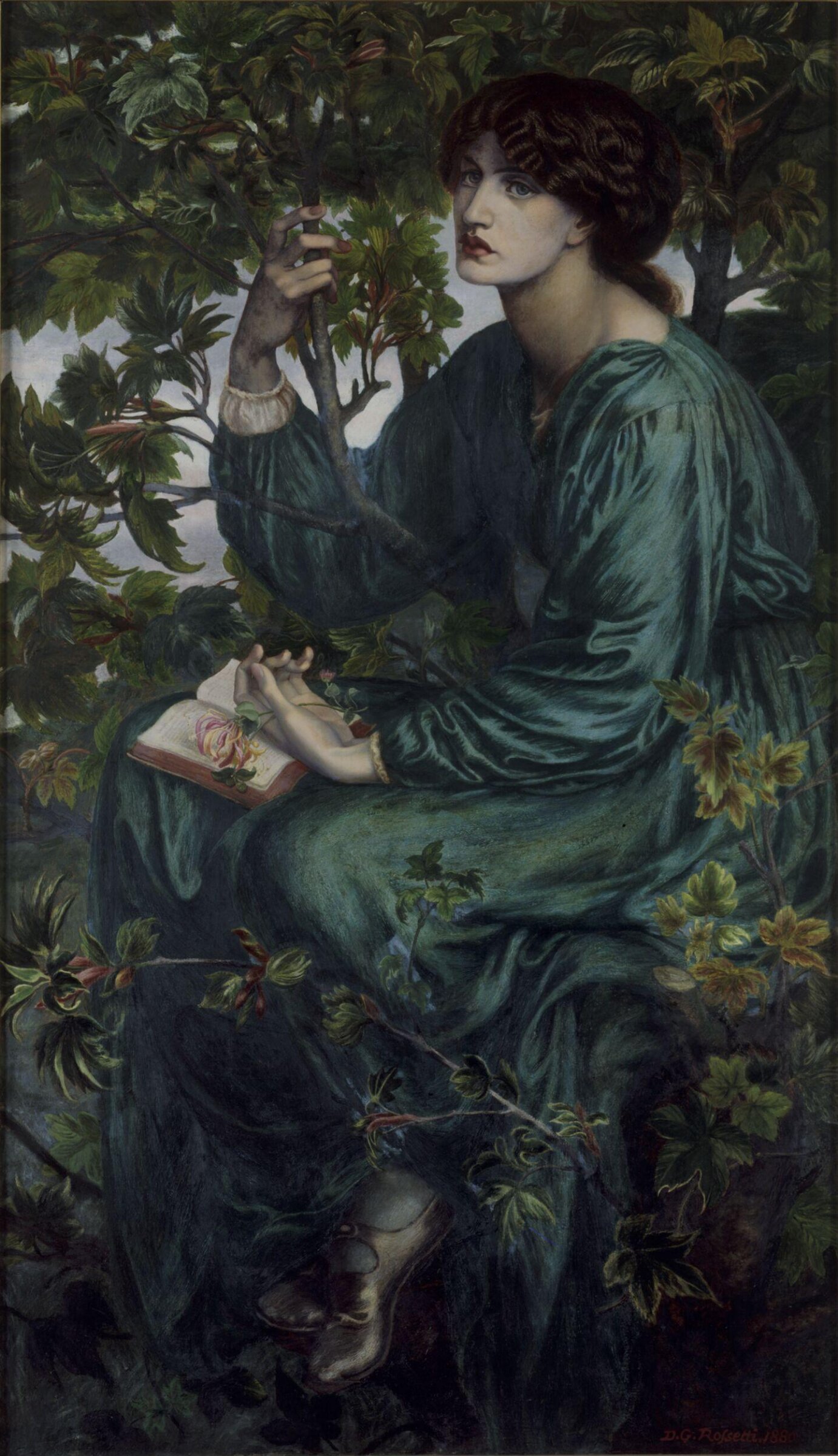
Dante Gabriel RossettiInghilterra, 1828–1882
The Beloved
Si può ammirare?
Non si sa

Londra, Regno Unito
Il proprietario è noto; non si sa se oggi sia esposta.
- Ultimo cambio di stato
- Fonte
- Il museo
Sul dipinto
The Beloved (also The Bride) is an oil painting on canvas by the English artist Dante Gabriel Rossetti (1828–1882), now in Tate Britain, London. Rossetti signed his initials (as a monogram) and the date as "1865-6" on the bottom left of the canvas. It depicts the bride, or "beloved", from the Song of Solomon in the Hebrew Bible as she approaches her bridegroom, with her attendants.
Leggi
The bride, caught in the action of moving back her veil, is attended by four virginal bridesmaids and an African page, who contrasts strikingly with the red hair and pale skin of the bride, and the varying shades of brunette hair and skin tones of the four bridesmaids. It has been suggested that this colour contrast, carefully painted as a frame to the bride's features, was influenced by Édouard Manet's controversial painting Olympia, in progress when Rossetti visited Manet's studio in late 1864 while working on The Beloved, and the painting also owes much to the works of Titian.
In many respects, the painting fits into the series of "bust-length oil paintings of beautiful women" which were Rossetti's main painted output from 1859 to about 1867. These were a conscious change of style, to explore painterly effects of (in his words) "flesh painting" and colour, abandoning the densely packed narrative scenes, in media other than oil painting, he had produced over most of the 1850s, when he followed more closely the ideals of the Pre-Raphaelite Brotherhood. These grew "larger and more luxurious" in the next decade, and included Bocca Baciata, Venus Verticordia, Beata Beatrix, The Blue Bower, Monna Vanna, Regina Cordium, and Lady Lilith. But these were all rather tightly framed pictures of a single figure, "in confined layers of space", with varying props and background, reflecting a variety of historical periods.
It is generally agreed that Rossetti set out to show a range of skin colours within the figures, but the identification and interpretation of these varies greatly.
Scheda
- Numero di inventario
- NG3053
In catalogo
Fonti
- Wikidata
- Immagine: National Gallery — Dante Gabriel Rossetti · Public domain · Wikimedia Commons
Nel frattempo, nella vita di Dante Gabriel Rossetti
Tutta la vita1862–1866
Designing his sister Christina’s books
With his sister, the poet Christina Rossetti, Dante Gabriel designed and illustrated the first edition of “Goblin Market” (1862) and “The Prince’s Progress” (1866); his key bindings were designed between 1861 and 1871.
1862–1882
A Tudor house at 16 Cheyne Walk
After his wife’s death Rossetti leased a Tudor house at 16 Cheyne Walk in Chelsea, where he lived for twenty years surrounded by extravagant furnishings and a parade of exotic birds and animals.
1863–1865
Fanny Cornforth: “housekeeper” and model
Rossetti kept Fanny Cornforth — described by William Allingham as his “housekeeper” — in her own establishment nearby in Chelsea and between 1863 and 1865 painted many voluptuous images of her.
1864–1867
The first commissions from the patron Leyland
In 1864–1867 Rossetti began to receive his first commissions from the patron and collector Frederick Richards Leyland, who collected Renaissance art and Pre-Raphaelite painting.
1865
Alexa Wilding: a meeting on the Strand
In 1865 Rossetti spotted the auburn-haired Alexa Wilding, a dressmaker and would-be actress, one evening on the Strand: she agreed to sit for him the next day but failed to arrive, and weeks later he saw her again, jumped from his cab and persuaded her to go straight to his studio. He paid her a weekly fee to sit for him exclusively, and she sat for more of his finished works than any other model.
1865
Photographs of Jane Morris at Rossetti’s house
In July 1865 a series of photographs of Jane Morris was taken at Rossetti’s house in Chelsea; the photographer is unknown, but each photograph bears the stamp of Rossetti’s artistic inspiration, as he posed the sitter himself.