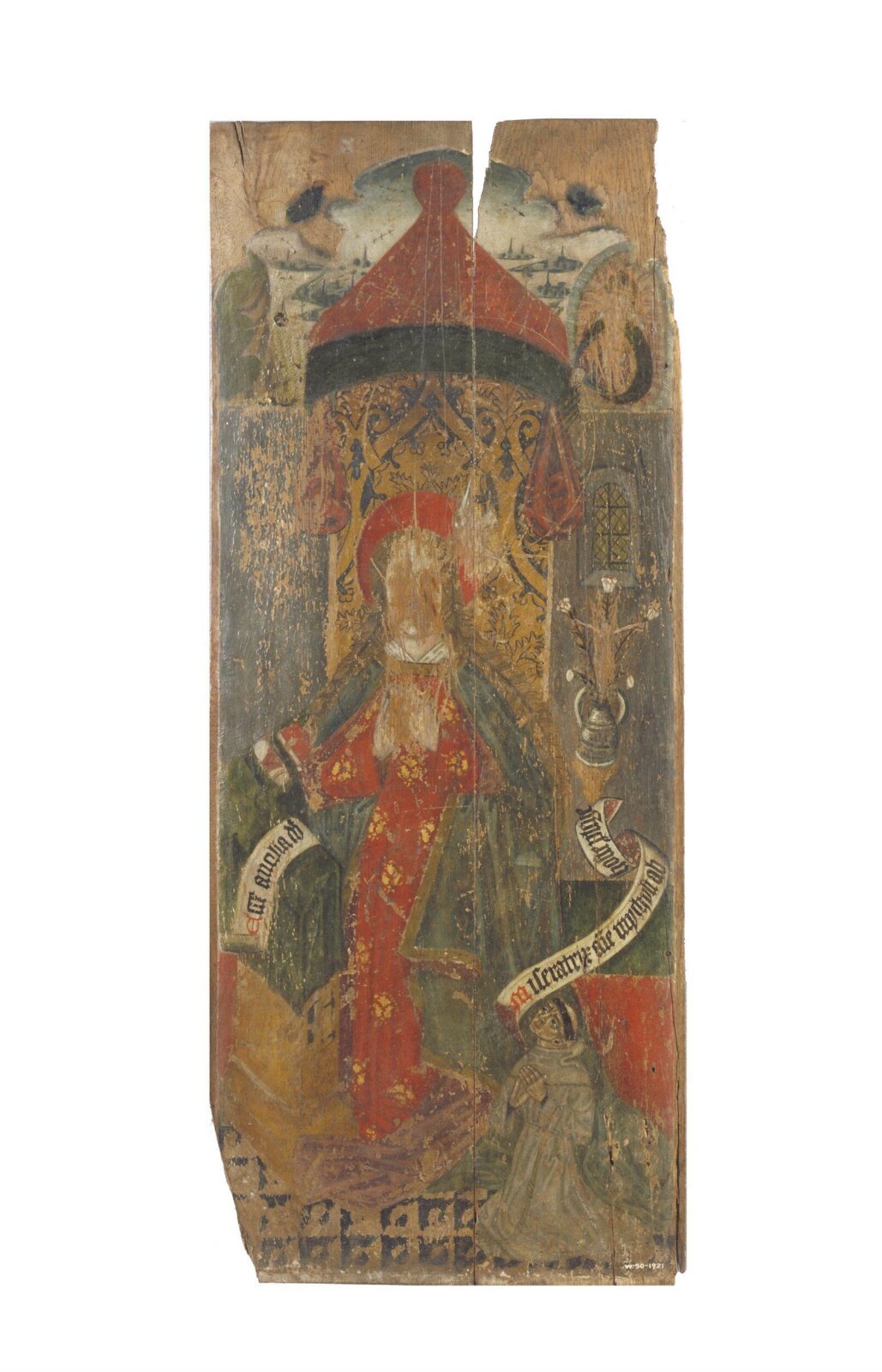
The Annunciation
Si può ammirare?
Sì, riceve visite

Victoria and Albert Museum
SalaBritish Galleries, Room 58bLondra, Regno Unito
Esposta al pubblico. Chi lo garantisce è indicato qui sotto.
- Verificato
- 7 giorni fa
- Ultimo cambio di stato
- 25 set 2026
- Fonte
- I dati di collezione del museo stesso
About the painting
Object Type
Solid, lower panels were a common feature of church screens in East Anglia. Usually they were painted in rich colours and elaborately gilded. This panel is typical of such late 15th-century church decoration in its combination of religious imagery with intricate patterns and naturalistic detail.
Historical Associations
The face and hands of the Virgin Mary and the figure of Christ were almost certainly defaced after the Reformation which was established in England after Henry VIII (ruled 1509-1547) broke with Papal authority in 1534. Religious objects were either removed or else modified to rid them of their associations with Roman Catholic worship. The churches of East Anglia were also cleansed during the Civil War (1642-1646) on the orders of the 2nd Earl of Manchester. This included the modification of images in wood and glass.
Ownership & Use
Read on
The panel includes a portrait of a friar. His presence in the image suggests that he could have been the donor, the person who ordered the work. Paintings with donor portraits were usually commissioned in thanksgiving or commemoration. They signified the patron's piety and devotion, as well as their wealth and status in society.
Subjects Depicted
To the right of the enthroned Virgin Mary is a vase of lilies, an image commonly associated with the Annunciation. Lilies also symbolised purity and were therefore an attribute of the Virgin. Amongst the stems of the flowers is a figure of Christ crucified. The use of this motif in this position was characteristically English. A dove by the Virgin's head represents the Holy Spirit. The seascape above the throne's canopy may refer to one of the Virgin's titles, 'Star of the Sea', although this is more usually represented by a star on her cloak.
Victoria and Albert Museum
Scheda
- Numero di inventario
- W.50-1921
What it shows
In catalogo
Fonti
- Victoria and Albert Museum: the museum's own open data · acquisita 7 giorni fa
- Immagine: Victoria and Albert Museum — © Victoria and Albert Museum, London