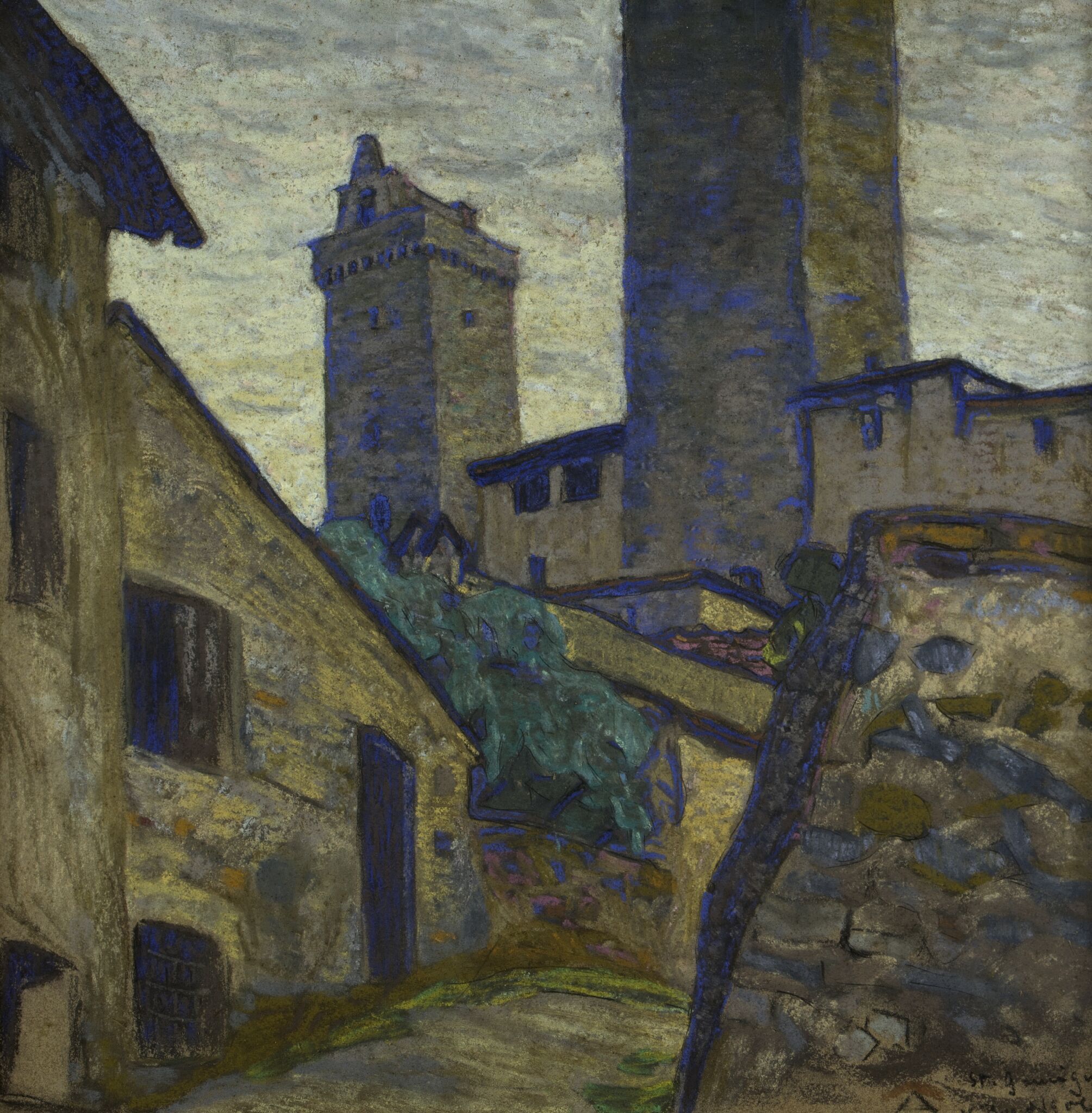
 Nicholas RoerichRussia, 1874–1947
Сан Джиминьяно
Si può vedere?
Non si sa
Dove si trova «Сан Джиминьяно» oggi? Collezione: Galleria Tret'jakov, Mosca. Non si sa.

Mosca, Russia
Il proprietario è noto; non si sa se oggi sia esposta.
- Ultimo cambio di stato
- Fonte
- Il museo
Sull’opera
Con le parole del museo — in russo
Весной 1906 года художник отправился в грандиозное путешествие по Италии – с апреля по сентябрь он проехал с севера в центр страны, с интересом изучал ее богатейшее наследие. Рерих восхищался росписями Андреа Орканьи и Беноццо Гоццоли, нередко сравнивая французов-современников с художниками эпохи итальянского Возрождения. В письмах жене Елене Ивановне Рерих он восторженно делился впечатлениями об увиденных пизанских и сиенских фресках: «Неужели ты не увидишь примитивов на месте – как это красиво. И какой это ключ ко многому. Если бы Тебе в Сиену приехать... зато на всю жизнь какой кругозор. Теперь ни Пювис, ни Денис [Пьер Пюви де Шаванн и Морис Дени] не удивят. Известно, откуда они взяли…»
Leggi
На несколько дней он остановился в Сан-Джиминьяно и изобразил этот средневековый город. В поездках ради удобства Рерих использовал краски Рафаэлли – палочки масляной пастели. Быстрыми штрихами мастерски выстраивается улица с видом на высокую башню-колокольню Торре Гросса.
Спустя три года художник представил эту работу на выставке Союза русских художников в Москве (1909).
Galleria Tret'jakov
Scheda
- Numero di inventario
- 22746
In catalogo
Fonti
- Galleria Tret'jakov
- Immagine: Galleria Tret'jakov — © State Tretyakov Gallery
Nella vita di Nicholas Roerich
Tutta la vita1903–1904
A “journey through antiquity”: over forty towns
With his wife Roerich visits more than forty towns with ancient monuments to study the roots of Russian culture. The result is about 90 architectural studies, a collection of photographs of old Russia and articles in which he is among the first to raise the question of the great artistic value of early Russian icon painting and architecture.
1904
Talashkino, Maria Tenisheva's estate
After touring the towns along the Volga and visiting Mozhaisk and the Savvino-Storozhevsky Monastery, Roerich ends his trip at Talashkino near Smolensk, the estate of Maria Tenisheva. Together with Malyutin, Vrubel, Benois, Korovin and Repin he puts into practice projects to revive ancient Russian traditions and folk crafts; his collaboration with Tenisheva will last until 1917 and their friendship until her death.
23 ottobre 1904
Son born: Svetoslav Roerich
1904–1905
Neolithic sites on the Valdai and a Stone Age collection
In 1904, with Prince Putyatin, Roerich finds several Neolithic sites on the Valdai Hills near Lake Piros, and from 1905 he builds a collection of Stone Age antiquities, which is highly praised that same year at the French Prehistoric Congress in Périgueux. By 1910 it holds more than 30,000 items from Russia, Germany, Italy and France; today they are in the Hermitage.
1906
Exhibitions abroad and the Salon d'Automne
From 1906 Roerich regularly takes part in exhibitions abroad: Paris, Venice, Berlin, Rome, Brussels, Vienna and London get to know his work, and his paintings are bought by the Luxembourg Museum, the National Museum in Rome, the Louvre and other museums. In 1907 he is elected a member of the Société du Salon d'Automne in France.
1906
Director of the Society's Drawing School
On taking up his post as director of the Drawing School, Roerich enlarges its premises, opens new classes and workshops — for icon painting, ceramics, chasing and weaving — restores the rights of the teaching council and founds a Museum of Russian Art at the school; he hopes to reorganise it as a Free People's Academy.