ART WIKI32.963 in sala
MappaCollezioneArtistiMuseiMostreRivista
Accedi

ART WIKI

Dove è appeso il capolavoro, e quando si può entrare.

Collezioni: Art Institute of Chicago, Cleveland Museum of Art, Ermitage, Galleria Tret'jakov, Getty Museum, Harvard Art Museums, Hirshhorn Museum and Sculpture Garden, Metropolitan Museum of Art, Minneapolis Institute of Art, Museo del Louvre, Museo Puškin delle belle arti, Museo russo, Museum of Modern Art, National Gallery of Art, National Museum of Asian Art, National Portrait Gallery, Rijksmuseum, Smithsonian American Art Museum, Statens Museum for Kunst, Victoria and Albert Museum, Villa Getty, Whitney Museum of American Art, Catalogo statale del fondo museale russo (274 musei), Europeana (19 musei), Wikidata (6 musei), Paris Musées (12 musei) e Joconde, la banca dati dei musei del Ministero della Cultura francese (495 musei). Le immagini appartengono ai titolari dei diritti.

Sezioni

  • Mappa
  • Ricerca
  • Collezione
  • Capolavori
  • Esposte ora
  • Artisti

Altro

  • Musei e gallerie
  • Mostre
  • Rivista
  • Da dove vengono i dati
  • Privacy e cookie
HomeMappaCatalogo
  1. Collezione/
  2. National Gallery of Art/
  3. Restaurant--Hollywood 82
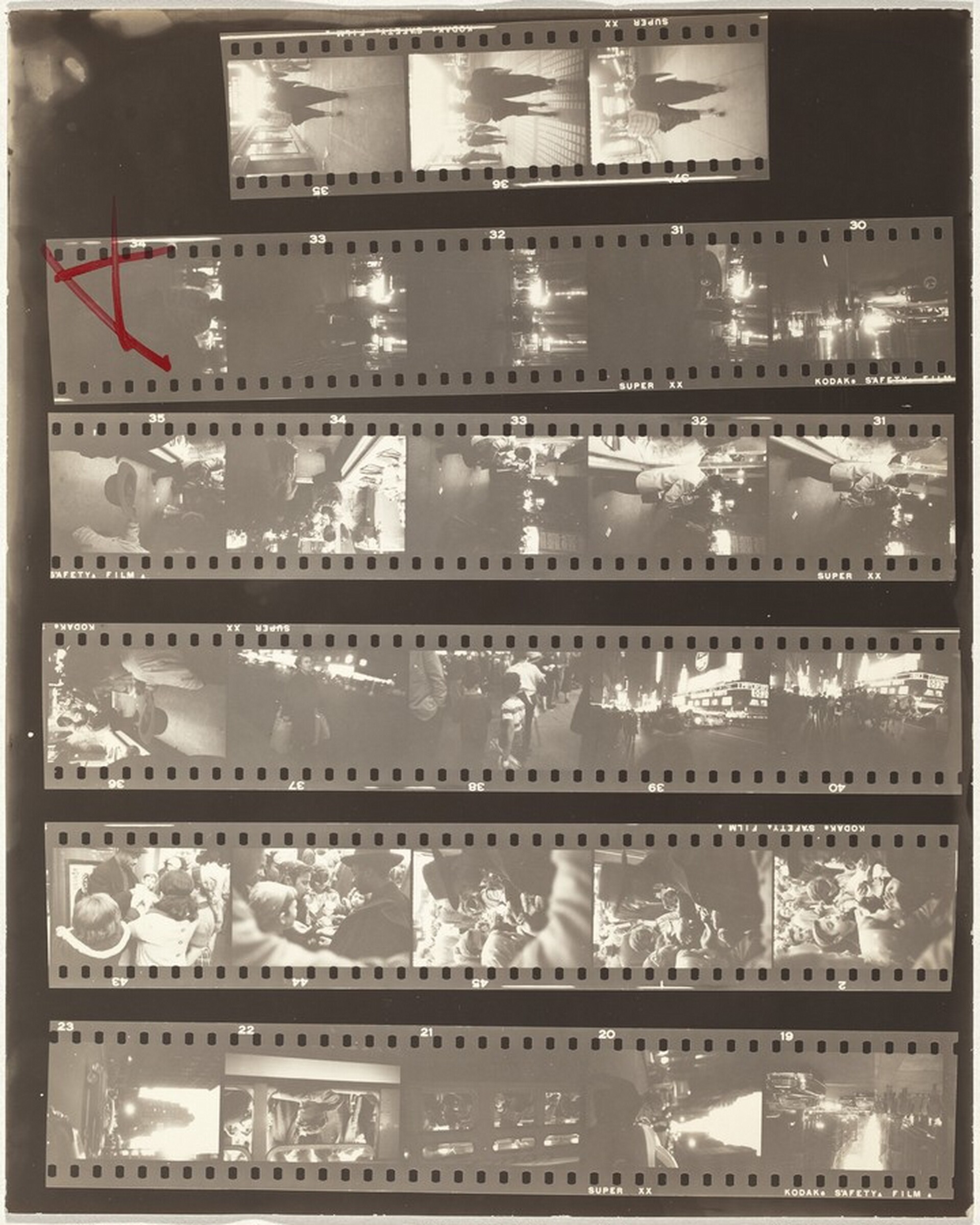
Restaurant--Hollywood 82, Robert Frank, August 1958

Restaurant--Hollywood 82

August 1958 · Photograph

Scheda

August 1958 · a 34 anni
19242019
Numero di inventario
1990.28.3044

Nel frattempo, nella vita di Robert Frank

Tutta la vita
  1. 1955–1957

    Across America on a Guggenheim Fellowship

    Inspired by Jakob Tuggener’s Fabrik, Bill Brandt’s The English at Home and Walker Evans’s American Photographs, and on the recommendation of Evans, Alexey Brodovitch, Alexander Liberman, Edward Steichen and Meyer Schapiro, he secures a Guggenheim Fellowship in 1955 to travel across the United States and photograph all strata of its society, from Detroit and Dearborn to Savannah, Miami Beach and St. Petersburg, New Orleans, Houston, Los Angeles, Reno, Salt Lake City, Butte and Chicago. Over two years of road trips, part of them with his family, he takes 28,000 shots, of which he selects 83 for The Americans.

  2. 1955–1957

    Jailed in Arkansas

    In a small Arkansas town he is taken to the police station and put in jail: it comes out that he is Jewish because of a letter from the Guggenheim Foundation, and the sheriff says they will have to find somebody who speaks Yiddish. Frank later recalled that it was scary and nobody knew where he was; elsewhere in the South a sheriff told him he had “an hour to leave town”, and these incidents may have contributed to the dark view of America found in his work.

  3. 1957

    Meets Jack Kerouac

    Shortly after returning to New York he meets the Beat writer Jack Kerouac, by Frank’s account at a New York party where poets and Beatniks were, though by another account Joyce Johnson, Kerouac’s lover at the time, introduced them, and shows him the photographs from his travels. Kerouac immediately says he can write something about these pictures and eventually contributes the introduction to the U.S. edition of The Americans; Frank also becomes a lifelong friend of Allen Ginsberg and one of the main visual artists to document the Beat subculture.

  4. 1958

Altre opere di Robert Frank

Tutte le opere

Sotto lo stesso tetto: National Gallery of Art

Pagina del museo

Sullo stesso tema · Taverns/cafes/inns

Tutte le opere sul tema

“Les Américains” is published in Paris

Because his images depart from contemporary photographic standards, Frank has difficulty at first in securing an American publisher, and the book is first published in Paris by Robert Delpire in the Encyclopédie Essentielle series, with texts by Simone de Beauvoir, Erskine Caldwell, William Faulkner, Henry Miller and John Steinbeck positioned opposite the photographs.

  • 1959

    “The Americans” in the U.S.: harsh criticism

    The book is finally published in the United States by Grove Press, without the texts but with Kerouac’s introduction, and initially receives substantial criticism: Popular Photography derides the images as meaningless blur, grain, muddy exposures, drunken horizons and general sloppiness. Sales are poor at first too, but the popular Kerouac’s introduction helps it reach a larger audience, and over time The Americans becomes a seminal work in American photography and art history, the work with which Frank is most clearly identified.

  • Robert Frank, ritrattoRobert FrankStati Uniti, 1924–2019

    Si può ammirare?

    Al momento non riceve

    National Gallery of Art

    Washington, Stati Uniti

    Appartiene alla collezione, ma al momento non è esposta.

    Verificato
    3 giorni fa
    Ultimo cambio di stato
    19 ago 2026
    Fonte
    Il museo
    Sulla mappaPagina del museo

    Che cosa raffigura

    Taverns/cafes/inns

    In catalogo

    FotografieArte del dopoguerraXX secoloAmerican

    Fonti

    • National Gallery of Art
    • Immagine: National Gallery of Art — © the artist or rights holder
    Fourth of July—Jay, New York, Robert Frank, 1954

    Fourth of July—Jay, New York

    1954 · National Gallery of Art

    Parade—Hoboken, New Jersey, Robert Frank, 1955, printed 1977

    Parade—Hoboken, New Jersey

    1955, printed 1977 · National Gallery of Art

    Construction--New York City no number, Robert Frank, 1950s

    Construction--New York City no number

    1950s · Non esposta · National Gallery of Art

    Alfred Leslie--Painters no number, Robert Frank, 1950s

    Alfred Leslie--Painters no number

    1950s · Non esposta · National Gallery of Art

    New York City no number, Robert Frank, late 1950s

    New York City no number

    late 1950s · Non esposta · National Gallery of Art

    7th Avenue--New York City 1, Robert Frank, early 1950s

    7th Avenue--New York City 1

    early 1950s · Non esposta · National Gallery of Art

    Revival no number, Robert Frank, mid-late 1950s

    Revival no number

    mid-late 1950s · Non esposta · National Gallery of Art

    Revival no number, Robert Frank, mid-late 1950s

    Revival no number

    mid-late 1950s · Non esposta · National Gallery of Art

    Ginevra de' Benci [obverse], Leonardo da Vinci, c. 1474/1478

    Leonardo da Vinci

    Ritratto di Ginevra de' Benci, c. 1474/1478

    Wreath of Laurel, Palm, and Juniper with a Scroll inscribed Virtutem Forma Decorat [reverse], Leonardo da Vinci, c. 1474/1478

    Leonardo da Vinci

    Wreath of Laurel, Palm, and Juniper with a Scroll inscribed Virtutem Forma Decorat [reverse], c. 1474/1478

    Green Wheat Fields, Auvers, Vincent van Gogh, 1890

    Vincent van Gogh

    Green Wheat Fields, Auvers, 1890

    Girl in White, Vincent van Gogh, 1890

    Vincent van Gogh

    Girl in White, 1890

    Roses, Vincent van Gogh, 1890

    Vincent van Gogh

    Roses, 1890

    Self-Portrait, Vincent van Gogh, 1889

    Vincent van Gogh

    Self-Portrait, 1889

    Farmhouse in Provence, Vincent van Gogh, 1888

    Vincent van Gogh

    Farmhouse in Provence, 1888

    La Mousmé, Vincent van Gogh, 1888

    Vincent van Gogh

    La Mousmé seduta, 1888

    Sketches from a Tavern: Woman Standing and Two Men Seated, Attributed to Rembrandt van Rijn

    Rembrandt van Rijn

    Sketches from a Tavern: Woman Standing and Two Men Seated

    Non esposta · National Gallery of Art

    A Corner of the Moulin de la Galette, Henri de Toulouse-Lautrec, 1892

    Henri de Toulouse-Lautrec

    A Corner of the Moulin de la Galette, 1892

    National Gallery of Art

    Quadrille at the Moulin Rouge, Henri de Toulouse-Lautrec, 1892

    Henri de Toulouse-Lautrec

    Quadrille at the Moulin Rouge, 1892

    National Gallery of Art

    La Goulue and Her Sister, Henri de Toulouse-Lautrec, c. 1892

    Henri de Toulouse-Lautrec

    La Goulue and Her Sister, c. 1892

    Non esposta · National Gallery of Art

    The Railway Restaurant, Edouard Manet, c. 1879

    Édouard Manet

    The Railway Restaurant, c. 1879

    Non esposta · National Gallery of Art

    Plum Brandy, Edouard Manet, c. 1877

    Édouard Manet

    La prugna, c. 1877

    National Gallery of Art

    Henry Schlactner, Kerouac’s friend Al Sublette by Peter Orlovsky. Foster’s Cafeteria S.F. 1955. Me on right., Allen Ginsberg, 1955, printed later

    Allen Ginsberg

    Henry Schlactner, Kerouac’s friend Al Sublette by Peter Orlovsky. Foster’s Cafeteria S.F. 1955. Me on right., 1955, printed later

    Non esposta · National Gallery of Art

    Cafe, Max Liebermann

    Max Liebermann

    Cafe

    Non esposta · National Gallery of Art