ART WIKI33.040 in sala
MappaCollezioneArtistiMuseiMostreRivista
Accedi

ART WIKI

Dove è appeso il capolavoro, e quando si può entrare.

Collezioni: Art Institute of Chicago, Cleveland Museum of Art, Ermitage, Galleria Tret'jakov, Getty Museum, Harvard Art Museums, Hirshhorn Museum and Sculpture Garden, Metropolitan Museum of Art, Minneapolis Institute of Art, Museo del Louvre, Museo Puškin delle belle arti, Museo russo, Museum of Modern Art, National Gallery of Art, National Museum of Asian Art, National Portrait Gallery, Rijksmuseum, Smithsonian American Art Museum, Statens Museum for Kunst, Victoria and Albert Museum, Villa Getty, Whitney Museum of American Art, Catalogo statale del fondo museale russo (274 musei), Europeana (19 musei), Wikidata (6 musei), Paris Musées (12 musei) e Joconde, la banca dati dei musei del Ministero della Cultura francese (495 musei). Le immagini appartengono ai titolari dei diritti.

Sezioni

  • Mappa
  • Ricerca
  • Collezione
  • Capolavori
  • Esposte ora
  • Artisti

Altro

  • Musei e gallerie
  • Mostre
  • Rivista
  • Da dove vengono i dati
  • Privacy e cookie
HomeMappaCatalogo
  1. Collezione/
  2. Harvard Art Museums/
  3. Red Painting
Red Painting, Joseph Marioni, 1999
JJoseph MarioniStati Uniti, 1943–2024

Red Painting

1999 · Painting

Si può ammirare?

Al momento non riceve

Harvard Art Museums

Cambridge, Stati Uniti

Appartiene alla collezione, ma al momento non è esposta.

Verificato
9 giorni fa
Ultimo cambio di stato
27 set 2026
Fonte
Il museo
Sulla mappaPagina del museo

Sul dipinto

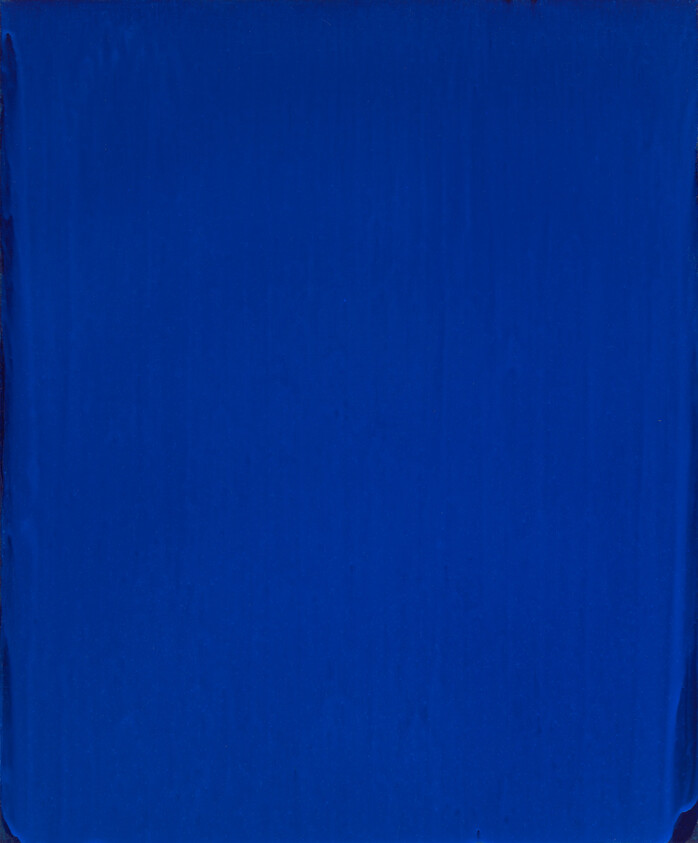
As a monochrome painting by an artist who has consciously predicated his painterly project in response to Michael Fried’s "Footnote #6," in his celebrated essay, "Art and Objecthood -- "[T]he task of the modernist painter is to discover those conventions that, at a given moment, alone are capable of establishing his work’s identity as painting" -- "Red Painting 1999 No. 4", 1999 adds both to the Fogg Art Museum's collection and to the particular formalist gauntlet laid down by Michael Fried during his years as a graduate student at Harvard. This connection is underscored by the donors’ decision to dedicate the painting to Fried. Marioni self-consciously responds to the painting of a number of artists in our collections, especially to Pollock; Rothko; Noland; Louis; Stella and Marden; even more specifically to Robert Ryman.

Continua a leggere

During the 1980’s, Marioni also instigated a series of dialogues and exhibition projects with the German painter Gunter Umberg, around the European concept of "concrete" painting. Like Ryman, who, in his mostly white paintings, has extracted seemingly unlimited outcomes by varying the organization and manner of his strokes; the type and density of his pigments, and the nature of his support surface and attachments of support to wall, Marioni has adapted a Minimalist reliance on permutations of a set of pre-determined variables, in his case, sticking to monochrome acrylic on canvas, but introducing a broad range of color. Marioni, however, paints with a roller, eliminating the constructive element of the stroke. In this, his project is at once more phenomenological, more iconic, and more anthropomorphic than his Abstract Expressionist or Minimalist predecessors.

Marioni’s preference for an unmediated application of paint echoes Pollock, but toward different ends: he is interested in allowing the paint "to be what it naturally is, liquid color," and he aims to avoid any intimation of drawing. At the same time, his layered pigments incorporate stain, but are not about staining; he relishes the corporeal association of paint with skin. Marioni has referred repeatedly to his Catholic interest in the fundamentally iconic essence of painting, citing both Veronica’s veil – the painting as relic – and Malevich as inspiration, toward this end. His paintings alternate between square, or iconic, formats and more vertical, larger scale planes. In both cases, Marioni treats the entire painting as image and works to inspire a private dialogue between the painting and its viewer.

(Linda Norden)

Harvard Art Museums

Scheda

1999 · a 56 anni
19432024
Numero di inventario
1999.249

In catalogo

DipintiAcrilicoPittura americanaArte contemporaneaXX secoloStati Uniti

Fonti

  • Harvard Art Museums
  • Immagine: Harvard Art Museums — © President and Fellows of Harvard College

Altre opere di Joseph Marioni

Tutte le opere
Helios II, Joseph Marioni, 2020

Helios II

2020 · Non esposta · National Gallery of Art

#23-74, Joseph Marioni, 1974

#23-74

1974 · Non esposta · Whitney Museum of American Art

Blue Painting, Joseph Marioni, 1999

Blue Painting

1999 · Non esposta · Whitney Museum of American Art

Yellow Painting, Joseph Marioni, 2007

Yellow Painting

2007 · Non esposta · Art Institute of Chicago

Sotto lo stesso tetto: Harvard Art Museums

Pagina del museo
Glück auf in Deutschland (N:4), Pınar Öğrenci, 2024

Pınar Öğrenci

Glück auf in Deutschland (N:4), 2024

Glück auf in Deutschland (N:10), Pınar Öğrenci, 2024

Pınar Öğrenci

Glück auf in Deutschland (N:10), 2024

Glück auf in Deutschland (N:7b), Pınar Öğrenci, 2024

Pınar Öğrenci

Glück auf in Deutschland (N:7b), 2024

Glück auf in Deutschland (N:6), Pınar Öğrenci, 2024

Pınar Öğrenci

Glück auf in Deutschland (N:6), 2024

Glück auf in Deutschland (N:11), Pınar Öğrenci, 2024

Pınar Öğrenci

Glück auf in Deutschland (N:11), 2024

Dwarpalika (Temple Guardian), Sneha Shrestha, 2023

Sneha Shrestha

Dwarpalika (Temple Guardian), 2023

The Eternal Pond of the Universe, Bingyi 冰逸, 2022-2024

Bingyi 冰逸

The Eternal Pond of the Universe, 2022-2024

Triangle Constellation, Carlos Amorales, 2015

Carlos Amorales

Triangle Constellation, 2015