Leonardo da VinciItalia, 1452–1519
Ritratto di Isabella d'Este
Portrait d'Isabelle d'Este
Si può vedere?
Non si sa
Dove si trova «Ritratto di Isabella d'Este» oggi? Collezione: Museo del Louvre, Parigi. Non si sa.

Parigi, Francia
Il proprietario è noto; non si sa se oggi sia esposta.
- Ultimo cambio di stato
- Fonte
- Il museo
Sull’opera
Il Ritratto di Isabella d'Este è un disegno preparatorio eseguito a carboncino, sanguigna e pastello giallo su carta (63x46 cm) di Leonardo da Vinci, databile al 1500 circa e conservato nel Louvre (Cabinet des Dessins) a Parigi.
Scheda
- Numero di inventario
- MI 753, Recto
In catalogo
Fonti
- Museo del Louvre
- Immagine: Museo del Louvre — GrandPalaisRmn (Musée du Louvre) / Michel Urtado
Nella vita di Leonardo da Vinci
Tutta la vita1482–1500 · Luogo di lavoro
Milan
1499
The French take Milan
Milan was captured by the troops of King Louis XII of France. Leonardo left the city, and the model of the Francesco Sforza monument was badly damaged.
1500 · Residenza
Florence
1500
Flight to Venice with Salaì and Pacioli
When Ludovico Sforza was overthrown by France, Leonardo fled Milan for Venice with his assistant Salaì and his friend the mathematician Luca Pacioli. There he worked as a military architect and engineer, devising ways to defend the city from naval attack.
1500
Back in Florence: a workshop with the Servites
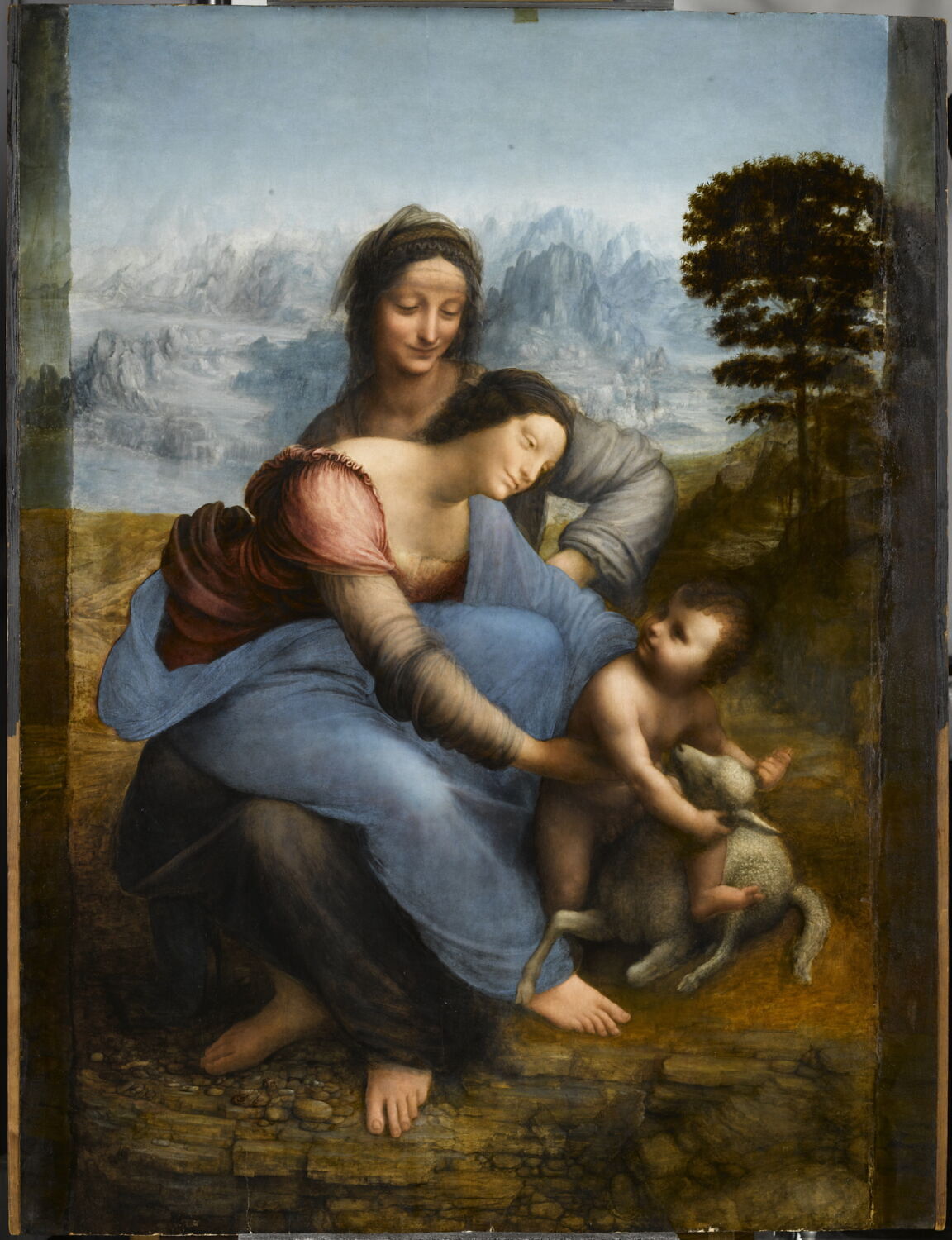
In Florence Leonardo and his household were guests of the Servite monks at Santissima Annunziata, who gave him a workshop. According to Vasari, the cartoon of the Virgin and Child with Saint Anne and Saint John the Baptist he made there won such admiration that people flocked to see it “as if they were going to a solemn festival”.
1502
In the service of Cesare Borgia
In Cesena Leonardo entered the service of Cesare Borgia, son of Pope Alexander VI, travelling throughout Italy with him. To win his patronage he drew a town plan of Imola, after which Borgia made him his chief military engineer and architect.

![Wreath of Laurel, Palm, and Juniper with a Scroll inscribed Virtutem Forma Decorat [reverse], Leonardo da Vinci, c. 1474/1478](https://api.nga.gov/iiif/ff62e8d0-45c4-498f-ad36-6358de827e04/full/!2400,2400/0/default.jpg)
![Ginevra de' Benci [obverse], Leonardo da Vinci, c. 1474/1478](https://api.nga.gov/iiif/8f29e3c9-a289-4d53-abf0-31a66e9e98fa/full/!2400,2400/0/default.jpg)