ART WIKI33.040 in sala
MappaCollezioneArtistiMuseiMostreRivista
Accedi

ART WIKI

Dove è appeso il capolavoro, e quando si può entrare.

Collezioni: Art Institute of Chicago, Cleveland Museum of Art, Ermitage, Galleria Tret'jakov, Getty Museum, Harvard Art Museums, Hirshhorn Museum and Sculpture Garden, Metropolitan Museum of Art, Minneapolis Institute of Art, Museo del Louvre, Museo Puškin delle belle arti, Museo russo, Museum of Modern Art, National Gallery of Art, National Museum of Asian Art, National Portrait Gallery, Rijksmuseum, Smithsonian American Art Museum, Statens Museum for Kunst, Victoria and Albert Museum, Villa Getty, Whitney Museum of American Art, Catalogo statale del fondo museale russo (274 musei), Europeana (19 musei), Wikidata (6 musei), Paris Musées (12 musei) e Joconde, la banca dati dei musei del Ministero della Cultura francese (495 musei). Le immagini appartengono ai titolari dei diritti.

Sezioni

  • Mappa
  • Ricerca
  • Collezione
  • Capolavori
  • Esposte ora
  • Artisti

Altro

  • Musei e gallerie
  • Mostre
  • Rivista
  • Da dove vengono i dati
  • Privacy e cookie
HomeMappaCatalogo
  1. Collezione/
  2. Minneapolis Institute of Art/
  3. Plum Drawn from the Mind
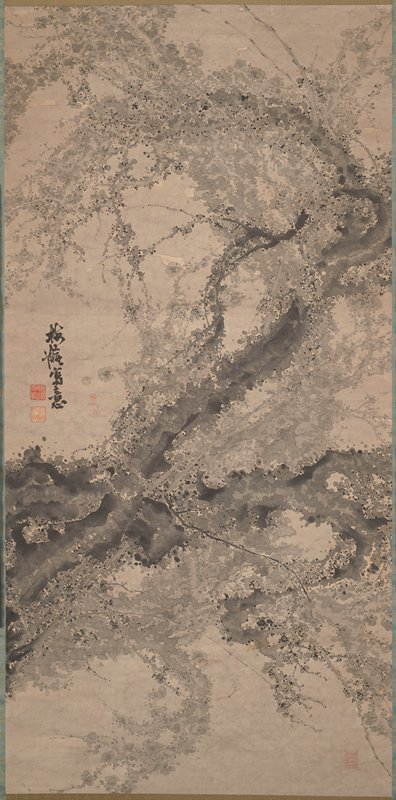
Plum Drawn from the Mind, Baichi Dōjin, first half 19th century
BBaichi DōjinGiappone

Plum Drawn from the Mind

first half 19th century · Painting

Si può ammirare?

Al momento non riceve

Minneapolis Institute of Art

Minneapolis, Stati Uniti

Appartiene alla collezione, ma al momento non è esposta.

Verificato
9 giorni fa
Ultimo cambio di stato
25 set 2026
Fonte
Il museo
Sulla mappaPagina del museo

Sul dipinto

The practice of painting blossoming plum branches in monochrome ink seems to have emerged in 10th-century China, and it became popular among the Japanese literati of the 18th and 19th centuries. Delicate flowers budding from a wizened plum tree in winter carried associations of longevity, renewal, and purity. The inscription, shai, meaning “drawn from the mind, ” is the opposite of shasei, or “sketched from life”; indeed, this is a particularly free-spirited and imaginative interpretation of this subject. A variety of tones of ink applied in impressionistic splotches with a wet brush convey the vital splendor of a plum tree breaking into a profusion of blossoms on the cusp of spring.

Baichi was a priest of the Pure Land, or Jōdo, school of Buddhism and was known for his poetry, calligraphy, and paintings of landscapes and flora.

Minneapolis Institute of Art

Scheda

Numero di inventario
2014.109.2

In catalogo

DipintiInchiostroPittura giapponeseNeoclassicismoRomanticismoXIX secoloGiappone

Fonti

  • Minneapolis Institute of Art
  • Immagine: Minneapolis Institute of Art — public domain

Sotto lo stesso tetto: Minneapolis Institute of Art

Pagina del museo
Olive Trees, Vincent van Gogh, 1889

Vincent van Gogh

Olive Trees, 1889

Grainstack, Sun in the Mist, Claude Monet, 1891

Claude Monet

Grainstack, Sun in the Mist, 1891

Lucretia, Rembrandt van Rijn, 1666

Rembrandt van Rijn

Lucretia, 1666

Self-Portrait with Dr. Arrieta, Francisco José de Goya y Lucientes, 1820

Francisco de Goya

Goya curato dal dottor Arrieta, 1820

Study for Improvisation V, Vassily Kandinsky, 1910

Vasily Kandinsky

Study for Improvisation V, 1910

Tahitian Landscape, Paul Gauguin, 1891

Paul Gauguin

Tahitian Landscape, 1891

Chestnut Trees at Jas de Bouffan, Paul Cézanne, c. 1885–86

Paul Cézanne

Chestnut Trees at Jas de Bouffan, c. 1885–86

The Union of England and Scotland (Charles I as the Prince of Wales), Peter Paul Rubens, 1633–34

Peter Paul Rubens

The Union of England and Scotland (Charles I as the Prince of Wales), 1633–34






