 Nicholas RoerichRussia, 1874–1947
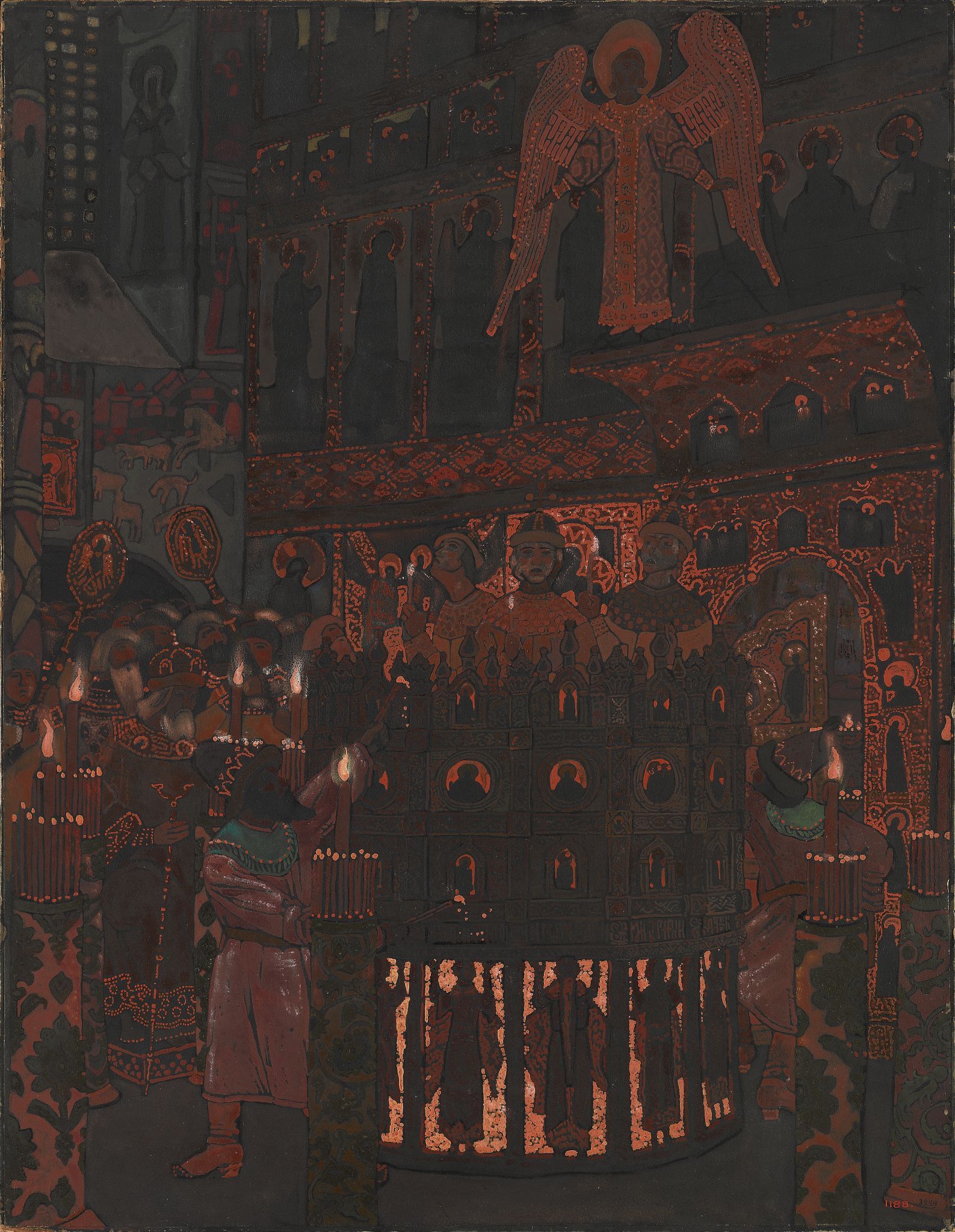
Пещное действо
Si può vedere?
Non si sa
Dove si trova «Пещное действо» oggi? Collezione: Galleria Tret'jakov, Mosca. Non si sa.

Mosca, Russia
Il proprietario è noto; non si sa se oggi sia esposta.
- Ultimo cambio di stato
- Fonte
- Il museo
Sul dipinto
Con le parole del museo — in russo
В январе 1906 года в Праге, в павильоне Cоюза изящных искусств «Манес», открылась первая персональная выставка Рериха за рубежом. Художник представил 82 произведения. Среди многих картин выделялась работа «Пещное действо», в 1909 году поступившая в Русский музей императора Александра III и впоследствии в Третьяковскую галерею. Художник написал эту картину осенью 1904-го, о чем сообщил в письме княгине М.К. Тенишевой 25 сентября: «Много работаю. В ходу „Пещное действо“».
В основу произведения легла библейская легенда из Книги пророка Даниила об иудейских юношах в вавилонском пленении (Дан. 3: 22–50). Азарий, Ананий и Мисаил были ввергнуты в пещь огненную по приказанию вавилонского царя Навуходоносора за отказ поклониться золотому истукану. Обратившись к Богу за помощью, отроки были спасены ангелом, спустившимся с небес и победившим огонь.
Leggi
На фоне иконостаса Софийского собора Великого Новгорода художник стилизованно изобразил представление с «халдейской пещью». По древнему обряду два служителя в народных костюмах обходят печь справа налево. В верхней части картины изображен светящийся Ангел Господень. Отроки запевают со свечами в руках, их головы увенчаны княжескими шапками с крестами. Рерих эффектно передал свечение огней, яркие контрасты цвета и света. Действо входило в рождественский цикл древнерусской богослужебной драмы с XII века. Работая над картиной, Рерих ознакомился с летописями и со статьей А.А. Спицына «Пещное действо и халдейская печь» (1901). Сцена «Пещного действа» в Успенском соборе экранизирована С.М. Эйзенштейном в кинофильме «Иван Грозный» (1944).
Galleria Tret'jakov
Scheda
- Numero di inventario
- 22847
In catalogo
Fonti
- Galleria Tret'jakov
- Immagine: Galleria Tret'jakov — © State Tretyakov Gallery
Nella vita di Nicholas Roerich
Tutta la vita1898–1903
Lecturer at the Archaeological Institute
From 1898 Roerich works with the St Petersburg Archaeological Institute: he teaches a course titled “Artistic Technique as Applied to Archaeology”, directs training excavations and compiles the “Archaeological Map of St Petersburg Province”. He digs in the provinces of St Petersburg, Pskov, Novgorod, Tver, Yaroslavl and Smolensk.
3 agosto 1902
Son born: George de Roerich
1903–1904
A “journey through antiquity”: over forty towns
With his wife Roerich visits more than forty towns with ancient monuments to study the roots of Russian culture. The result is about 90 architectural studies, a collection of photographs of old Russia and articles in which he is among the first to raise the question of the great artistic value of early Russian icon painting and architecture.
1904
Talashkino, Maria Tenisheva's estate
After touring the towns along the Volga and visiting Mozhaisk and the Savvino-Storozhevsky Monastery, Roerich ends his trip at Talashkino near Smolensk, the estate of Maria Tenisheva. Together with Malyutin, Vrubel, Benois, Korovin and Repin he puts into practice projects to revive ancient Russian traditions and folk crafts; his collaboration with Tenisheva will last until 1917 and their friendship until her death.
1906
Exhibitions abroad and the Salon d'Automne
From 1906 Roerich regularly takes part in exhibitions abroad: Paris, Venice, Berlin, Rome, Brussels, Vienna and London get to know his work, and his paintings are bought by the Luxembourg Museum, the National Museum in Rome, the Louvre and other museums. In 1907 he is elected a member of the Société du Salon d'Automne in France.
1906
Director of the Society's Drawing School
On taking up his post as director of the Drawing School, Roerich enlarges its premises, opens new classes and workshops — for icon painting, ceramics, chasing and weaving — restores the rights of the teaching council and founds a Museum of Russian Art at the school; he hopes to reorganise it as a Free People's Academy.