 Gustave CourbetFrancia, 1819–1877
Paysage
Si può ammirare?
Non si sa
Musée de Soissons
Soissons, Francia
Il proprietario è noto; non si sa se oggi sia esposta.
- Ultimo cambio di stato
- Fonte
- Il museo
Sul dipinto
Con le parole del museo — in francese
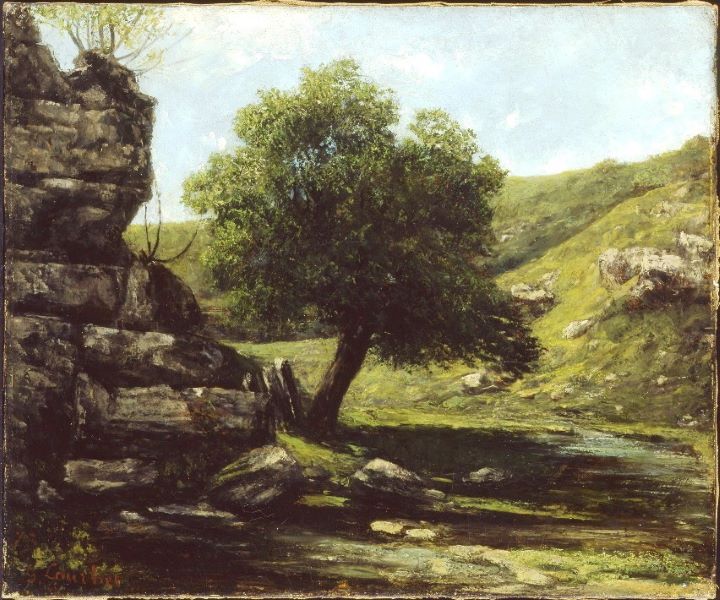
Il s’agit d’un paysage rocheux et verdoyant habité par un seul arbre peint au centre de la composition. Dans cette toile, Courbet met à l’honneur la nature, c’est elle le sujet principal du tableau. Au premier plan, sur la gauche, des rochers de plus ou moins grande taille occupent le devant du paysage. Derrière, au second plan, un arbre au feuillage abondant projette son ombre sur le sol, une ombre qui prolonge la masse sombre des rochers. À l’arrière-plan, on découvre une étendue verte qui descend. Ce terrain verdoyant est parsemé de plusieurs rochers plus petits et plus clairs (couleur craie) que ceux du premier plan ; plus clairs puisque peints en pleine lumière. Le ciel, sur lequel se dégage la partie supérieure de la frondaison de l’arbre, est d’un bleu céleste ponctué de quelques petits nuages blancs disséminés ici ou là. La composition est simple, mais déséquilibrée.
Continua a leggere
Sur la gauche, la masse compacte des rochers qui occupent pratiquement toute la hauteur de la toile alourdissent l’ensemble, tandis que le paysage verdoyant peint à l’arrière-plan ouvre l’espace sur la droite. L’arbre situé entre les deux, au centre de la toile, tempère ce déséquilibre et introduit un axe vertical, même si le tronc de cet arbre penche vers la droite. Le centre de la composition se situe juste au dessus du tronc d’arbre, à la naissance du feuillage. Le sujet de cette toile c’est la nature matérialisé par cet arbre qui capte le regard du spectateur au premier coup d’œil. La surface picturale consacrée à la représentation du ciel est d’ailleurs restreinte comparée à celle accordée à la représentation de la végétation et des rochers.
Musée de Soissons
Scheda
- Numero di inventario
- 93.7.2520
Che cosa raffigura
In catalogo
Fonti
- Musée de Soissons
- Immagine: Musée de Soissons — © ARRIGONI Bruno ; © musée municipal de Soissons; Ministère de la Culture (France), base Joconde
Nel frattempo, nella vita di Gustave Courbet
Tutta la vita18 March 1871
The Paris Commune
After the French defeat in the Franco-Prussian War a revolutionary government, the Paris Commune, briefly took power in the city on 18 March 1871. Courbet played an active part.
5 April 1871
Courbet organizes the Federation of Artists
Some three to four hundred painters, sculptors, architects and decorators attended the Federation's first meeting in the Grand Amphitheater of the School of Medicine. Courbet chaired it and proposed reopening the Louvre and the Musée du Luxembourg, holding a Salon free of government interference and awards, and abolishing the École des Beaux-Arts and other state institutions.
16 April 1871
Elected delegate for the 6th arrondissement
In special elections on 16 April Courbet was elected delegate for the 6th arrondissement of Paris; he was given the title of Delegate of Fine Arts and on 21 April was also made a member of the Commission on Education.
16 May 1871
The fall of the Vendôme Column
On 16 May 1871, nine days before the fall of the Commune, the column whose removal Courbet had requested back in September 1870 was pulled down in a large ceremony with military bands and photographers and broke into pieces. Some witnesses said Courbet was there, others denied it.
28 May – 7 June 1871
In hiding with friends, then arrested
After the French army's final suppression of the Commune on 28 May, Courbet went into hiding in the apartments of various friends; he was arrested on 7 June.
1873
Leaves for Switzerland to escape the debt for the column
In 1873 the newly elected president of the Republic, Patrice de MacMahon, announced plans to rebuild the column at Courbet's expense. Unable to pay, he went into self-imposed exile in Switzerland to avoid bankruptcy and remained there until his death.