Gerard van HonthorstPaesi Bassi, 1592–1656
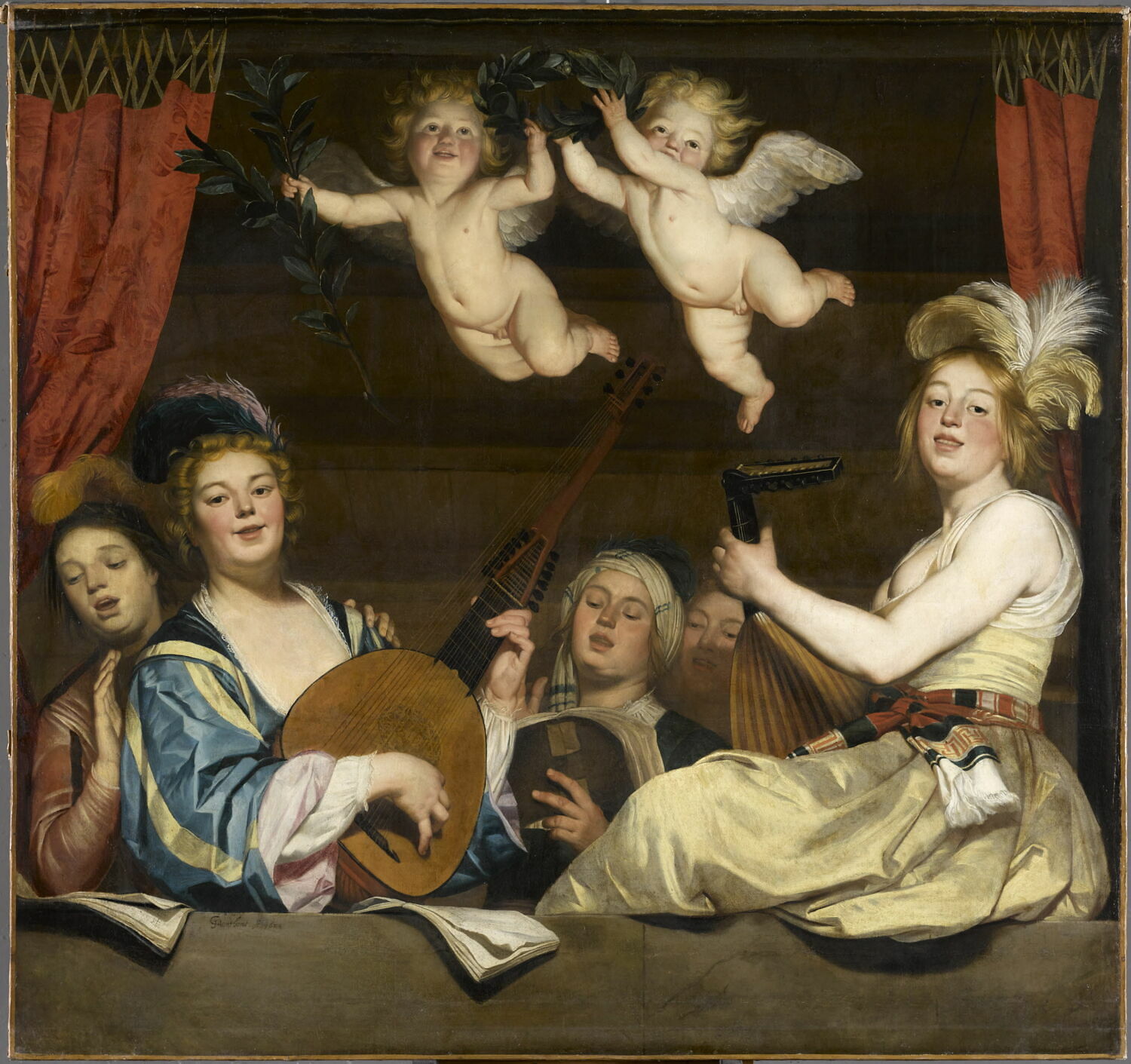
Musical Group on a Balcony
Si può vedere?
Sì, esposta ora
Dove si trova «Musical Group on a Balcony» oggi? Getty Museum, Museum East Pavilion, Gallery E201, Los Angeles. Sì, esposta ora. Verificato 5 ottobre 2026.
Aperto· fino alle 20:00
Esposta al pubblico.
- Verificato
- Ultimo cambio di stato
- Fonte
- Il museo
Sul dipinto
Smiling, singing figures gather around a balcony to play musical instruments, inviting the viewers below to join in the fun. The revelers' facial expressions and bright colorful clothes heighten the festive, carefree mood. A parrot and a dog, gazing down from their perches, round out the merry group. Possibly part of an allegory of Harmony, the painting may have originally been slightly wider and twice as long, containing a complete balustrade and more figures. The head of the man at the top is a modern addition. Gerrit van Honthorst painted this illusionistic ceiling, the earliest of its type made in the Netherlands in 1622, two years after his return from Italy, where he saw similar painted ceilings. Careful calculation of perspective allows the figures to burst plausibly through the flat plane of the painted panel.
Getty Museum
Scheda
- Numero di inventario
- 70.PB.34
In catalogo
Fonti
- Getty Museum
- Immagine: Getty Museum — Open Content
Nella vita di Gerard van Honthorst
Tutta la vitac. 1610 – 1620
At the palace of Marquis Giustiniani in Rome
In Rome Honthorst lodged at the palace of Marquis Vincenzo Giustiniani, where he painted “Christ Before the High Priest” (now in the National Gallery, London), and under Caravaggio's influence took up night scenes lit by a hidden artificial source. Italian documents of his day call him “Gherardo Fiammingo” or “Gherardo Hollandese”: the nickname “Gherardo delle Notti” came into use only in the 18th century.
c. 1610 – 1620
Commissions from Cardinal Scipione Borghese
Cardinal Scipione Borghese became another important patron, securing him commissions at San Silvestro in Monte Compatri and Santa Maria della Vittoria in Rome. The artist also worked for Cosimo II de' Medici, Grand Duke of Tuscany.
1620
Returns to Utrecht
Back in Utrecht, Honthorst built a considerable reputation at home and abroad: Sir Dudley Carleton, the English envoy at The Hague, recommended his work to the Earl of Arundel, and his work impressed the young Rembrandt and Frans Hals.
1622
The Guild of St. Luke and a drawing academy
Honthorst was admitted to the Guild of St. Luke and the same year opened a drawing academy in Utrecht, in fact a small studio for visiting pupils. According to Joachim von Sandrart, his pupil in the mid-1620s, the master taught about 24 students at a time, each paying 100 guilders a year.
1623
Marries and heads the Guild of St. Luke
In the year of his marriage Honthorst was president of the Guild of St. Luke in Utrecht.