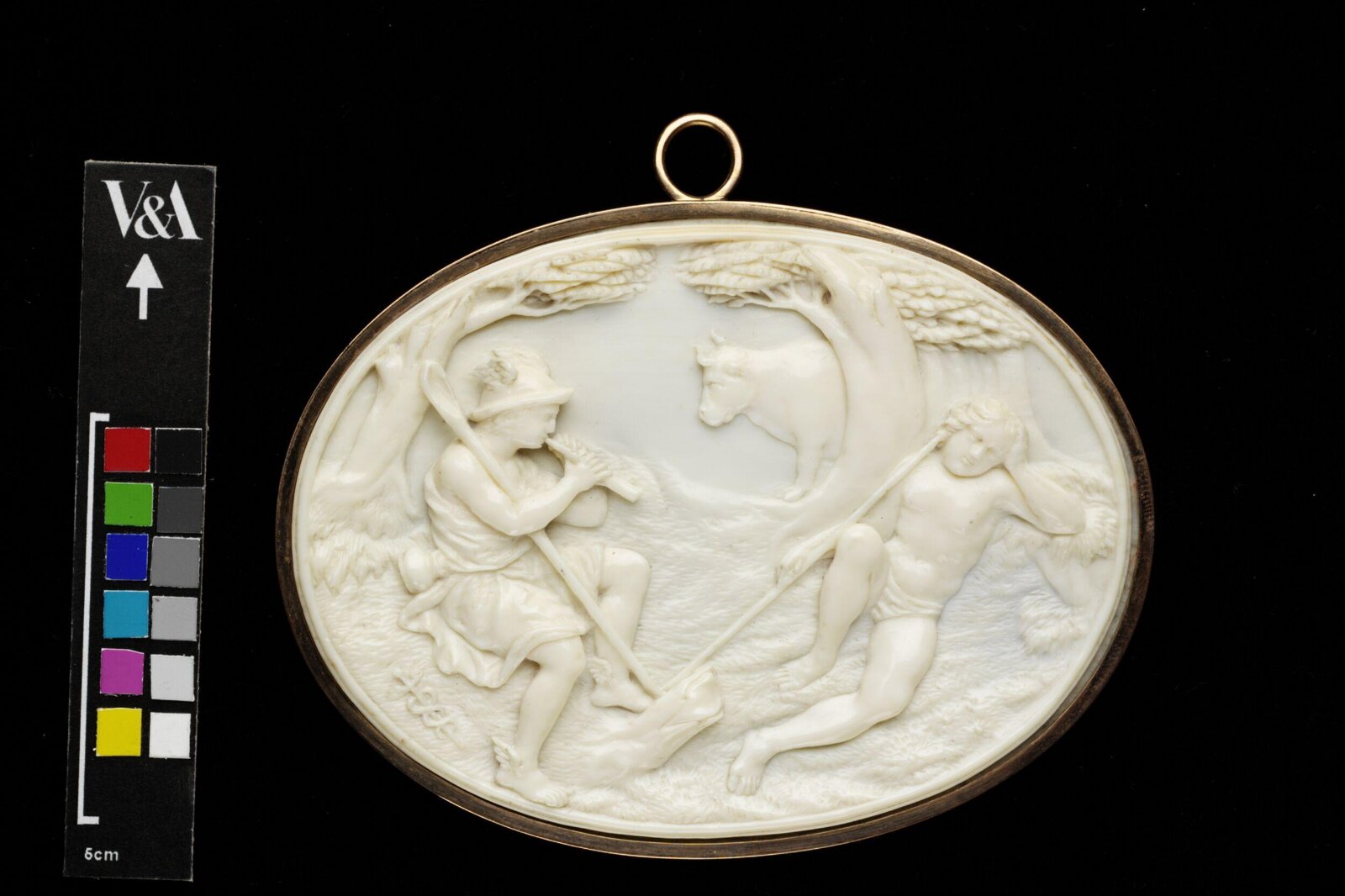
Theodore Xavery
Mercury and Argus
Si può ammirare?
Sì, riceve visite

Esposta al pubblico. Chi lo garantisce è indicato qui sotto.
- Verificato
- Ultimo cambio di stato
- Fonte
- I dati di collezione del museo stesso
About the sculpture
This ivory relief was perhaps made by T (Theodore?) Xavery in the Netherlands in ca. 1775.
The monochrome colouring of material meant that ivories such as this could ape in miniature the ancient marbles much valued by connoisseurs and collectors of the time. In the story from classical mythology, the all-seeing giant Argus was murdered by Mercury at the instruction of Jupiter. He had been sent by Juno to watch over Io, whom Jupiter wished to seduce.
The ivory is worked very finely, so that if held up to the light, the figures in high relief stand out against the flat translucent background.
Read on
The composition depends from a plaquette by Paulus van Vianen, much copied in the 17th and 18th centuries. Jeremy Warren discusses the plaquette in his catalogue of the sculpture at the Ashmolean Museum, Oxford. Jorgen Hein's catalogue of the ivories in the Rosenborg collection, Copenhagen, includes another ivory version, I, cat. no. 82, p. 188.
Victoria and Albert Museum
Scheda
- Numero di inventario
- A.17-1964
What it shows
In catalogo
Fonti
- Victoria and Albert Museum: the museum's own open data · acquisita 11 giorni fa
- Immagine: Victoria and Albert Museum — © Victoria and Albert Museum, London