 Jacopo SansovinoItalia, 1486–1570
Lucretia
Si può vedere?
Non esposta al momento
Dove si trova «Lucretia» oggi? Collezione: Victoria and Albert Museum, Londra. Non esposta al momento. Verificato 25 settembre 2026.

Londra, Regno Unito
Appartiene alla collezione, ma al momento non è esposta.
- Verificato
- Ultimo cambio di stato
- Fonte
- Il museo
Sulla scultura
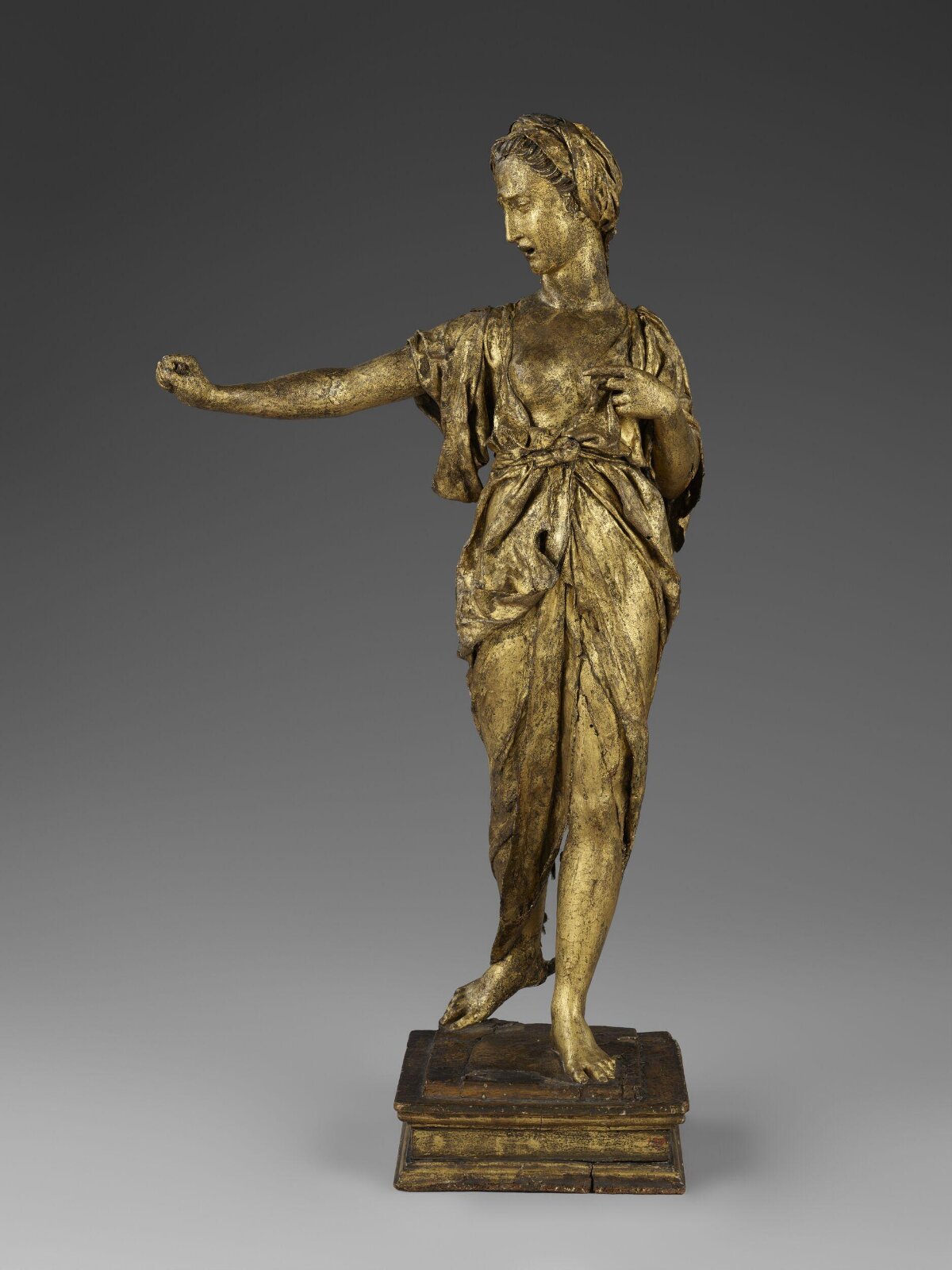
This fully gilded wood sculpture represents Lucretia – a heroine from Roman legend whose suicide after she was raped by Sextus Tarquinius sparked a revolution that helped found Rome. The episode was described by the ancient Roman historian Livy in Ab Urbe Condita (The History of Rome), Book 1, sections 57-60, a text that was widely read in the Renaissance. The story is also recounted in the Roman poet Ovid’s Fasti, Book 2.
Here, Lucretia is represented just before she stabs herself: her head tilts down to the right to look at her extended right hand, which originally must have held a dagger. Her left hand clasps the folds of her robe, as if pulling it away to uncover her heart.
Leggi
While a Christie’s sale catalogue (June 5-7, 1899), described the sculpture as Florentine sixteenth-century, by the time the sculpture was acquired by the V&A in 1962, it was suspected to be French. It was not included in Pope-Hennessy’s 1964 Catalogue of Italian Sculpture in the Victoria and Albert Museum and was therefore little known to specialists of Italian Renaissance art.
Now, however, it is thought to be an accomplished work by Jacopo Sansovino, a Florentine sculptor and architect who spent long periods of his career in Venice and Rome. For the attribution, see Principi 2025. Bruce Boucher, who did not know of the sculpture when he prepared his 1991 monograph on Jacopo Sansovino, has since then enthusiastically endorsed the attribution (private communication, 2025).
The figure of Lucretia and the base are carved from one piece of poplar wood, a material commonly used for medieval and Renaissance Italian sculptures. Structural modifications in the wood revealed through X-radiography suggest that Sansovino meticulously positioned the head, right arm, and fingers of Lucretia.
Anne Brodrick noted that the extended right arm, now attached with a nail through the shoulder and chest, was likely repositioned by the artist, as the X-radiograph showed remnants of a previous join in the shoulder (report dated 1984; see also Brodrick 2000). Brodrick also proposed that the head and neck originally faced forward. The neck was cut, evident from a nail fragment left in the base of the neck, and a new wedge-shaped neck was then attached to the body with a nail. The head was re-attached with a nail hammered from the top of the head into the angled neck, so the head would tilt down. After undertaking these structural modifications, Sansovino modelled the hair in gesso.
Material analysis undertaken by conservation scientist Jo A. Darrah in 1982 determined that the robe is made of linen dipped in animal glue (size), wrapped around the figure’s head and body. Using glue instead of gesso – as was common for drapery on Renaissance sculptures – makes for more delicate and defined folds, as it is thinner and lighter. Once the glue hardened, the figure was covered in a thin gesso layer and red clay bole to create a smooth surface onto which tin leaf was applied and coated with glaze as a sealant. Another layer of tin leaf was applied over this, then a layer of translucent ground onto which gold leaf was applied, which was coated with yellow-tinted glaze.
Lucretia was covered in grey overpaint when it entered the V&A collection in 1962; its appearance at the time is recorded in a photograph in the Warburg Institute’s Photographic Collection. The statuette is described as 'gilded' in a Christie’s sale catalogue (June 5-7, 1899), indicating it was overpainted between 1899 and 1962. The grey paint layer was removed at the V&A soon after acquisition, revealing well-preserved gilding underneath.
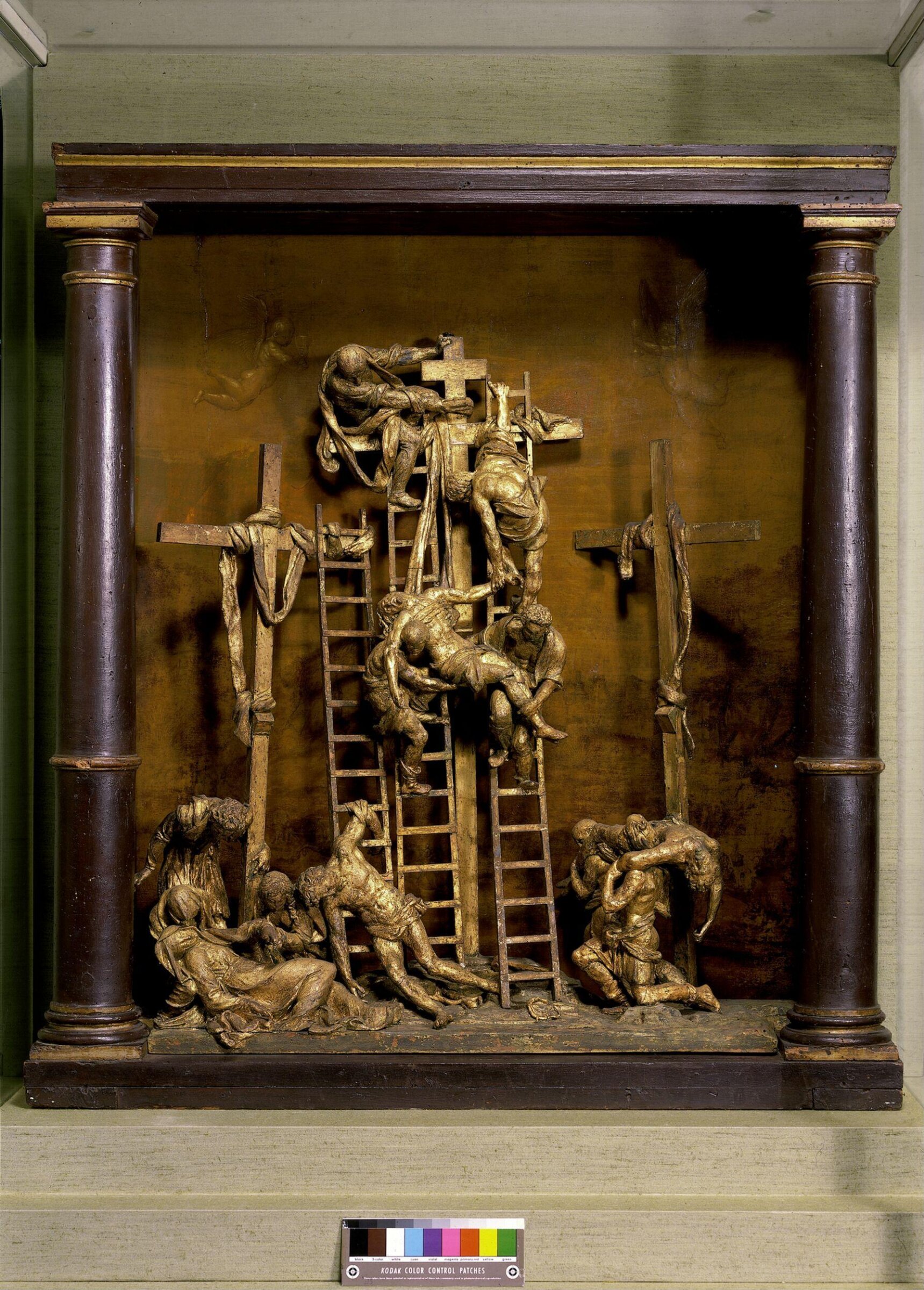
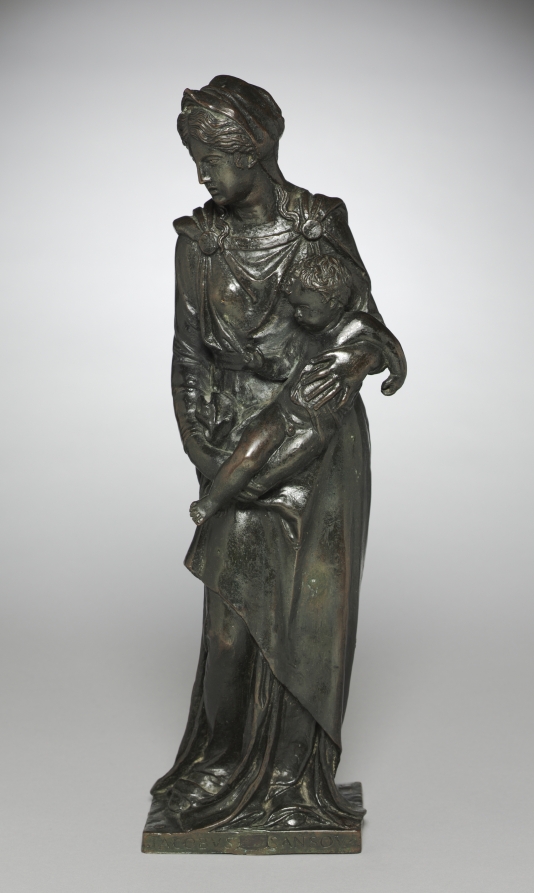
Lucretia may have been used as a model for Sansovino’s studio or for another artist. Other models by Sansovino are stylistically and technically similar, though not identical, to Lucretia, notably the gilded wax and glue-dipped linen Virgin and Child, ca. 1510-11, in the Fine Art Museum, Budapest. The Virgin and Child was likely a model for a public competition in Florence and later used by the painter Andrea del Sarto as a model for his 1513 Charity, which was part of a fresco cycle depicting the life of Saint John the Baptist and the four virtues in the Chiostro dello Scalzo, Florence. Sansovino’s Descent from the Cross of about 1508 (Victoria and Albert Museum, 7595-1861) is another work of similar technique, composed of gilt wood and wax with cloth, which the sculptor produced as a model for the painter Pietro Perugino.
Noting affinities with Raphael's drawing of Lucretia (Metropolitan Museum of Art, New York, inv. 1997.153), in which the heroine similarly holds out a dagger in her right hand, Principi 2025 proposed that Sansovino's three-dimensional Lucretia was probably made while the sculptor was working in Rome. As Principi observed, Cardinal Giovanni de' Medici, later Pope Leo X (r. 1513-1521) was particularly fond of the figure of Lucretia: he composed poetry in her honour and owned a now-lost ancient sculpture of the heroine, unearthed in Rome in 1508. It is possible, therefore, that the present sculpture relates to project connected to this important member of the Medici family, either as cardinal or later as pope.
Last updated: 10/08/2026
Victoria and Albert Museum
Scheda
- Numero di inventario
- A.2-1962
In catalogo
Fonti
- Victoria and Albert Museum
- Immagine: Victoria and Albert Museum — © Victoria and Albert Museum, London