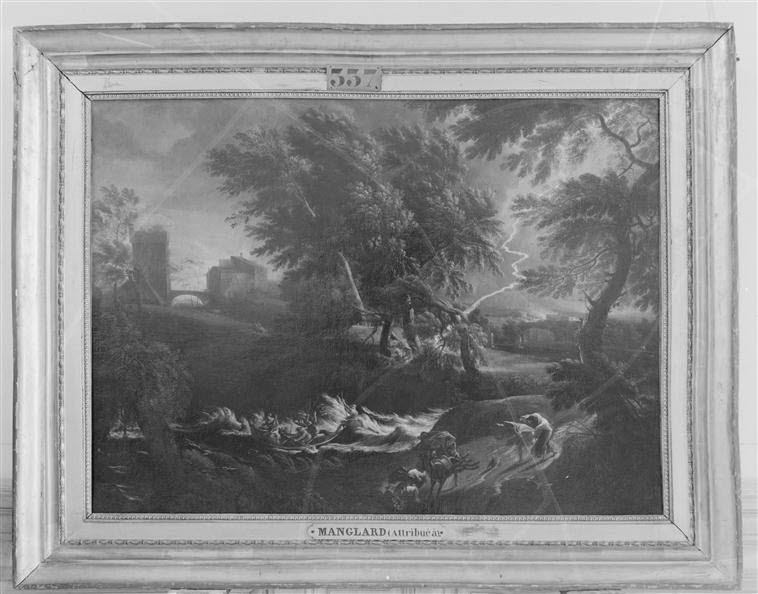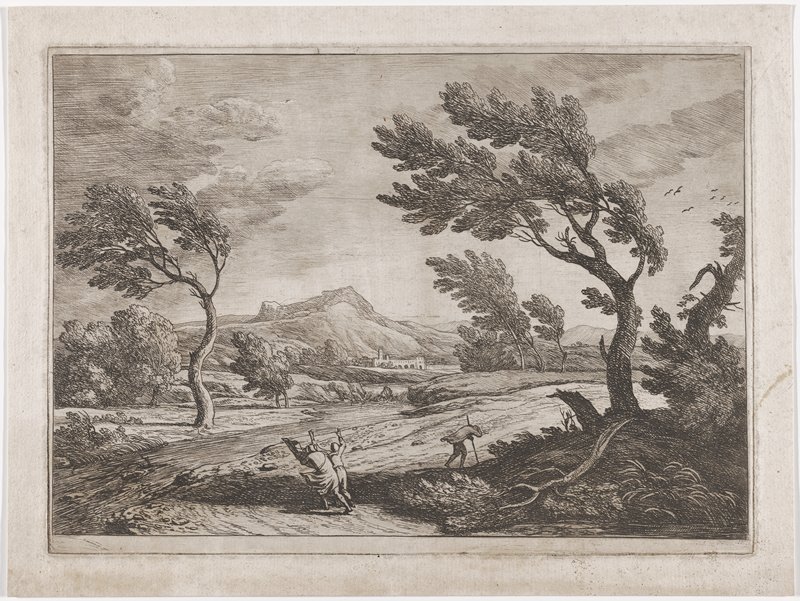
L'Ouragan (The hurricane)
Si può vedere?
Non esposta al momento
Dove si trova «L'Ouragan (The hurricane)» oggi? Collezione: Minneapolis Institute of Art, Minneapolis. Non esposta al momento. Verificato 29 settembre 2026.

Minneapolis, Stati Uniti
Appartiene alla collezione, ma al momento non è esposta.
- Verificato
- Ultimo cambio di stato
- Fonte
- Il museo
Sull’opera
A powerful wind sweeps through this country landscape. Trees and bushes bend before it. A branch has broken from the tree at right and has fallen, partially into the country road. The clothes of travelers billow up. A subtle, changable light animate the sky. Close inspection reveals that Adrien Manglard worked hard to achieve his effects. His etched lines are of varying thicknesses, suggesting that he has used stop-out varnish to vary the exposure of his copper plate to the stching acid. To gain even finer lines, he has mechanically abraded the surface of the copper and then burnished it to vary the texture. He has left the large building at the foot of the mountain as the single brightest highlight in the image, a way of underscoring the one place where the travelers can find protection from the elements.
Minneapolis Institute of Art
Scheda
- Numero di inventario
- 2021.69.24
In catalogo
Fonti
- Minneapolis Institute of Art
- Immagine: Minneapolis Institute of Art — public domain
Nella vita di Adrien Manglard
Tutta la vita1710s (probably c. 1715)
Moves to Rome
Having trained in Lyon under the Dutch landscapist Adriaen van der Cabel, and then, after moving to Marseille or Avignon, under the Carthusian painter Joseph Gabriel Imbert, from whom he learned figure painting, Manglard moves to Rome, where he will spend most of his life. He comes simply as a “tourist”, without the protection of the French Academy; the exact date is unknown, but it is certainly before 1722.
1715–1760 · Luogo di lavoro
Rome
from the mid-1720s
Patronage of Rome’s leading families
He enjoys the patronage of notable commissioners, among them the most important Roman families — the Colonna, the Orsini, the Rondani, the Rospigliosi and the Chigi. For the Chigi he frescoes two rooms on the piano nobile of the Palazzo Chigi, today the official residence of the Prime Minister of Italy, including the Sala delle Marine.
1726
Two matching paintings for the Savoy court
In the 1720s Manglard begins working for the Savoy court: in 1726 he sends two paintings from Rome, a matching pair bought by Victor Amadeus II, Duke of Savoy; they are now in the Galleria Sabauda in Turin.
1735 · Formazione
Accademia di San Luca
1 August 1760
Death in Rome
After a career in Italy that spanned over forty years, Manglard dies in Rome; he was also an art collector, and his universal successor is his brother Pierre, then living in Paris. His best-known pupil is arguably Claude-Joseph Vernet, and Philip, Duke of Parma, alone commissioned more than 140 paintings from him.