 Jusepe de RiberaSpagna, 1591–1652
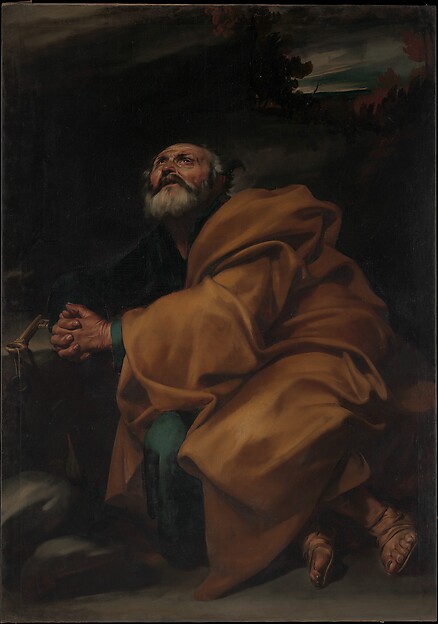
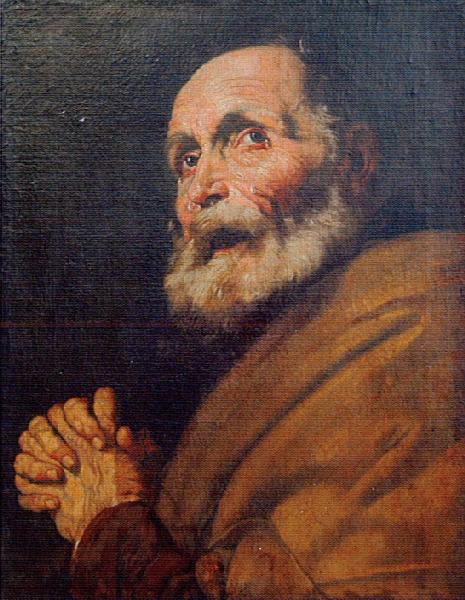
Les larmes de saint Pierre
Si può vedere?
Non si sa
Dove si trova «Les larmes de saint Pierre» oggi? Collezione: Musée des Beaux-Arts de Carcassonne, Carcassonne. Non si sa.
Carcassonne, Francia
Il proprietario è noto; non si sa se oggi sia esposta.
- Ultimo cambio di stato
- Fonte
- Il museo
Scheda
- Numero di inventario
- 892.1.198
Che cosa raffigura
In catalogo
Fonti
- Musée des Beaux-Arts de Carcassonne
- Immagine: Musée des Beaux-Arts de Carcassonne — © Carcassonne, musée des beaux-arts; Ministère de la Culture (France), base Joconde
Nella vita di Jusepe de Ribera
Tutta la vitanot after 1613 (possibly from 1606)
Sets out for Italy to study the old masters
Probably no later than 1613, perhaps as early as 1606, Ribera leaves for Italy to study the paintings of the old masters: first north to Cremona, Milan and Parma, then to Rome, where he gets to know the work of Guido Reni and Ludovico Carracci. Other accounts allow that he may have been there as early as 1605–09; he never returns to Spain.
late 1616
The permanent move to Naples
In late 1616 Ribera moves to Naples, then ruled by Spain, for good — according to Mancini, to escape his creditors, since he lived beyond his means despite a high income. Many of his paintings will be taken back to Spain by returning Spaniards, but he himself never goes back.
late 1620s
Recognised as Naples's leading painter
Ribera's career picks up in the late 1620s, and he is accepted as the leading painter in Naples thereafter; he runs a workshop with many pupils, among them Francesco Fracanzano, Luca Giordano, Bartolomeo Passante and Hendrick de Somer.
1630
Velázquez visits Ribera in Naples
In 1630 Diego Velázquez visits Ribera in Naples — evidence of how well known the master was in his homeland.
1647–1648
The uprising against Spain: refuge in the palace
During the uprising against Spanish rule in 1647–48 Ribera and his family take refuge in the Viceroy's palace.
3 settembre 1652
Died