 Sérusier, PaulDanimarca, 1864–1927
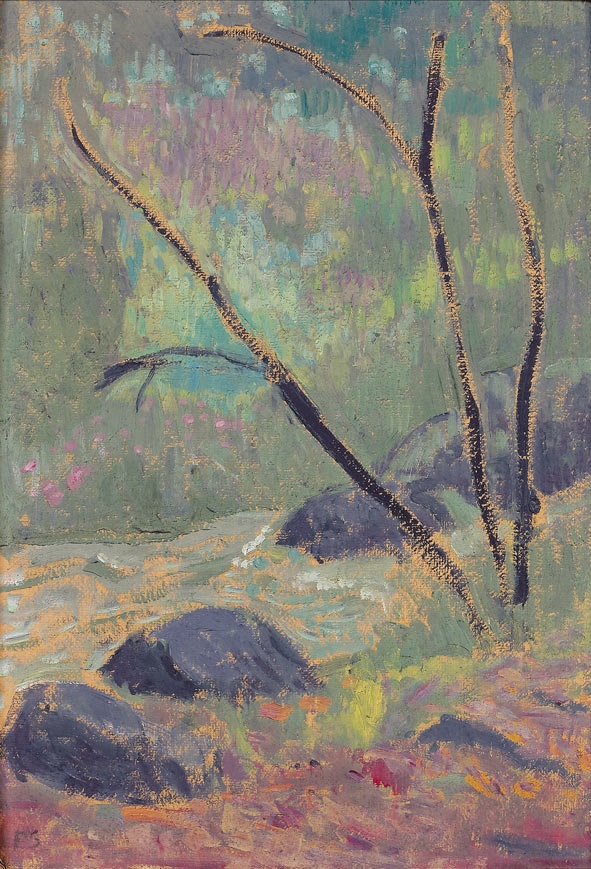
Le Huelgoat (Finistère)
Si può vedere?
Non si sa
Dove si trova «Le Huelgoat (Finistère)» oggi? Collezione: Musée d'art et d'histoire de Meudon, Meudon. Non si sa.
Meudon, Francia
Il proprietario è noto; non si sa se oggi sia esposta.
- Ultimo cambio di stato
- Fonte
- Il museo
Sul dipinto
Con le parole del museo — in francese
Paul Sérusier devient, vers 1889, le théoricien du groupe des Nabis regroupant Edouard Vuillard, Pierre Bonnard, Maurice Denis, Emile Bernard et Félix Vallotton. Ces artistes sont à la recherche de la spiritualité à travers l’art. Cultivé, passionné de doctrines théosophiques, Paul Sérusier se lie d’amitié avec Paul Gauguin avec qui il partage une vision commune de l’art. Ce petit tableau, exécuté au Huelgoat, se caractérise par une palette sourde ainsi que par un graphisme fortement marqué.
Musée d'art et d'histoire de Meudon
Scheda
- Numero di inventario
- 2006-3-20
Che cosa raffigura
In catalogo
Fonti
- Musée d'art et d'histoire de Meudon
- Immagine: Musée d'art et d'histoire de Meudon — ; Ministère de la Culture (France), base Joconde
Nella vita di Sérusier, Paul
Tutta la vita1889
Living with Gauguin at Le Pouldu
He visits Gauguin in Brittany several times and in 1889 settles with him at Le Pouldu for a long stay; from an academic student he becomes a modern painter.
1889
Meeting Filiger and de Haan
At Le Pouldu he meets other artists — Charles Filiger and the Dutchman Meijer de Haan.
early 1890s
Ideologist of the Nabis and a central figure of the early 1890s
He leads a whole movement, and many discoveries of Gauguin, who has left for Oceania, are attributed to him; the Nabis group (its name from the Hebrew word for “prophet”) proclaims a program of painterly Symbolism: emotions and symbols can be conveyed through the relationships of forms. The critic Albert Aurier calls him the first among the young artists in his article “The Symbolists” and promises him a great future.
1892
Meeting Charles Mackie
He meets and befriends the Scottish artist Charles Hodge Mackie while Mackie and his wife are honeymooning in France.
1895
Travels in Italy and Germany with Maurice Denis
Travelling through Italy and Germany with Maurice Denis, he is among the first European artists to discover the special beauty of the Italian and German primitives, finding in them expressive power and originality of decorative solutions.
1895
“Pastorale Bretonne” in The Evergreen
His friendship with Mackie leads him to contribute the illustration “Pastorale Bretonne” to “The Evergreen: A Northern Seasonal: The Book of Spring”, published by Patrick Geddes and colleagues in Edinburgh.