 Pietro PeruginoItalia, 1448–1523
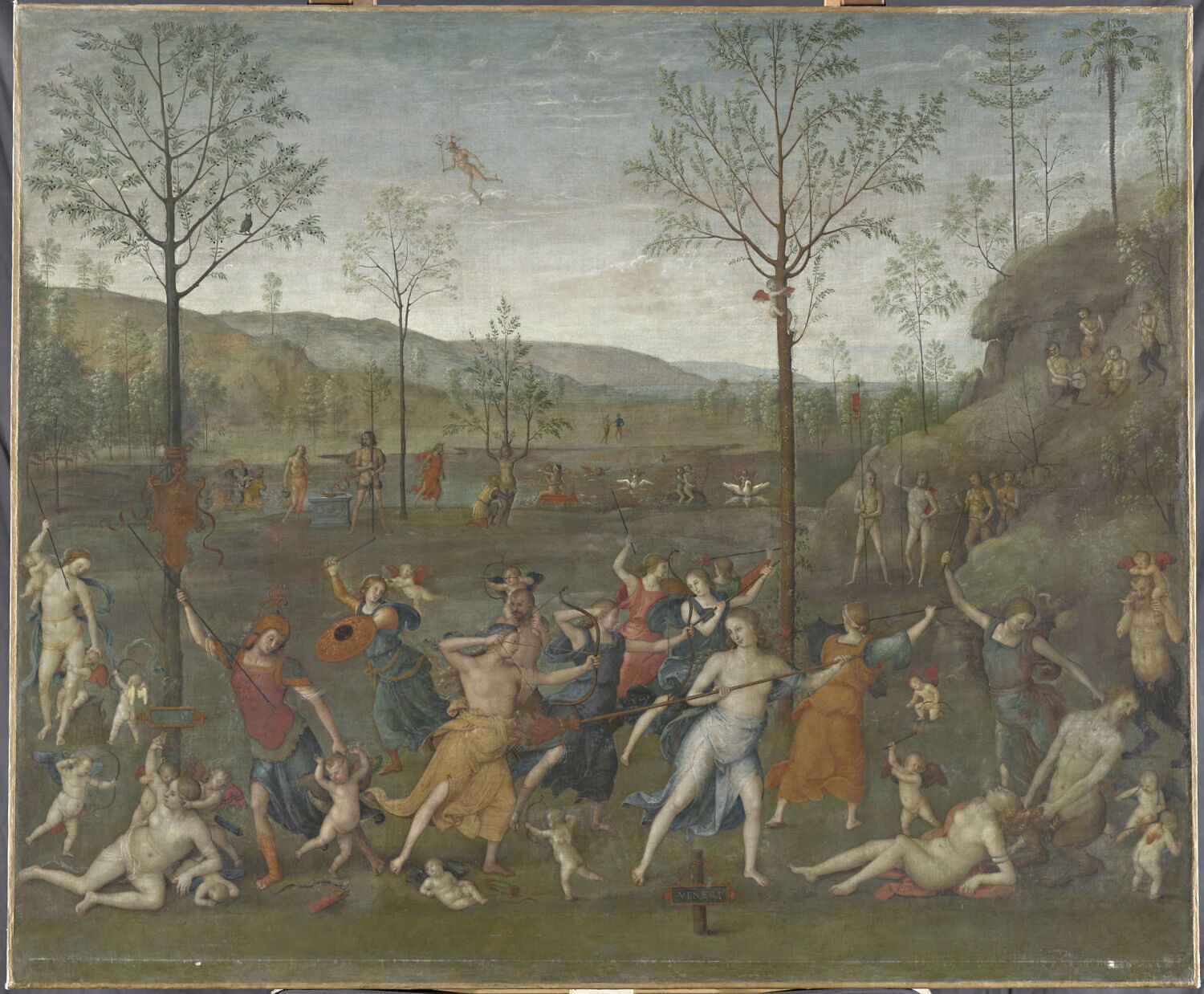
Le Combat de l'Amour et de la Chasteté
Si può vedere?
Sì, esposta ora
Dove si trova «Le Combat de l'Amour et de la Chasteté» oggi? Museo del Louvre, Salle 710, Aile Denon, Niveau 1, Parigi. Sì, esposta ora. Verificato 26 settembre 2026.

Chiuso· apre alle 9:00
Esposta al pubblico.
- Verificato
- Ultimo cambio di stato
- Fonte
- Il museo
Sul dipinto
La Lotta tra Amore e Castità è un dipinto tempera su tela (160x191 cm) di Pietro Perugino, datato 1503 e conservato nel Museo del Louvre a Parigi. Fu originariamente dipinta per lo studiolo di Isabella d'Este nel Castello di San Giorgio a Mantova.
Scheda
- Numero di inventario
- INV 722
In catalogo
Fonti
- Museo del Louvre
- Immagine: Museo del Louvre — © 2025 GrandPalaisRmn (musée du Louvre) / Didierjean/Chan-Liat
Nella vita di Pietro Perugino
Tutta la vita1486–1499
Two studios: in Florence and in Perugia
Between 1486 and 1499 Perugino works mainly between Florence and Perugia, maintaining a studio in each city. In the 1480s and 1490s he is one of the most celebrated artists of Italy.
1504
On the commission to site Michelangelo's “David”
Perugino sits on the commission of artists charged with choosing the site for Michelangelo's David.
1506
Leaving Florence for good
After a series of failures and the loss of his pupils, Perugino leaves Florence for good in 1506 and goes to Perugia, and from there, a year or two later, to Rome.
1507–1508
Julius II summons him to Rome: the Stanza dell'Incendio
Pope Julius II summons Perugino to paint the Stanza dell'Incendio del Borgo in the Vatican, but soon prefers a younger competitor, Raphael, who had been trained by Perugino. Perugino manages to paint the ceiling with figures of God the Father in different glories in five medallions.
1523
Death from the plague; the grave unknown
Perugino dies of the plague at Fontignano; like other plague victims he is hastily buried in an unconsecrated field, the precise spot now unknown. He dies with considerable property, leaving three sons.
1523
Died