Jacob Isaacksz. van RuisdaelPaesi Bassi, 1628–1682
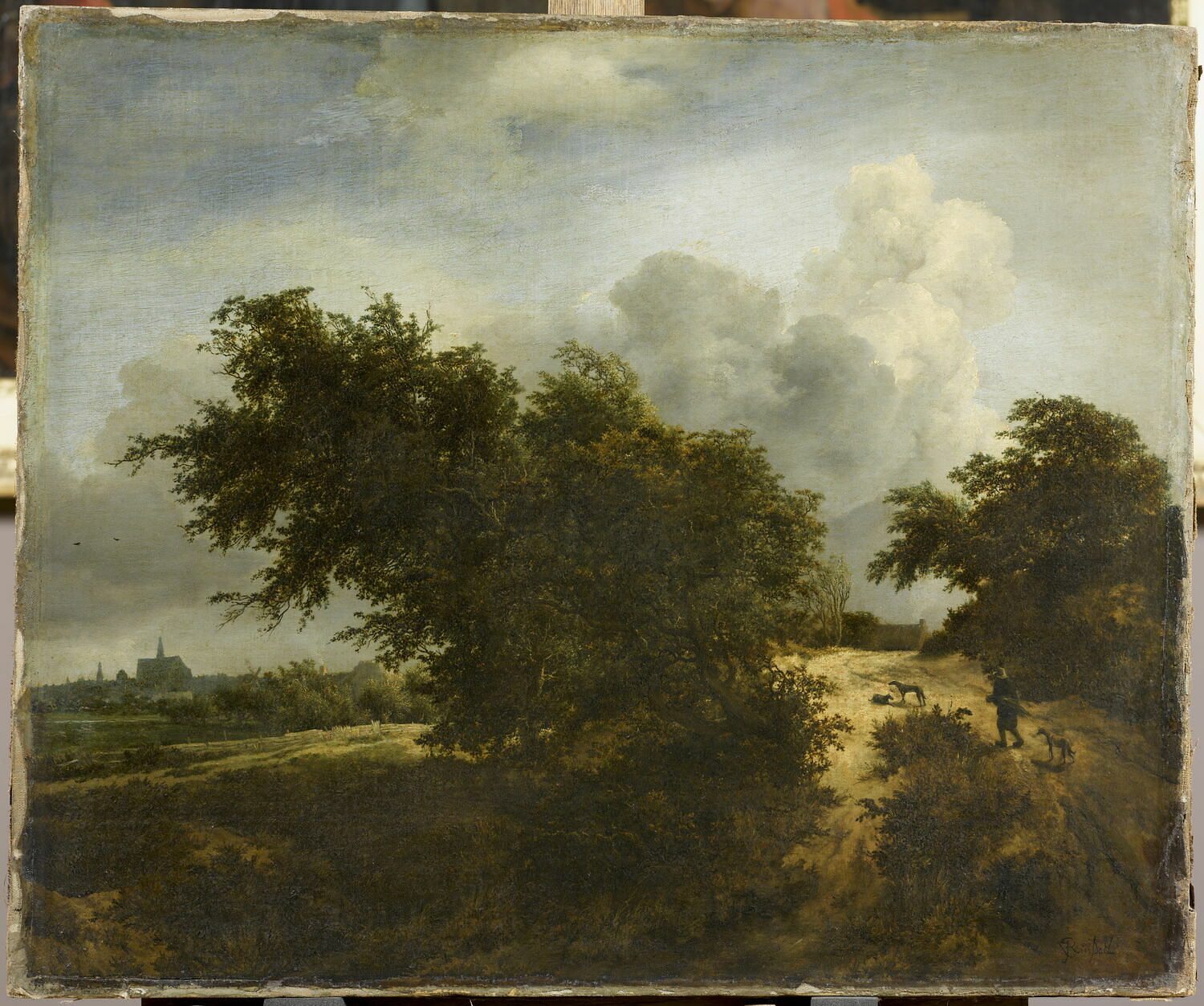
Landscape with a Wheatfield
Si può ammirare?
Sì, esposta ora
Dove si trova «Landscape with a Wheatfield» oggi? Getty Museum, Museum South Pavilion, Gallery S106, Los Angeles. Sì, esposta ora. Verificato 5 ottobre 2026.
Esposta al pubblico.
- Verificato
- Ultimo cambio di stato
- Fonte
- Il museo
Sul dipinto
Tended by a single, small harvester, a rolling field of golden grain sways gently under a dramatic sky of billowing clouds. In the center, a solitary figure approaches along a winding path. A farmhouse and the steeple of a church can be seen in the far distance. In a poetic, yet convincing manner, Jacob van Ruisdael captured the changing effects of light passing through clouds and the play of sunlight and shadow across the earth. He contrasts the uncut wheat in the field and the newly bound sheaves on the right, the broad expanse of blue sky above and the low, yellow fields below. Dwarfed by their surroundings, the small figures convey the insignificance of humanity in the face of nature.
Getty Museum
Scheda
- Numero di inventario
- 83.PA.278
In catalogo
Fonti
- Getty Museum
- Immagine: Getty Museum — Open Content
Nel frattempo, nella vita di Jacob Isaacksz. van Ruisdael
Tutta la vita1640s
Trips to Blaricum, Egmond aan Zee and Rhenen
For a landscape painter Ruisdael travelled little: in the 1640s he visited Blaricum, his grandfather's home village, Egmond aan Zee and Rhenen.
1650
Journey to Germany with Nicolaes Berchem
With Nicolaes Berchem, one of the painters who would later add figures to his landscapes, Ruisdael travels to Bentheim and Steinfurt, just across the German border (other accounts date the trip to Westphalia to around 1650). Afterwards his landscapes take on a more heroic character, with larger and more prominent forms.
1653
Almost stops dating his paintings
For unknown reasons Ruisdael almost entirely stops dating his work from 1653: only five works of the 1660s bear a partially obscured year, and none from the 1670s and 1680s. Dating his later pictures therefore rests largely on detective work and speculation.
c. 1657
Moves to Amsterdam
Ruisdael moves to prosperous Amsterdam, which likely offered a bigger market for his work: his fellow Haarlem painter Allart van Everdingen had already moved there and found buyers. He lived there for the rest of his life (other accounts date the move to 1657).
17 June 1657
Baptised at Ankeveen
On 17 June 1657 Ruisdael was baptised at Ankeveen, near Naarden. His uncle Salomon belonged to the Mennonite congregation of Haarlem, as his father probably did too.
1668
Witness at the wedding of his pupil Meindert Hobbema
In 1668 Ruisdael witnesses the marriage of Meindert Hobbema, his only registered pupil. He himself never married — according to Houbraken, to reserve time to serve his old father.