Camille Jacob PissarroFrancia, 1830–1903
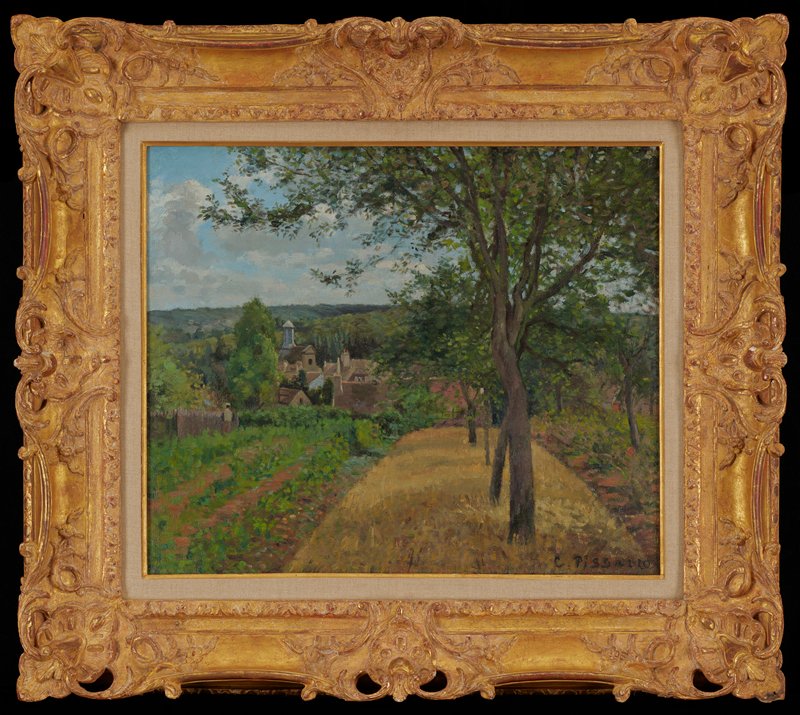
Landscape, Eragny
Si può vedere?
Sì, esposta ora
Dove si trova «Landscape, Eragny» oggi? Harvard Art Museums, Gallery 3500, floor 3, Special Exhibitions Gallery, Cambridge. Sì, esposta ora. Verificato 29 settembre 2026.

Esposta al pubblico.
- Verificato
- Ultimo cambio di stato
- Fonte
- Il museo
Scheda
- Numero di inventario
- 1943.395
In catalogo
Fonti
- Harvard Art Museums
- Immagine: Harvard Art Museums — © President and Fellows of Harvard College
Nella vita di Camille Jacob Pissarro
Tutta la vita1880s
A search for something new: peasant labour without idealisation
By the 1880s some Impressionists felt the movement had exhausted itself, and Pissarro returned to scenes of country life, showing people at work without idealising them; in 1882 Renoir called these works “revolutionary”.
1880s
Theo van Gogh asks him to take in Vincent
The art dealer Theo van Gogh asked Pissarro whether he would take his elder brother Vincent as a lodger in his house; according to his son Lucien, Pissarro was impressed by Van Gogh's work, foresaw his fame and explained to him different ways of seeking and expressing light and colour.
1884
Settles at Éragny-sur-Epte
In April 1884 Pissarro and his family settled at Éragny-sur-Epte, a village near Gisors, where he lived for the rest of his life; he wrote to his son Lucien that the house was superb, with a garden and meadows. The house, garden, orchard, meadows and farm workers became recurring subjects for the last nineteen years of his career.
1885–1888
Pointillism: working beside Seurat and Signac
In 1885 Pissarro came into close contact with Georges Seurat and Paul Signac, whose technique juxtaposed small strokes of relatively pure colour, and until 1888 he experimented extensively with it, regarding it not as a rejection of Impressionism but as a possible continuation of it; among the older Impressionists this was unusual.
late 1880s
Abandoning Neo-Impressionism
By the end of the 1880s Pissarro found the method of divided colour too restrictive: it made it hard to respond freely to changing effects of nature, movement and personal sensation; what remained from the experiment was a heightened attention to colour relationships and a more structured handling of the surface.
1892
Buying the house at Éragny with Monet's help
When the Éragny house the Pissarros were renting was offered for sale in 1892, his old friend Claude Monet, who lived nearby at Giverny, agreed to make up to 15,000 francs available, helping Pissarro and his wife Julie buy it.