 Robert RauschenbergStati Uniti, 1925–2008
Landmark
Si può ammirare?
Al momento non riceve

Minneapolis Institute of Art
Minneapolis, Stati Uniti
Appartiene alla collezione, ma al momento non è esposta.
- Verificato
- l’altro ieri
- Ultimo cambio di stato
- 25 set 2026
- Fonte
- I dati di collezione del museo stesso
Sull’opera
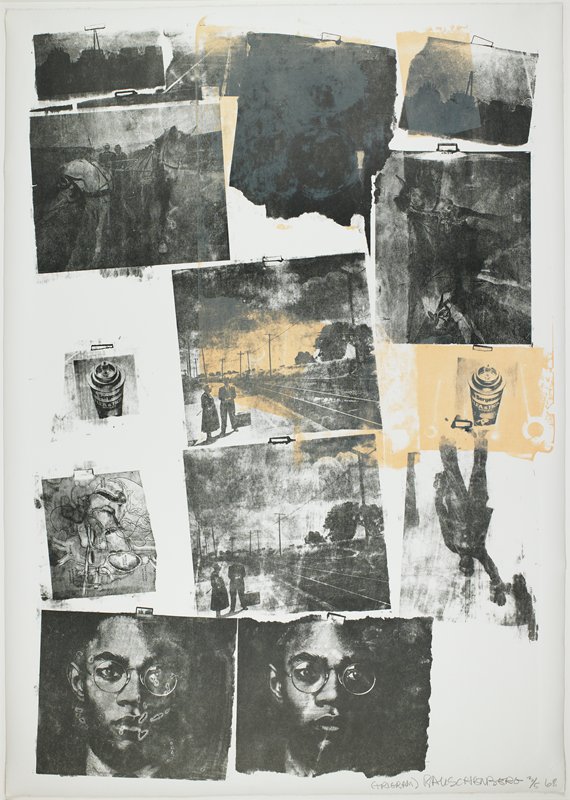
In composing Landmark, Rauschenberg assembled various photographic images clipped from popular news magazines, including several from the August 2, 1968 issue of Life magazine. Using a technique known as solvent transfer, he prepared his composition by arranging the magazine clippings facedown on a limestone printing matrix. He then brushed solvent (such as turpentine) on the reverse side of the images, which dissolved the ink present in the clippings and deposited it directly onto the limestone in the exact proportion of the original images. After transfering images to the matrix, the lithographic stone is prepared for printing in the normal manner. In this procedure, the original magazine images are reversed twice, once during the solvent transfer process and again during final printing, thus allowing the magazine images to appear in their original orientation.
Read on
For this photographic assemblege, Rauschenberg included pictures of train travel in America, Soviet Army activities in Czechoslovakia during the Cold War, and a then-groundbreaking heart transplant operation. In juxtaposing seemingly unrelated images, Rauschenberg invites viewers to draw their own understanding and conclusions about the work, using personal experiences, memories, and their imaginations to find meaning.
Minneapolis Institute of Art
Scheda
- Numero di inventario
- 2008.54.2
In catalogo
Fonti
- Minneapolis Institute of Art: the museum's own open data · acquisita 5 giorni fa
- Immagine: Minneapolis Institute of Art — Robert Rauschenberg, Landmark, 1968 © Robert Rauschenberg Foundation
Nel frattempo, nella vita di Robert Rauschenberg
Tutta la vita1966
Founds E.A.T. with Billy Klüver
For “9 Evenings: Theatre and Engineering” at New York's 69th Regiment Armory Rauschenberg created the performance Open Score. The series was instrumental in the formation of Experiments in Art and Technology (E.A.T.), a non-profit for collaborations between artists and engineers which he and the Bell Laboratories scientist Billy Klüver officially launched in 1966.
27 giugno 1968 – 6 ottobre 1968
Exhibition: 4. documenta
26 July 1968
Buys a house on Captiva Island
On 26 July 1968 Rauschenberg bought the Beach House, his first property on Captiva Island off the Florida coast, though it did not become his permanent home until the autumn of 1970. Other accounts date the purchase to 1970.
1969
Watches the Apollo 11 launch at NASA's invitation
NASA invited Rauschenberg to witness the launch of Apollo 11. In response he created his “Stoned Moon” series of lithographs, combining diagrams and images from NASA's archives with his own drawings and handwritten text.
autumn 1970
Moves to Captiva for good
From the autumn of 1970 the Captiva house became Rauschenberg's permanent home and studio. The first works made there were the “Cardboards” (1971–72) and “Early Egyptians” (1973–74) series, from locally sourced cardboard and sand: instead of urban imagery he now favoured the natural fibres of fabric and paper.
1970
Sets up Change, Inc. to help artists
Rauschenberg created Change, Inc., a programme awarding one-time emergency grants of up to $1,000 to visual artists in financial need.