Jean-Antoine WatteauFrancia, 1684–1721
La Surprise
Si può vedere?
Sì, esposta ora
Dove si trova «La Surprise» oggi? Getty Museum, Museum South Pavilion, Gallery S203, Los Angeles. Sì, esposta ora. Verificato 5 ottobre 2026.
Aperto· fino alle 20:00
Esposta al pubblico.
- Verificato
- Ultimo cambio di stato
- Fonte
- Il museo
Sul dipinto
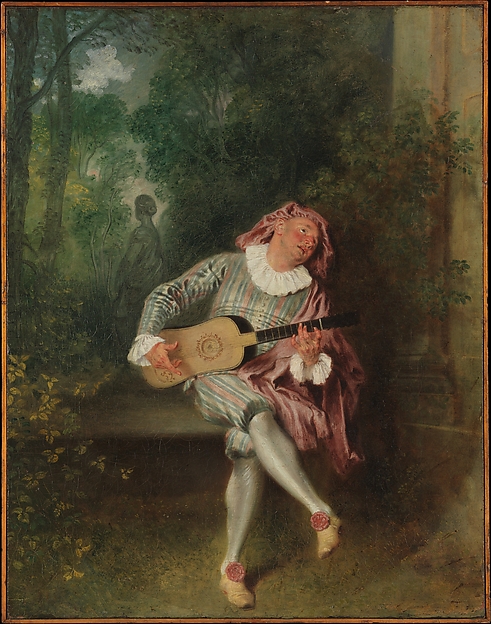
In a verdant park at sunset, a young woman abandons herself to her tousle-haired companion’s ardent embrace. Coiled up in a pose of centrifugal energy, the impulsive lovers are oblivious to the third figure: Mezzetin, sitting on the same rocky outcrop. Drawn from the theatrical tradition of the commedia dell’arte, this character represents a poignant foil to the couple’s unbridled passion. Introverted and with a melancholy air, he tunes his guitar, knowing that his serenading will mean nothing to the lovers and serve only to heighten his own sense of lonely longing as he gazes upon them. His costume, a rose-coloured jacket and knee-britches slashed with yellow and adorned with blue ribbons as well as a lace ruff and cuffs, is reminiscent of the paintings of Anthony van Dyck. The small dog at lower right, a quotation from Rubens, watches the couple with considerably more appreciation than Mezzetin can muster.
Getty Museum
Scheda
- Numero di inventario
- 2017.72
In catalogo
Fonti
- Getty Museum
- Immagine: Getty Museum — Open Content
Nella vita di Jean-Antoine Watteau
Tutta la vita1710s
Meets Edme-François Gersaint
At Sirois's house Watteau meets his son-in-law, the art dealer Edme-François Gersaint, who soon becomes a close friend.
1710s
Tuberculosis sets in
Watteau's fame grows steadily, yet he is as a rule dissatisfied with everything that comes from his brush; at the same time he develops a serious illness, tuberculosis.
28 August 1717
Elected to the Academy: a “fête galante”
By 1717 Watteau's “gallant scenes” have had such wide success that an exception is made for his reception piece, “Pilgrimage to Cythera”: in the minutes the words “pilgrimage to Cythera” are struck out and replaced by “fête galante”. Watteau is elected a full member of the Academy; the ceremony is attended by the First Painter to the King, Antoine Coypel, by Claude Gillot and by the Regent, the Duke of Orléans.
late 1719 – summer 1720
To London, to see Dr Richard Mead
Watteau's health is failing, and he goes to England at the invitation of Philippe Mercier, an admirer and imitator, hoping to overcome tuberculosis with the help of the well-known physician Richard Mead. The treatment brings no noticeable result and the London climate only aggravates his condition; he returns to Paris in summer 1720, gravely ill.
spring 1721
Moves to Nogent-sur-Marne
In spring Watteau's condition worsens; he leaves Gersaint's house but soon asks for help again, since he finds it hard to breathe in Paris. His friend the Abbé Pierre-Maurice Haranger asks Philippe Le Fèvre, the steward of the king's minor entertainments, to make available an empty house with a garden on the edge of Nogent-sur-Marne, far from the stuffiness and bustle of the capital.
18 luglio 1721
Died