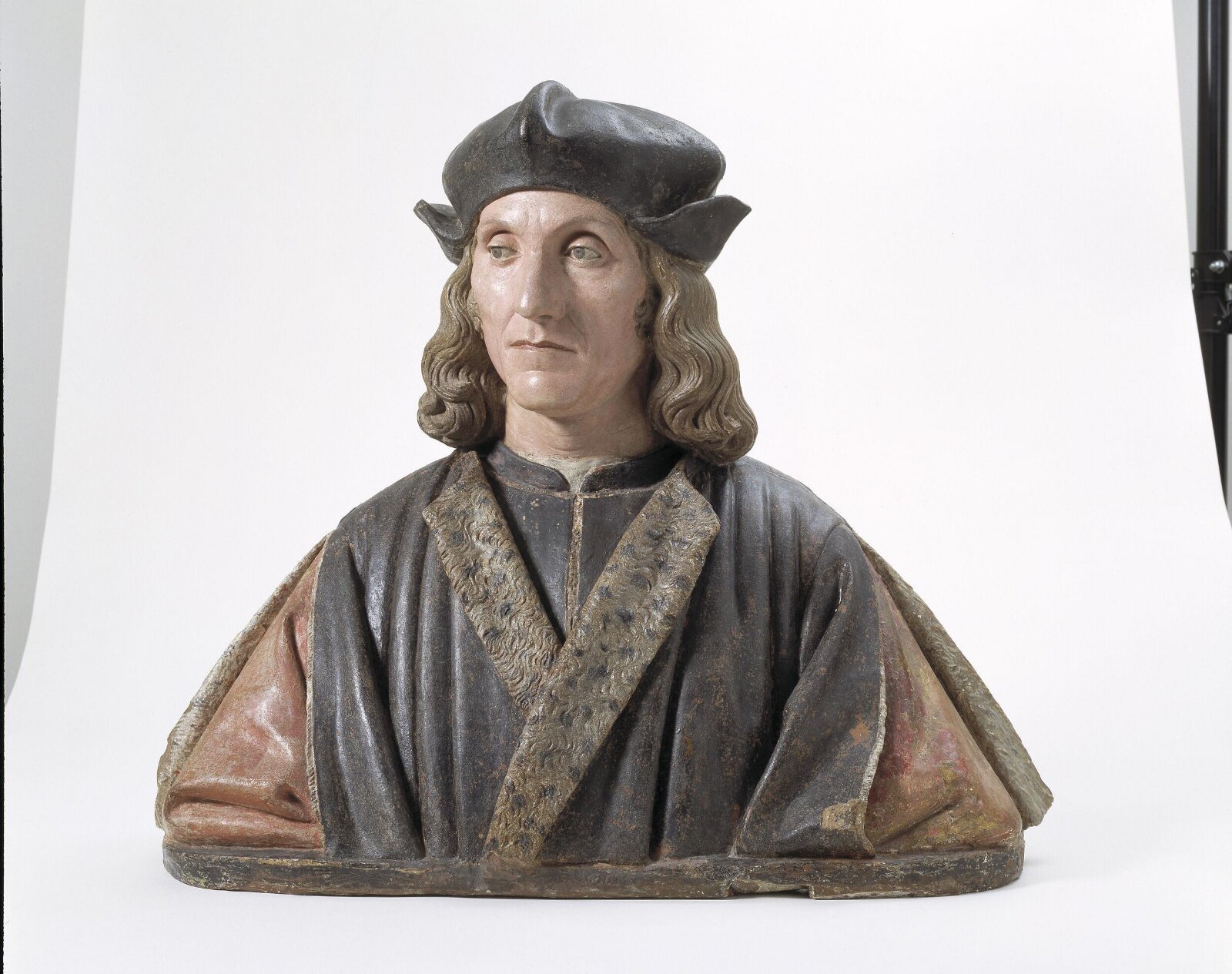
 Pietro TorrigianoItalia, 1472–1528
King Henry VII
Si può vedere?
Sì, esposta ora
Dove si trova «King Henry VII» oggi? Victoria and Albert Museum, British Galleries, Room 58, Londra. Sì, esposta ora. Verificato 25 settembre 2026.

Aperto· fino alle 22:00
Esposta al pubblico.
- Verificato
- Ultimo cambio di stato
- Fonte
- Il museo
Sulla scultura
Pietro Torrigiano was one of the first Italian sculptors to work in England. While training in a Florentine workshop, Torrigiano was said to have broken fellow apprentice Michelangelo Buonarroti’s nose during a dispute. Consequently, Torrigiano left Florence around 1490 to 1492, training and working in other Italian cities before working for royal courts across Europe (See Darr 1992, 'New Documents'). Torrigiano likely arrived in London around 1509, working in the city until 1519-22.
Leggi
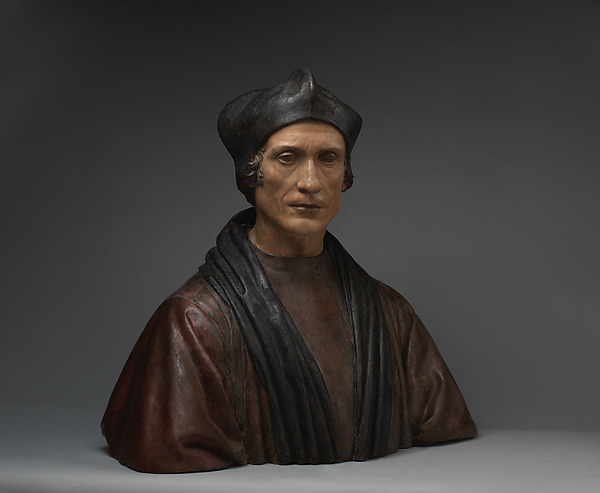
This painted terracotta bust of King Henry VII is one of the first works Torrigiano sculpted in London. It was probably produced at the same time as two other busts of similar style and dimensions, also attributed to Torrigiano, now in the Metropolitan Museum of Art in New York. Those busts represent a bishop (probably John Fisher) and a Florentine merchant (possibly Giovanni Cavalcanti); the latter was previously identified as Henry VIII as a young adult (for recent discussion of the group see Elizabeth Cleland in Cleland and Eaker 2022).
All three busts may have been commissioned by Fisher, the executor of Lady Margaret Beaufort’s will, or Cavalcanti, one of Torrigiano’s patrons, to demonstrate Torrigiano’s skill and win the commission for the tomb of Lady Margaret in Westminster Abbey in 1511 (Elizabeth Cleland in Cleland and Eaker 2022).
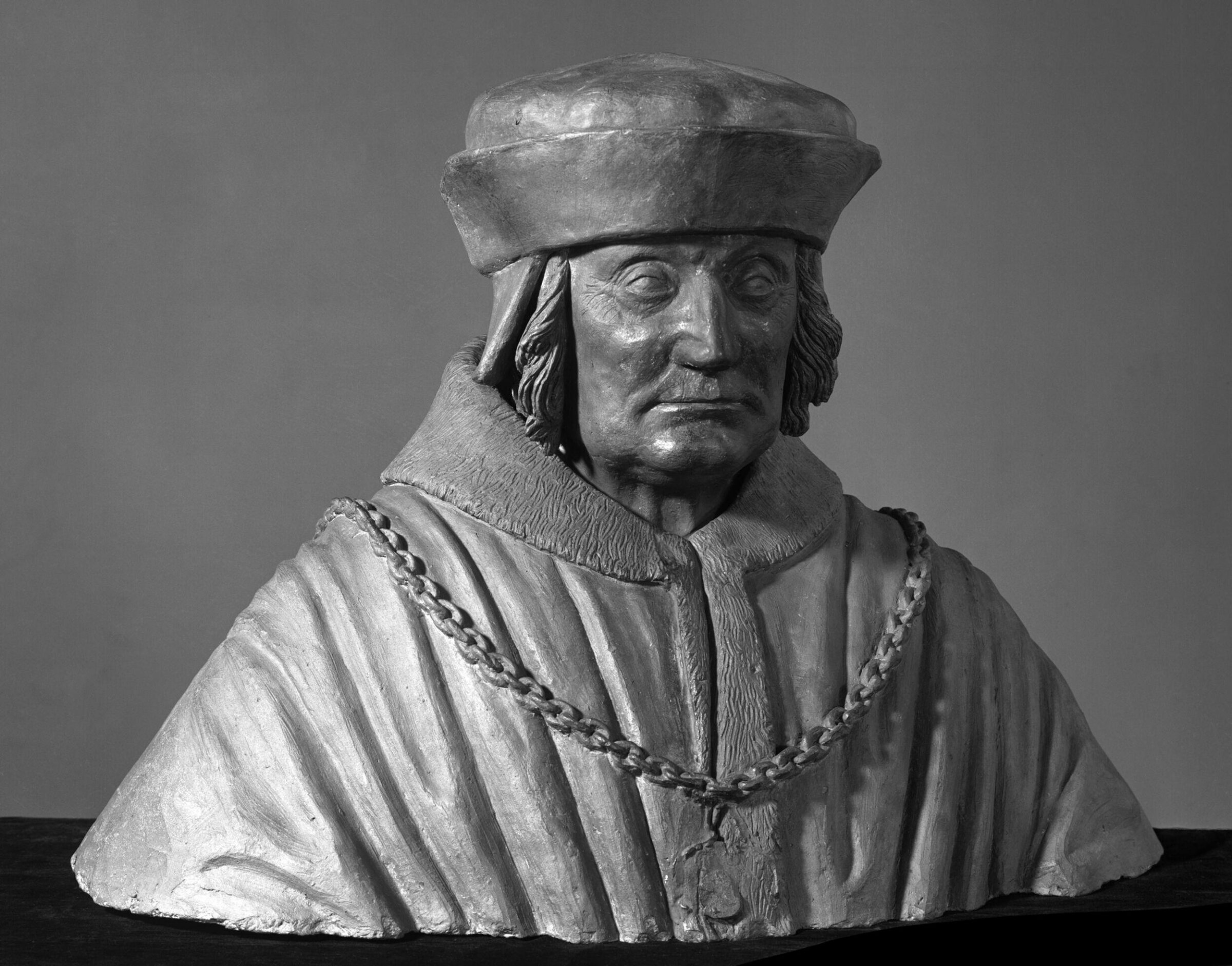
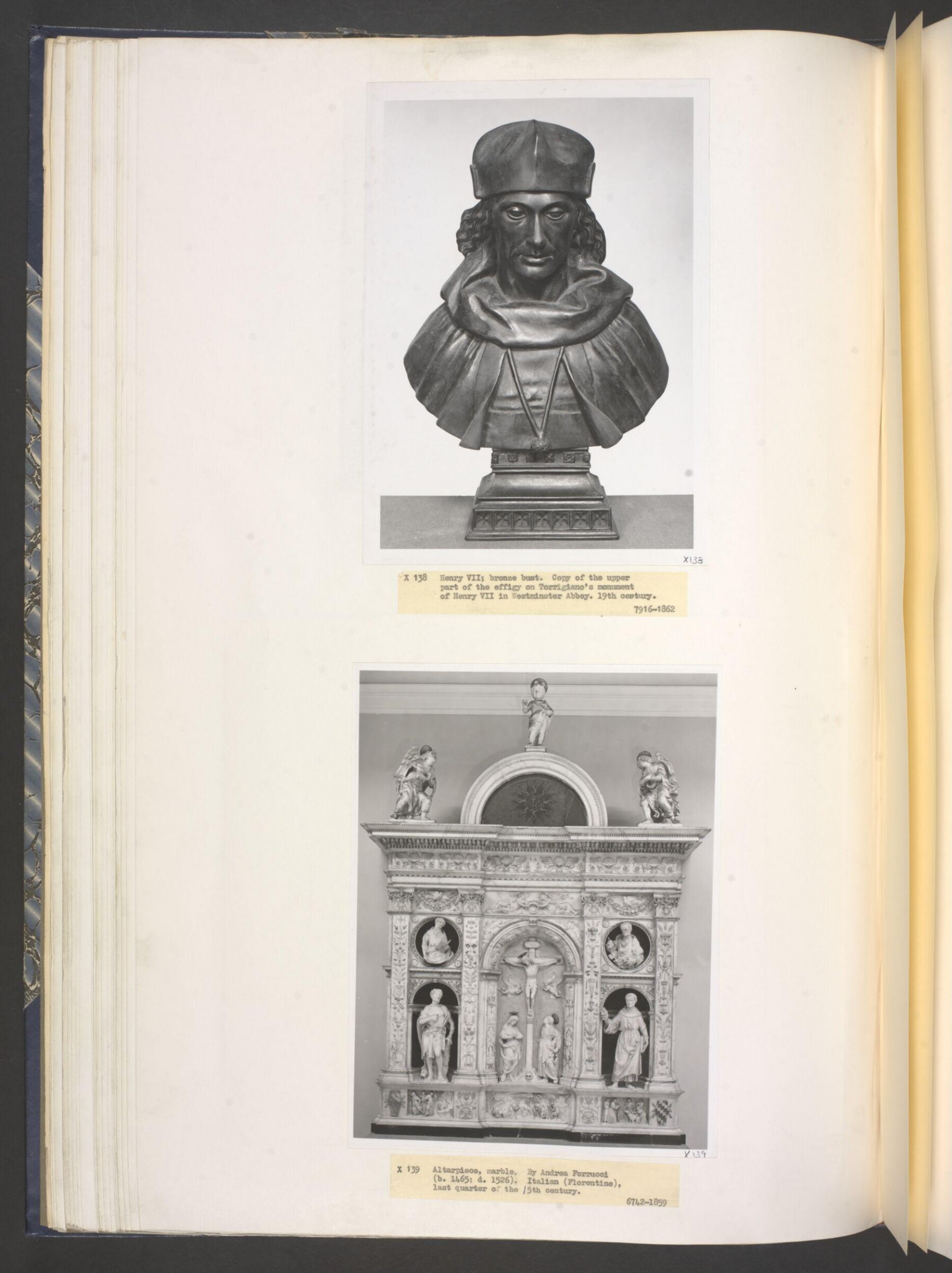
The Henry VII bust closely resembles the funeral effigy of Henry VII from Westminster Abbey, also attributed to Torrigiano, which is known to have been cast from a mould of the king’s death mask. The nearly identical measurements of the bust and effigy indicate both faces were cast from the mask mould. Torrigiano enlivened the bust by smoothing out the king’s features and fleshing out the cheeks, which would appear hollow if not adjusted from the death mask. The entire bust was likely produced from moulds, with minimal modelling.
Since terracotta shrinks during firing, it is difficult to produce a likeness from a face mask that retains its real proportions. This bust attests to Torrigiano’s deep knowledge of terracotta sculpture techniques, as it is near-life size. To mitigate shrinkage, grog (bits of fired clay) was added. The clay also has a higher silica (quartz) content than was normal, possibly from the addition of sand, which would have made the clay less plastic and therefore less likely to shrink (Boucher et al. 1996).
The first recorded repairs to the bust, carried out by sculptor John Flaxman, date to 1769. The bust had broken into seven pieces and was reassembled with beeswax and resin. The interior, which was hollowed out from the bottom to allow for even drying in the kiln, was filled by Flaxman with plaster and reinforced with sculptor’s tools (rifflers) and mutton bones, found when the plaster was removed during conservation at the V&A. The rifflers are still in the museum’s collection.
Grey overpaint was removed in 1928 at the V&A. After entering the collection in 1935, the bust underwent several further conservation campaigns. Earlier overpaint layers were removed from the face in the 1970s. Further overpaint removal and cleaning were carried out in the 1980s and 1990s. Jo Darrah conducted scientific analysis on paint samples in the 1970s and again in 1986.
The original polychromy was mostly well-preserved, revealing considerable differences between the original and repainted layers. The fur lining of the King’s coat, a symbol of his wealth and status, was overpainted white but was originally brown with black speckles, possibly in an effort to depict lynx.
Paint was applied over a white ground (priming layer applied over the entire surface), which was a common practice in the Renaissance. The bust was painted with pigment and glazes mixed with egg as a binding medium and some oil added to slow the drying time. The King’s hat and cloak are both painted with carbon black, but contain different pigments mixed in to give the appearance of different materials. The hat contains azurite to give a cooler tone, possibly mimicking felt, while the cloak contains red and green glaze, giving it a warmer hue.
The painting was likely carried out by a painter in London, as Renaissance polychrome sculptures were generally the result of collaborations. First sculpted in a sculptor’s workshop, they would then be sent to an artist’s workshop to be painted and gilded. The extent of collaboration and communication between sculptors and painters varied.
Last updated: 29/07/2025
Victoria and Albert Museum
Scheda
- Numero di inventario
- A.49-1935
Che cosa raffigura
In catalogo
Fonti
- Victoria and Albert Museum
- Immagine: Victoria and Albert Museum — © Victoria and Albert Museum, London