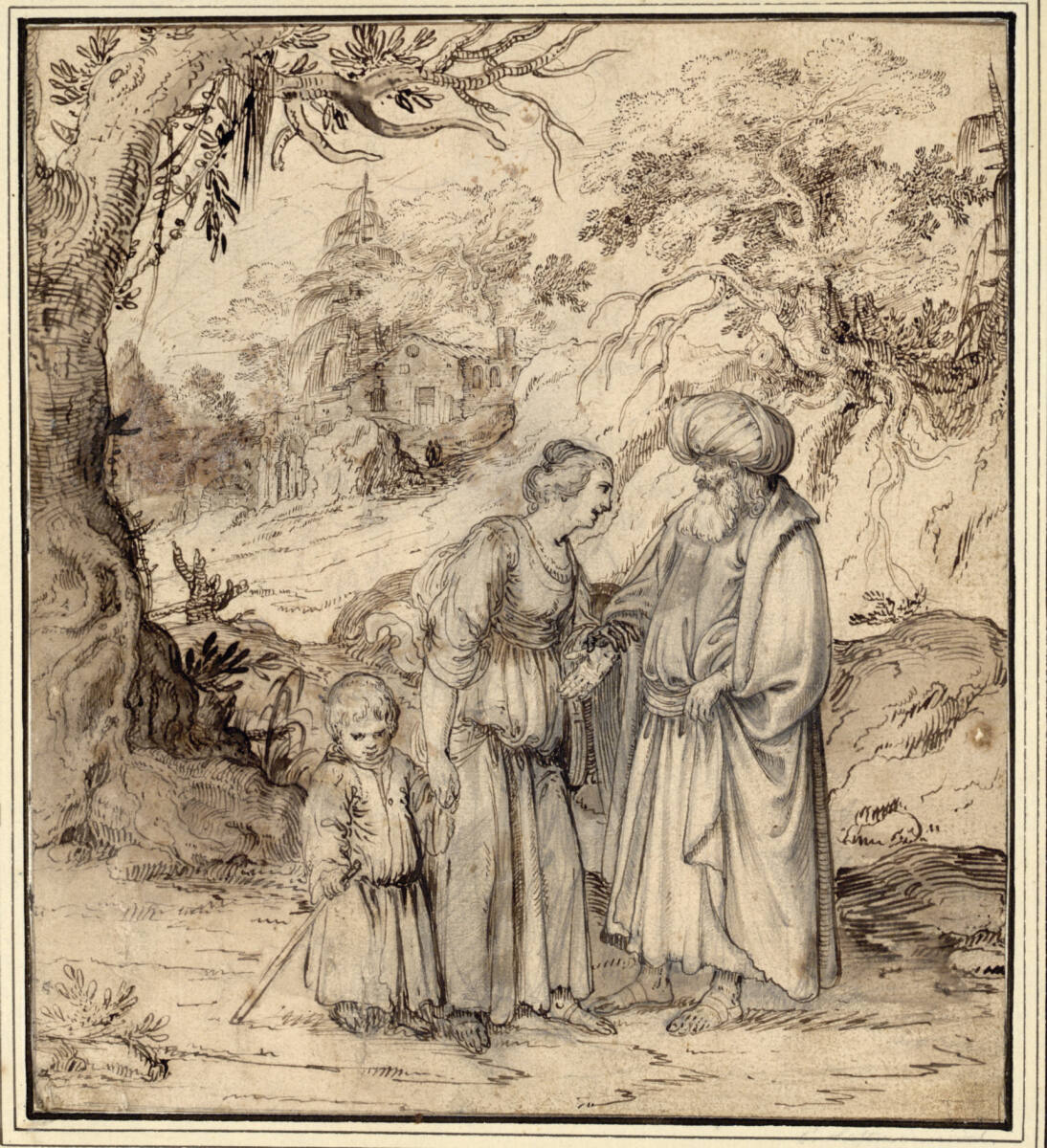
![[Juda und Tamar], Pieter Lastman, 1603–1633](https://diglib.hab.de/varia/haum/lastmann-p-p-v3-3319/max/000001.jpg)
[Juda und Tamar]
Si può vedere?
Non si sa
Dove si trova «[Juda und Tamar]» oggi? Collezione: Herzog Anton Ulrich-Museum, Braunschweig. Non si sa.

Braunschweig, Germania
Il proprietario è noto; non si sa se oggi sia esposta.
- Ultimo cambio di stato
- Fonte
- Il museo
Scheda
Che cosa raffigura
In catalogo
Fonti
- Herzog Anton Ulrich-Museum
- Immagine: Herzog Anton Ulrich-Museum — CC BY-NC-SA 4.0
Nella vita di Pieter Lastman
Tutta la vita1605
Sets out for Italy with Jan Symonsz Pynas
Having finished his training, in 1605 (by other accounts as early as 1603) he leaves for Italy with Jan Symonsz Pynas and Pynas’s brother, and for some time lives in Rome and Venice.
1605–1607
Encounters the work of Caravaggio
In Italy he becomes acquainted with the work of Caravaggio, which influences his individual style.
1618
Recognised as Amsterdam’s foremost painter
Having quickly won fame for his history and biblical pictures, he runs a large workshop and sells his works on the open market at good prices; in 1618 he is recognised as the most outstanding painter of his native Amsterdam. His pictures are biblical and mythological subjects set against idyllic Roman landscapes: “The Flight into Egypt”, “Odysseus and Nausicaa”, “Midas”, “The Raising of Lazarus”.
1625
Rembrandt studies in his workshop for half a year
In 1625 (by other accounts, in 1624) Rembrandt studies with him for six months; since Rembrandt never went to Italy, he quite probably took in Caravaggio’s influence and “Caravaggesque chiaroscuro” mainly or largely through this apprenticeship.
1632
Illness and a move to his brother’s
Never married, he moves in with his brother because of his health; the next year he dies, and on 4 April 1633 he is buried in the Old Church (Oude Kerk) in Amsterdam.
1633
Died