ART WIKI32.963 in sala
MappaCollezioneArtistiMuseiMostreRivista
Accedi

ART WIKI

Dove è appeso il capolavoro, e quando si può entrare.

Collezioni: Art Institute of Chicago, Cleveland Museum of Art, Ermitage, Galleria Tret'jakov, Getty Museum, Harvard Art Museums, Hirshhorn Museum and Sculpture Garden, Metropolitan Museum of Art, Minneapolis Institute of Art, Museo del Louvre, Museo Puškin delle belle arti, Museo russo, Museum of Modern Art, National Gallery of Art, National Museum of Asian Art, National Portrait Gallery, Rijksmuseum, Smithsonian American Art Museum, Statens Museum for Kunst, Victoria and Albert Museum, Villa Getty, Whitney Museum of American Art, Catalogo statale del fondo museale russo (274 musei), Europeana (19 musei), Wikidata (6 musei), Paris Musées (12 musei) e Joconde, la banca dati dei musei del Ministero della Cultura francese (495 musei). Le immagini appartengono ai titolari dei diritti.

Sezioni

  • Mappa
  • Ricerca
  • Collezione
  • Capolavori
  • Esposte ora
  • Artisti

Altro

  • Musei e gallerie
  • Mostre
  • Rivista
  • Da dove vengono i dati
  • Privacy e cookie
HomeMappaCatalogo
  1. Collezione/
  2. Minneapolis Institute of Art/
  3. Head Study (after Raphael)
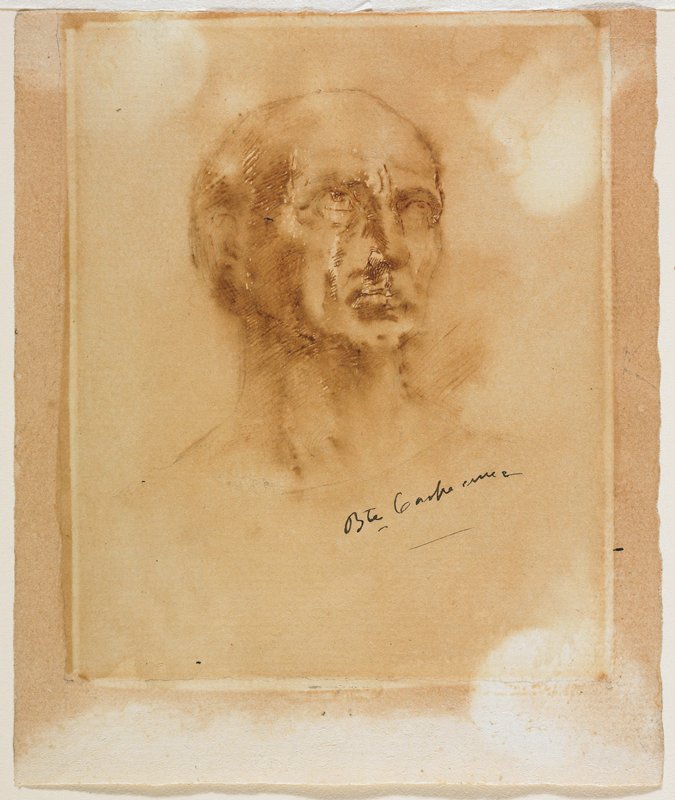
Head Study (after Raphael), Jean-Baptiste Carpeaux, c. 1840s
Jean-Baptiste Carpeaux, ritrattoJean-Baptiste CarpeauxFrancia, 1827–1875

Head Study (after Raphael)

c. 1840s · Drawing · 14.13 × 11.91 cm

Si può ammirare?

Al momento non riceve

Minneapolis Institute of Art

Minneapolis, Stati Uniti

Appartiene alla collezione, ma al momento non è esposta.

Verificato
3 giorni fa
Ultimo cambio di stato
25 set 2026
Fonte
Il museo
Sulla mappaPagina del museo

Sull’opera

This small head study by the great 19th-century French sculptor Jean-Baptiste Carpeaux is an exacting copy of a Raphael drawing, (identified by scholar Paul Joannides). Carpeaux devoted much of his early training to drawing, attending the Académie de Peinture, Sculpture, et Architecture in his hometown of Valenciennes as a boy, where drawing was the foundation of the curriculum, and the Ecole Gratuite de Dessin in Paris after his family moved there. At both institutions, Raphael's drawings were heralded as a model for students to study. With the expansion of lithography in the early 19th century, an inexpensive printing process that effectively mimics the drawn line, art schools in France increasingly taught students to draw by copying prints after master drawings rather than studying the master drawings firsthand.

Continua a leggere

It is possible in this instance, however, that Carpeaux had access to Raphael's original work, a small metalpoint drawing of about 1504-5, as it had belonged to the Frenchman Jean-Baptiste Wicar (1762-1834) who bequeathed the drawing along with the rest of his superb old master collection to the museum of Lille, a city not far from Carpeaux's native Valenciennes.

Raphael's small, affecting head study, perhaps related to a work depicting St. Jerome, is imbued with intense emotion, which Raphael deftly describes in the furrowed brow, upturned eyes, and pursed lips. This undoubtedly appealed to Carpeaux, an artist celebrated for creating dramatic, forcefully expressive sculptures that broke with tradition. Interestingly, a late self-portrait by Carpeaux, an oil sketch in the Musée des Beaux-Arts, Valenciennes, resembles the Raphael drawing the artist had copied decades earlier, utilizing the same bust-length format and showing his similarly balding head in three-quarters view. Carpeaux, however, depicts himself not looking up, like Jerome, in inspiration, but instead with downcast eyes and his face in shadow, so that the artist assumes a brooding, dark presence against the light support.

Minneapolis Institute of Art

Scheda

Numero di inventario
23.50.40

In catalogo

Disegni e acquerelliPennaFrancia

Fonti

  • Minneapolis Institute of Art
  • Immagine: Minneapolis Institute of Art — public domain
Altre opere di Jean-Baptiste Carpeaux

Tutte le opere
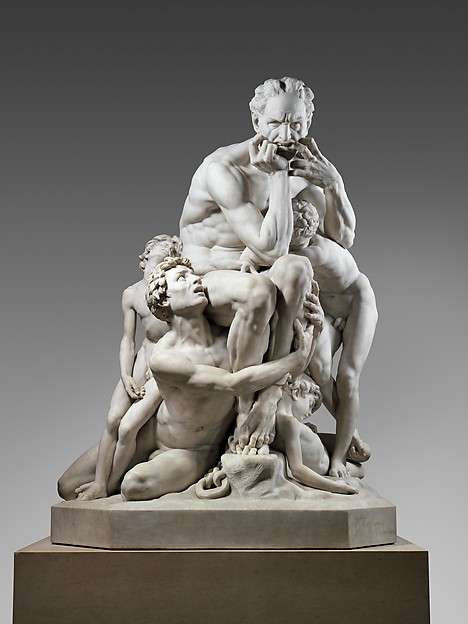
Ugolino and His Sons, Jean-Baptiste Carpeaux, 1865–67

Ugolino and His Sons

1865–67 · Metropolitan Museum of Art

La Science, France, 1800 - 1900

La Science

1800 - 1900 · Museo del Louvre

Neapolitan Fisherboy (Pêcheur napolitain à la coquille), Jean-Baptiste Carpeaux, 1857-after 1861

Neapolitan Fisherboy (Pêcheur napolitain à la coquille)

1857-after 1861 · National Gallery of Art

Girl with a Shell (Jeune fille à la coquille), Jean-Baptiste Carpeaux, 1863-1867

Girl with a Shell (Jeune fille à la coquille)

1863-1867 · National Gallery of Art

Madame Armande Dieudé Defly, 1785-1875, Jean-Baptiste Carpeaux, model 1863, probably cast 1891

Madame Armande Dieudé Defly, 1785-1875

model 1863, probably cast 1891 · National Gallery of Art

Madame Defly (1785–1875), Jean-Baptiste Carpeaux, 1863

Madame Defly (1785–1875)

1863 · Metropolitan Museum of Art

Genius of the Dance, Jean-Baptiste Carpeaux, 1864

Genius of the Dance

1864 · Metropolitan Museum of Art

Pietà, Jean-Baptiste Carpeaux, 1864

Pietà

1864 · Metropolitan Museum of Art

Sotto lo stesso tetto: Minneapolis Institute of Art

Pagina del museo
Olive Trees, Vincent van Gogh, 1889

Vincent van Gogh

Olive Trees, 1889

Grainstack, Sun in the Mist, Claude Monet, 1891

Claude Monet

Grainstack, Sun in the Mist, 1891

Lucretia, Rembrandt van Rijn, 1666

Rembrandt van Rijn

Lucretia, 1666

Self-Portrait with Dr. Arrieta, Francisco José de Goya y Lucientes, 1820

Francisco de Goya

Goya curato dal dottor Arrieta, 1820

Study for Improvisation V, Vassily Kandinsky, 1910

Vasily Kandinsky

Study for Improvisation V, 1910

Tahitian Landscape, Paul Gauguin, 1891

Paul Gauguin

Tahitian Landscape, 1891

Chestnut Trees at Jas de Bouffan, Paul Cézanne, c. 1885–86

Paul Cézanne

Chestnut Trees at Jas de Bouffan, c. 1885–86

The Union of England and Scotland (Charles I as the Prince of Wales), Peter Paul Rubens, 1633–34

Peter Paul Rubens

The Union of England and Scotland (Charles I as the Prince of Wales), 1633–34