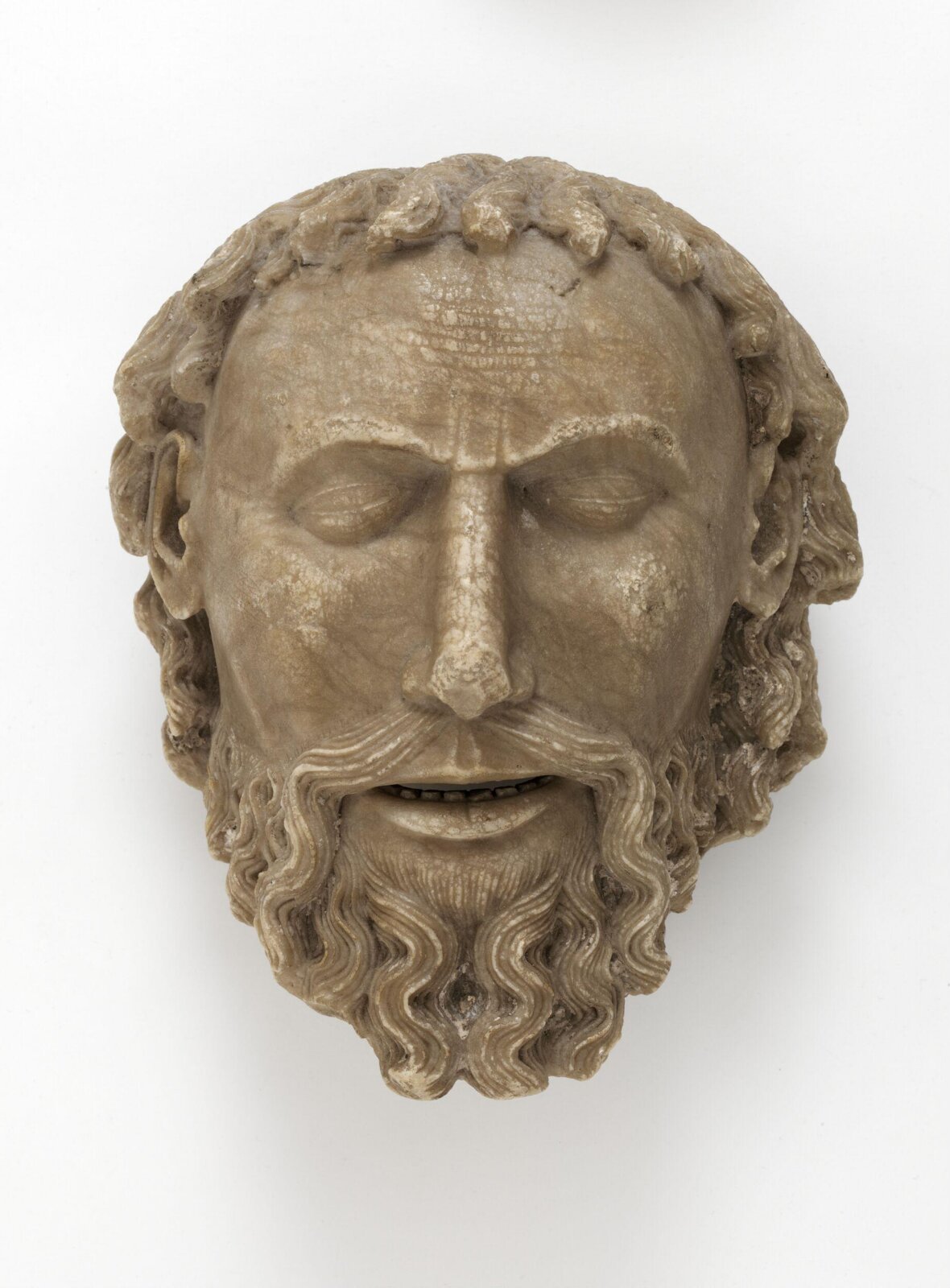
Head of St John the Baptist
Si può vedere?
Sì, esposta ora
Dove si trova «Head of St John the Baptist» oggi? Victoria and Albert Museum, Medieval & Renaissance, Room 10, Londra. Sì, esposta ora. Verificato 25 settembre 2026.

Aperto· fino alle 17:45
Esposta al pubblico.
- Verificato
- Ultimo cambio di stato
- Fonte
- Il museo
Sulla scultura
St John the Baptist was beheaded by the order of Herod, whose step-daughter Salome had asked for his head at the suggestion of her mother. Images of his head on a platter appear in Byzantine manuscript illumination from the 11th century, and the subject became popular throughout Europe largely through veneration of a famous relic at Amiens (brought from Byzantium in 1204). The type was known as a Johannesschüssel in Germany, and they were produced in wood from the 14th century, with production continuing in other media into the 16th century.
Leggi
The three holes in the underside of the neck indicate that this head may originally have been displayed on a platter, but that it would have sat semi-upright, rather than lying flat on its back. German examples with extant platters can be found with heads in a similar position. The carving which extends over the head except on the very back would also be unnecessary if the head had lain flat in a deep dish.
The head has a hollow back reaching through to the mouth, with a rectangular opening, which is something of a mystery. There are other alabaster St John's heads with similarly hollow backs, as well as wooden examples. Various explanations have been suggested: that the hollows were intended to house relics, that they were to lighten the heads if they were intended to be carried around, or that they were to allow the insertion of objects to acquire curative properties (eg against headaches).
There has been some debate over the origin of this particular example, which may originate from Germany or the Netherlands. It fits into a group of surviving heads which have numerous parallels with continental production.
There are two sorts of alabaster. Calcite alabaster is very hard and was used in ancient times. This object is made of gypsum alabaster which is a fine-grained, soft and smooth stone. Although at first glance it looks a little like marble, which it was intended to imitate, it was much easier to carve due to its softness, and alabaster objects were therefore significantly cheaper to produce. Marble does not originate in England, so it was imported if needed, whereas in the 15th century there were important alabaster quarries in Nottingham, York, Burton-on-Trent and London. England was a major centre for the production of objects such as this one. During period, they were exported in very large numbers to Europe where they survive, unlike many examples which remained in England and were destroyed or greatly damaged during the Reformation.
Victoria and Albert Museum
Scheda
- Numero di inventario
- A.31-1950
Che cosa raffigura
In catalogo
Fonti
- Victoria and Albert Museum
- Immagine: Victoria and Albert Museum — © Victoria and Albert Museum, London