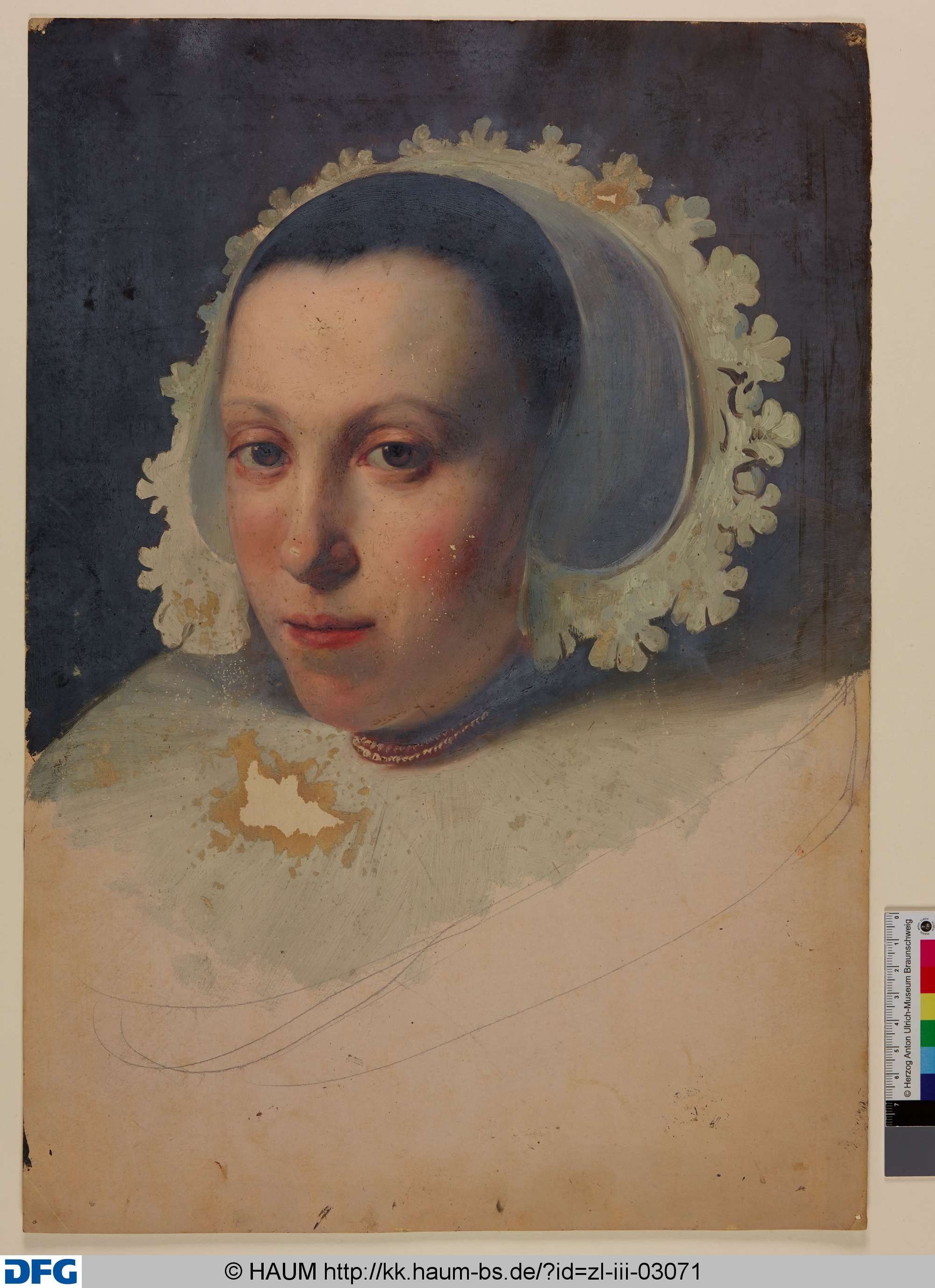
![[Gad; Gad; Gen. 49: 19], Karel van Mander the Elder, 1589–1629](https://diglib.hab.de/varia/haum/gheyn-j-d-ii-ab3-0139/max/000001.jpg)
 Karel van Mander the ElderPaesi Bassi storici, 1548–1606
[Gad; Gad; Gen. 49: 19]
Si può vedere?
Non si sa
Dove si trova «[Gad; Gad; Gen. 49: 19]» oggi? Collezione: Herzog Anton Ulrich-Museum, Braunschweig. Non si sa.

Braunschweig, Germania
Il proprietario è noto; non si sa se oggi sia esposta.
- Ultimo cambio di stato
- Fonte
- Il museo
Scheda
Che cosa raffigura
In catalogo
Fonti
- Herzog Anton Ulrich-Museum
- Immagine: Herzog Anton Ulrich-Museum — CC BY-NC-SA 4.0
Nella vita di Karel van Mander the Elder
Tutta la vita1583–1603
Inventory of Haarlem's art collection
While translating Vasari's “Lives” into Dutch, van Mander is offered a commission by the Haarlem city fathers to inventory “their” art collection — the city had confiscated all Catholic religious art after the Satisfaction of Haarlem, which gave Catholics equal rights with Protestants, was overturned in 1578. The work lasts twenty years and yields the chapters of his future “Schilder-Boeck” on Early Netherlandish painters.
1583–1603
Evenings of drawing and pupils in his home
After the Calvinist iconoclasm religious themes have gone out of fashion and mythology has become popular, but few painters could afford a trip to Italy, so van Mander receives budding artists in his home for evenings of communal drawing and study of classical mythology, to educate them in the proper techniques. A firm believer in the hierarchy of genres, and in the idea that true-to-life historical allegories can be achieved only through proper study of existing works, he counts Frans Hals and Hendrick Gerritsz Pot among his Haarlem pupils.
1587
Founding of the Haarlem academy
Together with Cornelis van Haarlem and Hendrick Goltzius van Mander founds an “academy to study after life”, later known as the Haarlem Academy of Mannerists. What it actually did is not entirely clear: by one account, modelled on the Italian pattern, it studied anatomy and drew from nude models, including women, which was forbidden in the North at the time; by another, it was an informal discussion group, and by a third it was literary in nature.
1604
The “Schilder-Boeck” is published
In Haarlem, from the press of Passchier van Wesbusch, appears the “Schilder-Boeck” (“Book of Painters”) — the first art-historical work in Northern Europe: lives of more than 250 painters, ancient and contemporary, together with the art theory of the day for aspiring painters. Inspired by Vasari's “Lives”, it comprises six parts, from a verse address to students and biographies of ancient, Italian, Netherlandish and German masters to a commentary on Ovid's “Metamorphoses” and a guide to depicting figures; its biographical details on early Netherlandish painters, and above all the Haarlem painters, are unique, gathered by van Mander himself.
1606
Dies in Amsterdam; his last words
Soon after the book's publication van Mander dies in Amsterdam at the age of fifty-eight; it was told that before his death he said: “When death comes and there is no other way out, then lie still and die.” Accounts give the date of his death as 2 or 11 September.
11 settembre 1606
Died