Georges SeuratFrancia, 1859–1891
Final Study for "Bathers at Asnières"
Si può vedere?
Sì, esposta ora
Dove si trova «Final Study for "Bathers at Asnières"» oggi? Art Institute of Chicago, Sala 240, Chicago. Sì, esposta ora. Verificato 29 settembre 2026.

Chicago, Stati Uniti
Aperto· fino alle 17:00
Esposta al pubblico.
- Verificato
- Ultimo cambio di stato
- Fonte
- Il museo
Sul dipinto
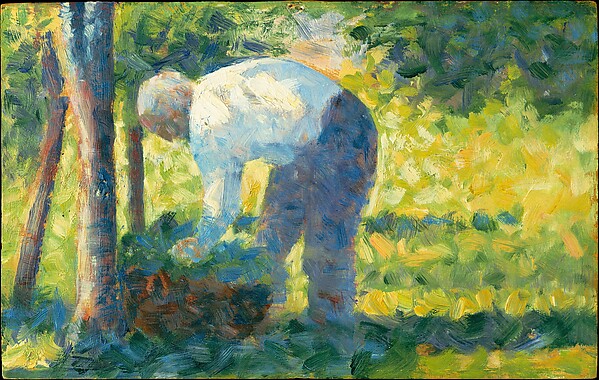
Georges Seurat made this painting as a preparatory work for his monumental Bathers at Asnières, now in the National Gallery, London. It shows men and boys on the bank of the Seine River in the working-class Parisian suburb of Asnières. The view presented here is just across the river from the leisure park Seurat immortalized in his best-known work, A Sunday on La Grande Jatte—1884. The frozen gestures and sedate poses of these bathers set a mood distinct from the sparkling scenes of Parisians enjoying restaurants and other riverbank activities favored by the Impressionists. Nevertheless, Seurat’s focus on a subject from modern life, his luminous palette, and his airy brushwork show how the young artist adapted characteristics of Impressionist painting for his own purposes.
Art Institute of ChicagoCC BY 4.0
Scheda
Che cosa raffigura
In catalogo
Fonti
- Art Institute of Chicago
- Immagine: Art Institute of Chicago — CC0 / public domain (AIC image API)
Nella vita di Georges Seurat
Tutta la vita1880–1882
A studio with Aman-Jean and two years of monochrome drawing
Back in Paris, Seurat shares a studio with his friend Aman-Jean while renting a small apartment at 16 rue de Chabrol; for the next two years he works at mastering the art of monochrome drawing and studies Eugène Delacroix carefully, making notes on his use of colour.
1880s
Charles Henry's lectures at the Sorbonne
In the 1880s Seurat hears lectures by the mathematician Charles Henry at the Sorbonne on the emotional properties and symbolic meaning of lines and colour; there remains controversy over how far he adopted Henry's ideas.
1880s
The colour theorists: Chevreul, Rood, Blanc
Seurat finds the idea of separate strokes of pure colour that blend optically in the viewer's eye in “Modern Chromatics” (1879) by the American physicist Ogden Rood and in the chemist Michel Eugène Chevreul's work on the law of simultaneous contrast of colours; according to his friends, his bedside book is Charles Blanc's “Grammaire des arts du dessin” (1867).
1 May – 20 June 1883
First exhibited work: the portrait of Aman-Jean at the Salon
Seurat's first exhibited work is a Conté crayon drawing of Edmond Aman-Jean shown at the Paris Salon of 1883; from that year until his death he exhibits at the Salon, the Salon des Indépendants, Les XX in Brussels and other shows.
1884
Meeting Paul Signac
At the first exhibition of the Groupe des Artistes Indépendants Seurat meets Paul Signac, a future follower of pointillism; Signac later wrote that “Bathers” is painted in broad flat strokes and looks less bright than the Impressionists' canvases, but that the systematic separation of light, shade and local colour gives it harmony.
15 May – 30 June 1884
The Salon rejects “Bathers”: a debut at the Indépendants
The official Salon rejects “Bathers at Asnières”, and Seurat shows the painting instead at the Groupe des Artistes Indépendants, which runs from 15 May to 30 June 1884 — his debut as a painter.