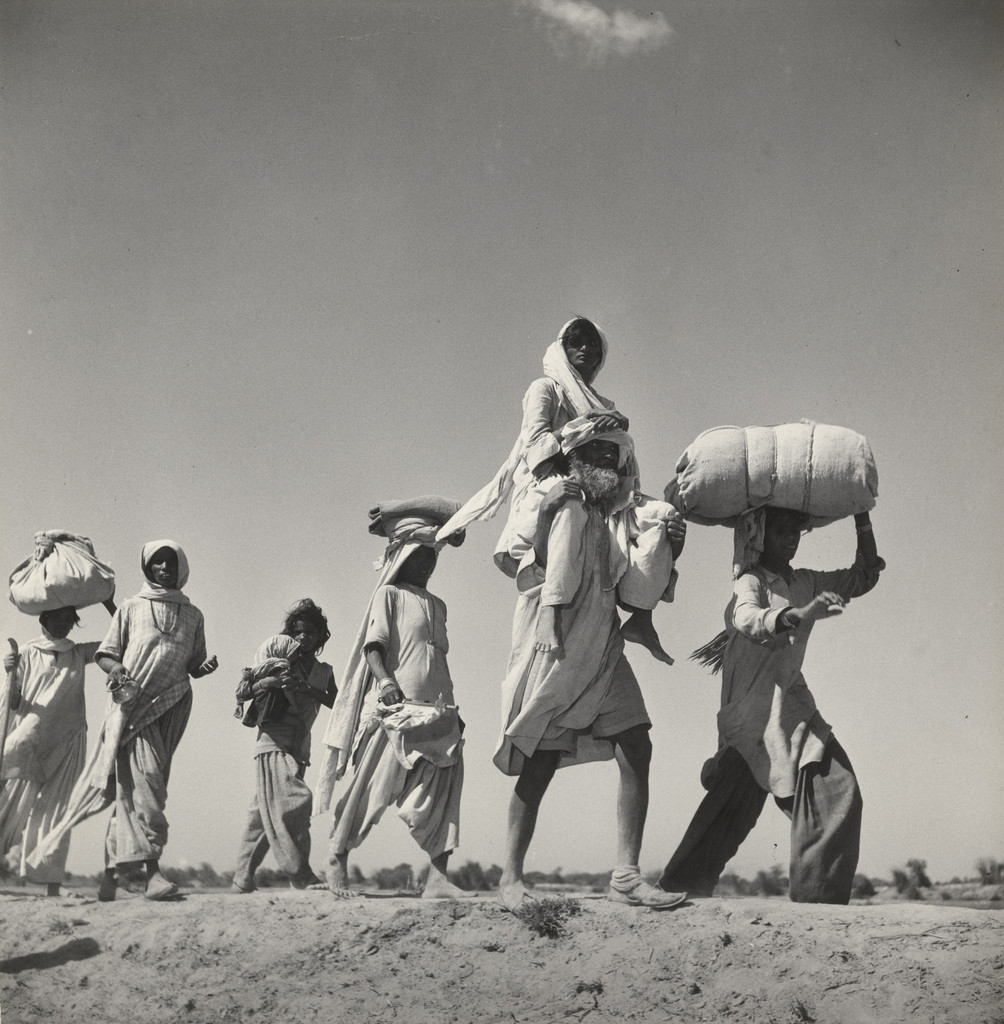
 Margaret Bourke-WhiteStati Uniti, 1904–1971
Exodus, Pakistan
Si può ammirare?
Al momento non riceve

Museum of Modern Art
New York, Stati Uniti
Appartiene alla collezione, ma al momento non è esposta.
- Verificato
- Fonte
- Il museo
Scheda
- Numero di inventario
- 97.1959.2
In catalogo
Fonti
- Museum of Modern Art
- Immagine: Museum of Modern Art — © the artist or rights holder
Nel frattempo, nella vita di Margaret Bourke-White
Tutta la vitaspring 1945
Photographs liberated Buchenwald
She arrives at the Buchenwald concentration camp and photographs it. She later said that using the camera was almost a relief, creating a slight barrier between her and the horror in front of her.
spring 1945
Through collapsing Germany with General Patton
In spring 1945 she travels through a collapsing Germany with General George S. Patton; before that, accompanying American troops in Italy, she repeatedly came under fire in areas of fierce fighting.
1946
Goes to India to photograph the independence struggle
Life sends her to India to document the country’s struggle for freedom. In her photograph of Gandhi she expressively places the spinning wheel, a symbol of Indian independence, in the foreground.
1947
Records the violence of the partition of India
She becomes one of the most effective chroniclers of the violence that erupted at the independence and partition of India and Pakistan: streets littered with corpses, the dead with open eyes, refugees with vacant stares. Her photographs of Dr. Bhimrao Ramji Ambedkar at his home in Mumbai are known equally well in India and Pakistan; she also photographed Gandhi and Pakistan’s founder, Mohammed Ali Jinnah.
1948
Interviews Gandhi hours before his assassination
She interviews and photographs Mohandas K. Gandhi only a few hours before his assassination in 1948, bearing out her knack for being in the right place at the right time. Her friend and colleague Alfred Eisenstaedt said that for her no assignment and no picture was unimportant.
late 1949
Life sends her to South Africa
She spends several months photographing in South Africa: 1,500 metres down a mine near Johannesburg, in fierce heat, she photographs two local miners drenched in sweat. Her pictures are among the first to bring American attention to the injustices of apartheid.