 Gerard ter BorchPaesi Bassi, 1617–1681
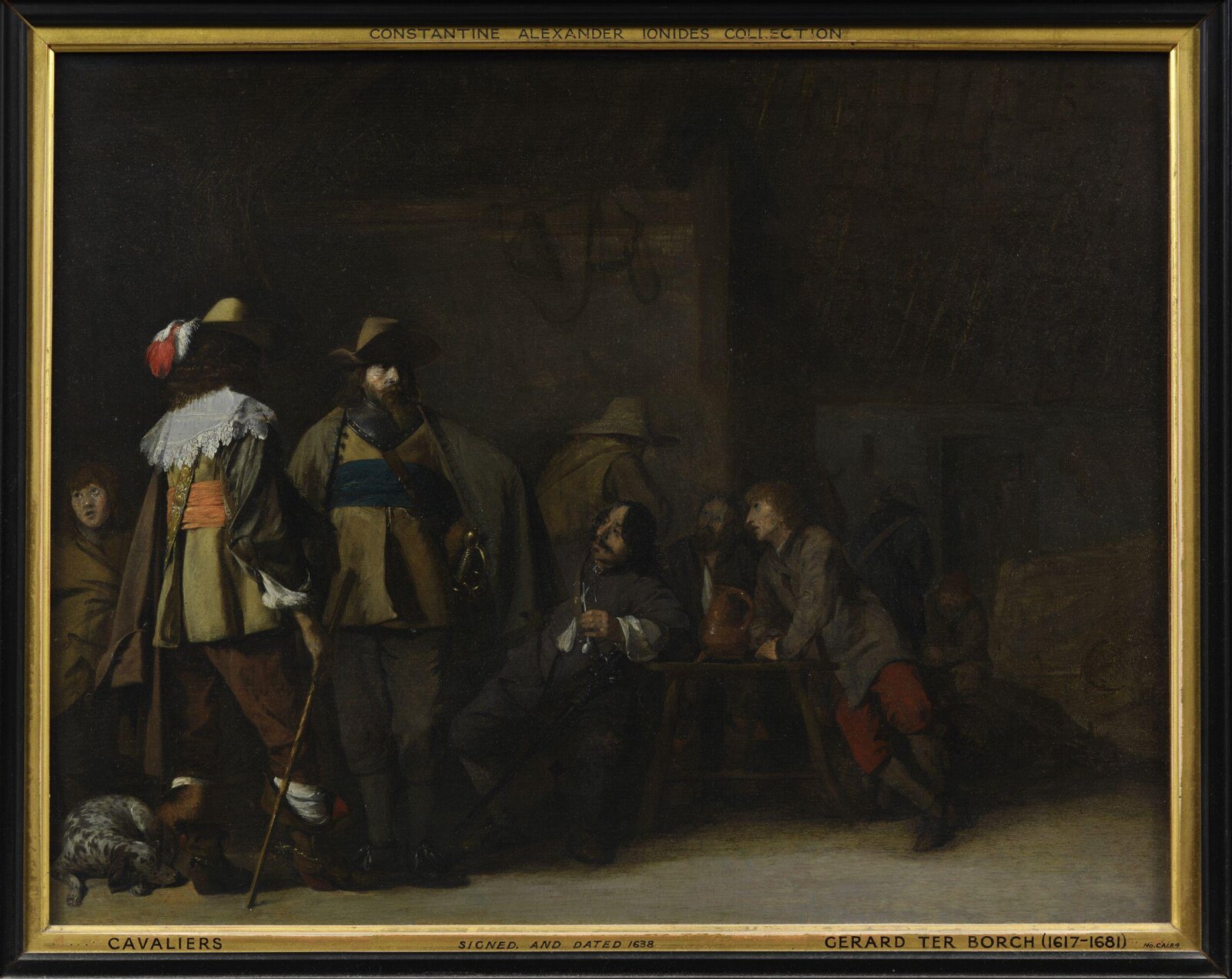
Cavaliers
Si può ammirare?
Al momento non riceve

Victoria and Albert Museum
Londra, Regno Unito
Appartiene alla collezione, ma al momento non è esposta.
- Verificato
- Ultimo cambio di stato
- Fonte
- I dati di collezione del museo stesso
About the painting
Gerard Ter Borch (1617-1681) was first trained by his father Gerard Ter Borch the Elder before going to Amsterdam in 1634 as an apprentice to the landscape painter Pieter Molijn (1595-1661). He joined the Haarlem Guild of St Luke in 1635 and soon went travelling in Europe until the early 1640s. He then moved to Deventer where he settled definitively at the end of the 1640s. He made few historical subjects and produced chiefly scenes of everyday life including scenes of skaters, soldiers and markets, high-life interior subjects and portraits. His genre paintings had a considerable influence on such contemporaries as Gabriel Metsu, Pieter de Hooch, Frans van Mieris and Johannes Vermeer. He had many pupils among which the most eminent was Caspar Netscher and his oeuvre was extensively copied.
Read on
This painting shows a guardroom scene with cavaliers and peasants resting in a domestic interior or a tavern. Unlike many Dutch painters who depicted soldiers, Ter Borch was familiar with them from personal experience. His native city, Zwolle and Deventer where he permanently settled in 1654 both housed garrisons because they were situated along the strategic defence lines established during the war with the Spanish. The date inscribed on the painting by a probable later hand, 1638, is consistent with the style of the painting but at that time, Ter Borch was still travelling in Europe. He most likely executed this painting during the early 1640s, once he was back in the Netherlands and witnessed the end of the Thirty Years War (1618-1648).
Victoria and Albert Museum
Scheda
- Numero di inventario
- CAI.84
What it shows
In catalogo
Fonti
- Victoria and Albert Museum: the museum's own open data · acquisita 10 giorni fa
- Immagine: Victoria and Albert Museum — © Victoria and Albert Museum, London
Nel frattempo, nella vita di Gerard ter Borch
Tutta la vita1636–1643
Journeys through Italy, Spain and France
According to the biographer Arnold Houbraken, in 1636–1643 he travels through Italy, Spain, France and the Southern Netherlands; in Madrid he paints a portrait of Philip IV (not preserved) and comes under the influence of Velázquez. Other accounts say he was invited to Madrid later, where Philip IV gave him employment and a knighthood, but an intrigue forced him to return to the Netherlands.
1640
Returns to Zwolle
After his uncle dies of the plague, he returns in 1640 to his native Zwolle.
1640–1645
Works as a portraitist in Amsterdam and Haarlem
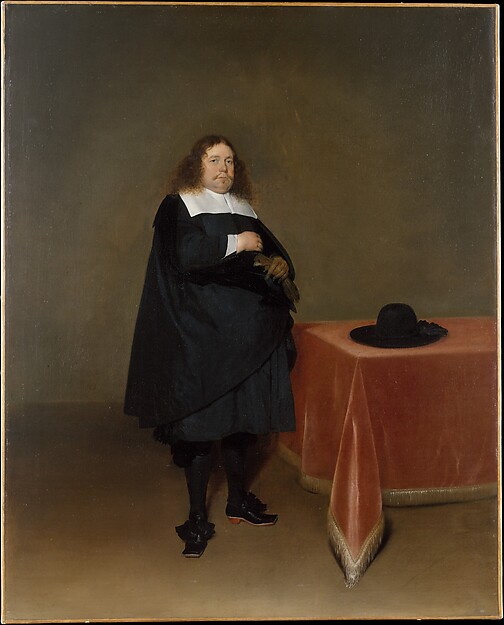
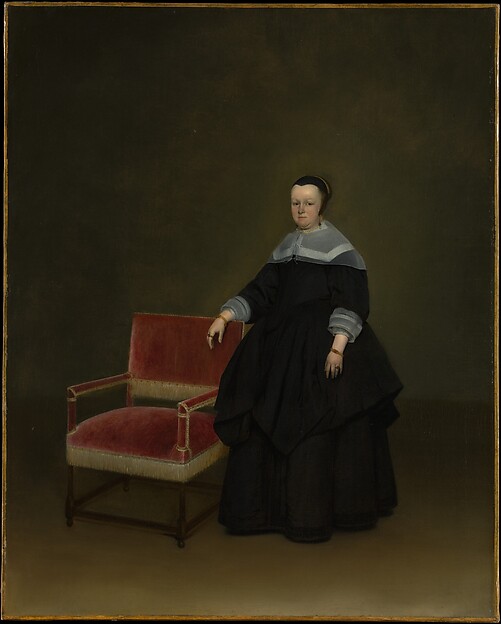
From 1640 to 1645 he lives in Holland, mainly in Amsterdam and Haarlem, and makes a name as a portraitist: small full-length portraits, possibly influenced by Hendrick Pot and Pieter Codde, and “soldier scenes” (kortegaardjes), groups of guardsmen. His portrait style takes shape by the early 1640s and hardly changes afterwards: sitters usually dressed in black against a neutral, mostly grey background.