Henri Fantin-LatourFrancia, 1836–1904
Bouquet of Flowers
Si può vedere?
Sì, esposta ora
Dove si trova «Bouquet of Flowers» oggi? Ermitage, Sala 409, San Pietroburgo. Sì, esposta ora. Verificato 29 agosto 2026.

San Pietroburgo, Russia
Chiuso· apre domani alle 12:00
Esposta al pubblico.
- Verificato
- Ultimo cambio di stato
- Fonte
- Il museo
Sul dipinto
Con le parole del museo — in russo
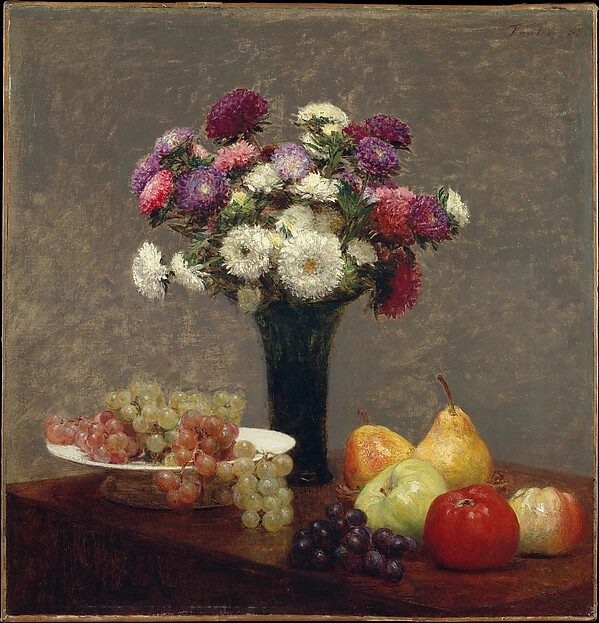
Анри Фантен-Латур, мастер больших групповых портретов и туманных аллегорий, ежегодно для заработка писал десятки натюрмортов, в которых почти неизменно присутствовали цветы. Данный цветочный букет — один из самых ранних в его творчестве. В натюрморте нет привкуса постановочности. Компоновка букета не противоречит времени цветения растений. Сами цветы, кажется только что собранные, — не изысканные оранжерейные редкости, а растения, которые можно найти в саду по соседству. Они составляют букет, радующий глаз яркими красками и разнообразием форм соцветий. Композиция исполнена довольно пастозно, в чем чувствуется влияние Курбе. При ее создании художник смог в полной мере реализовать свой талант колориста, показывая характер каждого цветка и объединяя их в красочное целое. Его цветы — не многозначные символы, но, прежде всего, предметы любования их живой и естественной красотой. Н. Б. Дёмина
Ermitage
Scheda
- Numero di inventario
- ЗКРсэ-557
In catalogo
Fonti
- Ermitage
- Immagine: Ermitage — © State Hermitage Museum
Nella vita di Henri Fantin-Latour
Tutta la vita1858
Meets James McNeill Whistler at the Louvre
In 1858 Fantin-Latour met the American painter James McNeill Whistler at the Louvre; Whistler became his friend and encouraged him to come to London.
1859
Meets Gustave Courbet
In 1859 Fantin-Latour met Gustave Courbet and worked in his studio for the next two years. According to other accounts, he only briefly frequented Courbet's studio in 1861; a painting from this period shows him with the painter and caricaturist Oulevay.
1859
The Salon of 1859 rejects his self-portrait
The Salon of 1859 rejected his first submissions, including one of his self-portraits. Fantin-Latour then began exhibiting with his friend Édouard Manet and the future Impressionists Pierre-Auguste Renoir and Claude Monet.
1859–1881
Stays in London at Whistler's invitation
At Whistler's invitation Fantin-Latour stayed in London several times between 1859 and 1881 and found many admirers in England for his still lifes of flowers and fruit. Whistler introduced him to his brother-in-law Francis Seymour Haden and the engraver Edwin Edwards; it was in London that Fantin learned etching.
1860s
Still lifes bring recognition in England
In the 1860s Fantin-Latour cultivated the still life, a genre that would play a capital role in his career. His flowers and fruit found recognition in England, while in France they were said to be practically unknown during his lifetime; his English patrons and dealers Edwin and Ruth Edwards advised him to use simple vases and table tops to show off his gift for rendering texture and colour.
1862
A still life at the Royal Academy in London
In 1862 one of his still lifes was exhibited at the Royal Academy in London. It was the first of a long series: thereafter he showed several there almost every year, and they invariably occupied a prominent place in the exhibition.