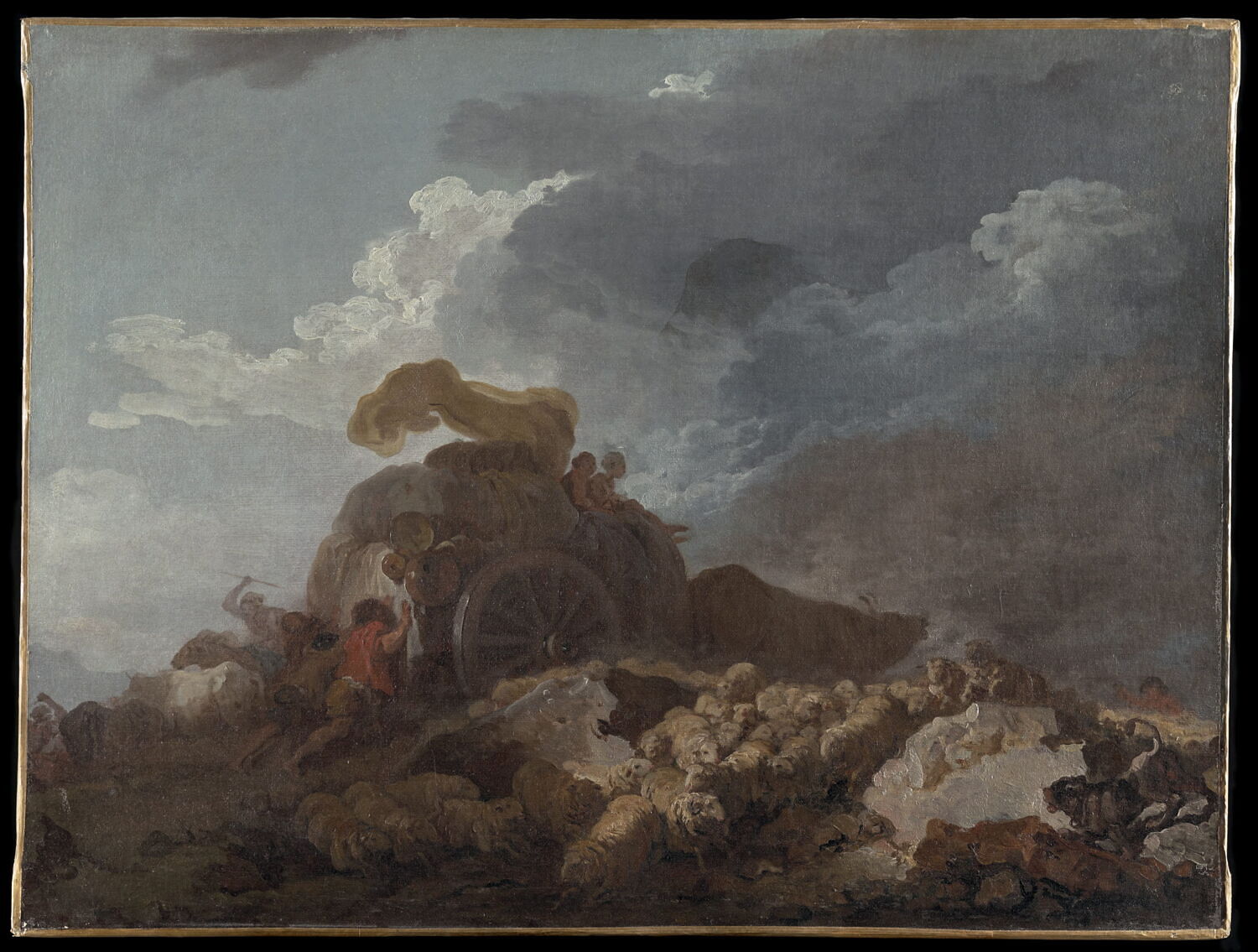
Jean-Honoré FragonardFrancia, 1732–1806
Bomen
Si può ammirare?
Non si sa

Rijksmuseum
Amsterdam, Paesi Bassi
Il proprietario è noto; non si sa se oggi sia esposta.
- Fonte
- Il museo
Sull’opera
Con le parole del museo — in olandese
Blad 52 verso uit een schetsboek met 83 bladen.
Rijksmuseum
Scheda
- Numero di inventario
- RP-T-1959-538-52(V)
Che cosa raffigura
In catalogo
Fonti
- Rijksmuseum
- Immagine: Rijksmuseum — public domain
Nel frattempo, nella vita di Jean-Honoré Fragonard
Tutta la vita1765
"Coresus and Callirhoe" at the Salon: admission to the Academy
He exhibited at the Paris Salon the painting "Coresus and Callirhoe" (now in the Louvre), for which the Royal Academy of Painting and Sculpture admitted him as a member. Diderot devoted a lavish panegyric to it, and the king bought the painting and ordered it reproduced at the Gobelins manufactory.
second half of the 1760s
Abandoning history painting for "gallant scenes"
Despairing of attaining the position of first painter in the classical genre, he abandoned it for erotic genre scenes, which enjoyed the greatest success at the court of Louis XV. He soon became a fashionable artist — a master of pastoral landscapes, female portraits and small-format "cabinet pictures."
17 June 1769
Marriage to Marie-Anne Gérard
He married the miniature painter Marie-Anne Gérard; that same year their daughter Rosalie was born, who became one of her father's favorite models.
October 1773
Second journey to Italy with Bergeret de Grancourt
After a summer trip to Flanders, he set off for Italy as guide to Pierre-Jacques Onésyme Bergeret de Grancourt; Fragonard also designed a family château for him.
September 1774
Return through Central Europe
The journey ended in September 1774 after visits to Vienna, Prague, Dresden, Frankfurt and, finally, Strasbourg.