 Jacob Isaacksz. van RuisdaelHollandia, 1628–1682
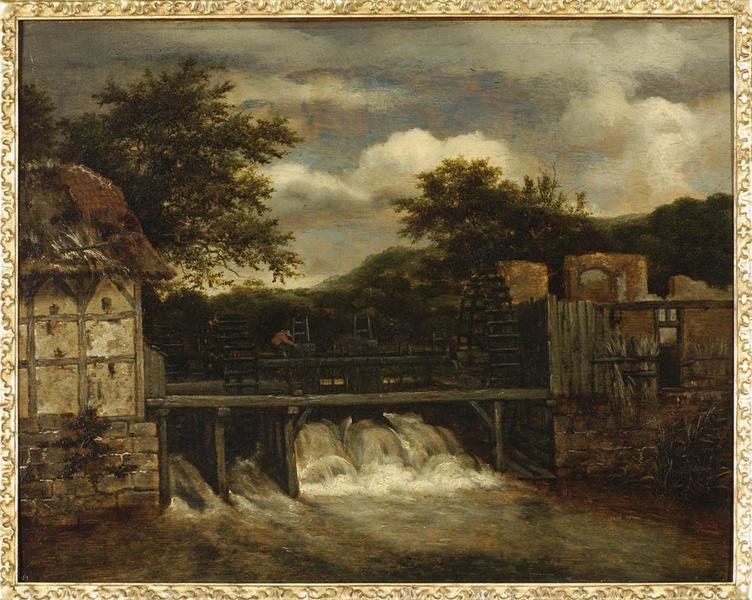
Les deux moulins
Megnézhető?
Nem tudjuk
Hol van most a(z) „Les deux moulins”? Gyűjtemény: Musée des Beaux-Arts de Strasbourg, Strasbourg. Nem tudjuk, hogy ma ki van-e állítva.
Strasbourg, Franciaország
A tulajdonos ismert; azt nem tudjuk, hogy ma ki van-e állítva.
- Ebben az állapotban ettől kezdve
- Forrás
- A múzeum
A festményről
Two Mills is a 1650s painting by the Dutch painter Jacob van Ruisdael. It is now in the Musée des Beaux-Arts of Strasbourg, France. Its inventory number is 625.
The painting belongs to a series of depictions of a watermill either at Singraven near Denekamp, or at Haaksbergen near Enschede. It was bought from Martin Henry Colnaghi for the Strasbourg museum by Wilhelm von Bode around 1892; the painting had previously belonged to the collector Albert Levy of London and Colnaghi had bought it at the sale of Levy's collection on 16 June 1876, item number 360, for 126 British pounds (equivalent to £12,570 in 2025).
Adatok
- Leltári szám
- MBA 265
Mit ábrázol?
A katalógusban
Források
- Musée des Beaux-Arts de Strasbourg
- Kép: Musée des Beaux-Arts de Strasbourg — © Service photographique des Musées de Strasbourg, © BACHER, © BERTOLA; Ministère de la Culture (France), base Joconde
Jacob Isaacksz. van Ruisdael életében
A teljes életút1640s
Trips to Blaricum, Egmond aan Zee and Rhenen
For a landscape painter Ruisdael travelled little: in the 1640s he visited Blaricum, his grandfather's home village, Egmond aan Zee and Rhenen.
1650
Journey to Germany with Nicolaes Berchem
With Nicolaes Berchem, one of the painters who would later add figures to his landscapes, Ruisdael travels to Bentheim and Steinfurt, just across the German border (other accounts date the trip to Westphalia to around 1650). Afterwards his landscapes take on a more heroic character, with larger and more prominent forms.
c. 1657
Moves to Amsterdam
Ruisdael moves to prosperous Amsterdam, which likely offered a bigger market for his work: his fellow Haarlem painter Allart van Everdingen had already moved there and found buyers. He lived there for the rest of his life (other accounts date the move to 1657).
1668
Witness at the wedding of his pupil Meindert Hobbema
In 1668 Ruisdael witnesses the marriage of Meindert Hobbema, his only registered pupil. He himself never married — according to Houbraken, to reserve time to serve his old father.
1672
Still comfortable after the Disaster Year
There is no record of Ruisdael owning land or shares, yet he appears to have lived comfortably even after the downturn of the disaster year 1672: in inventories of 1650–1679 his paintings averaged 40 guilders against 19 for attributed paintings generally. The legend that he died poor in a Haarlem almshouse confuses him with his cousin Jacob Salomonszoon.
1682. március 10.
Died