Jack WhittenAmerikai Egyesült Államok, 1939–2018
Khee II
Megnézhető?
Jelenleg nincs kiállítva
Hol van most a(z) „Khee II”? Gyűjtemény: Art Institute of Chicago, Chicago. Jelenleg nincs kiállítva. Ellenőrizve 2026. november 9.

Chicago, Amerikai Egyesült Államok
A gyűjteményhez tartozik, de jelenleg nincs kiállítva.
- Ellenőrizve
- Ebben az állapotban ettől kezdve
- Forrás
- A múzeum
A festményről
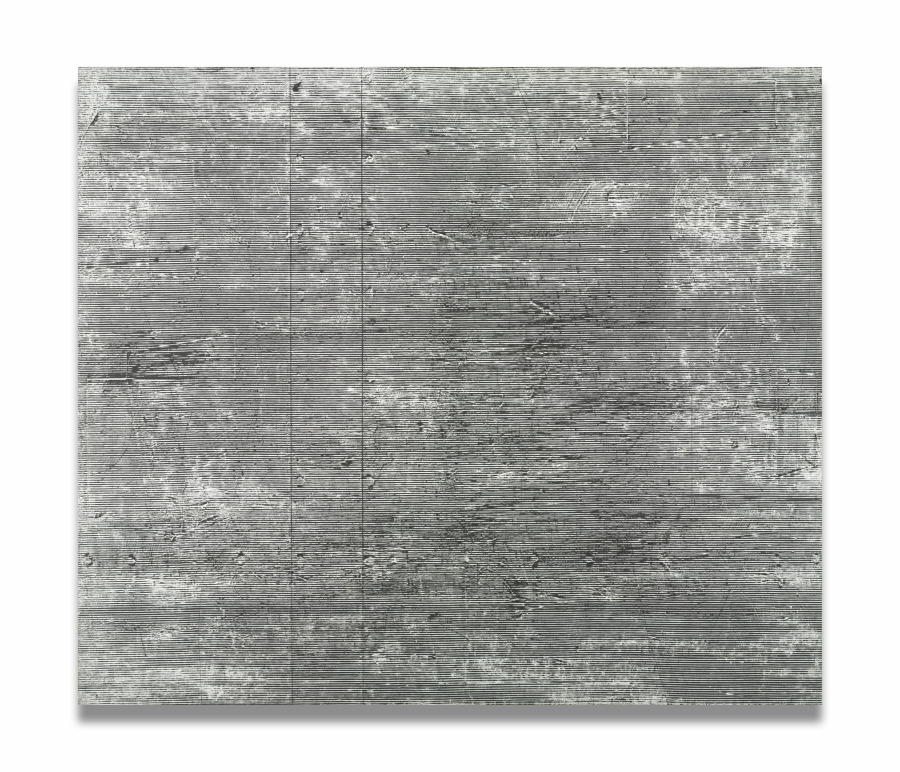
Jack Whitten made Khee II in 1978 through a process of pressure and dissolving paper; it is at the Art Institute of Chicago, Chicago. He put flat objects beneath the canvas, coated its surface with gesso and added sheets of coloured Japanese rice paper. As the paper dissolved, pigment remained. A rake or another notched implement dragged across the top pressed the hidden shapes into the canvas and spread the colour. Faint images emerge among alternating coloured bands. Whitten called his tool a developer, borrowing a term from photography.
A múzeum szavaival
In the early 1960s, as a young student in New York, Jack Whitten established ties with an older generation of black artists that included Romare Bearden and Jacob Lawrence, as well as with leading Abstract Expressionists such as Willem de Kooning, Ad Reinhardt, and Franz Kline. During the second half of the decade, Whitten began working toward an entirely unique relationship to painting that he described in this way: “About 1965 I wrote on my studio wall one day, the image is photographic; I must photograph my thoughts.” By 1970 the artist had eliminated both expressive color and figuration from his work, launching a ten-year series of paintings that capture, like a camera, the often chance-based immediacies of his dynamic studio process.
Tovább
Khee II exhibits all the hallmarks of Whitten’s mature process-derived paintings. As with other works from this period, the artist placed a variety of flat, shaped objects beneath the canvas. After preparing the surface with gesso, he layered it with thin sheets of colored Japanese rice paper. The rice paper dissolved, leaving behind pure pigment. Whitten then pulled a rake or other notched tool—which he calls a “developer,” in obvious reference to a photographer’s chemicals—across the work’s surface. This served both to impress the shapes from below, effectively embossing the canvas, and to disperse color on top of it. The result is a series of ghostlike images and alternating rows of color that vibrate with subtle luminosity. This is a glowing evocative abstract painting that is also a layer-by-layer document of its own making.
Art Institute of ChicagoCC BY 4.0
Adatok
- Leltári szám
- 2013.123
Mit ábrázol?
A katalógusban
Források
- Art Institute of Chicago
- Kép: Art Institute of Chicago — © the artist or rights holder