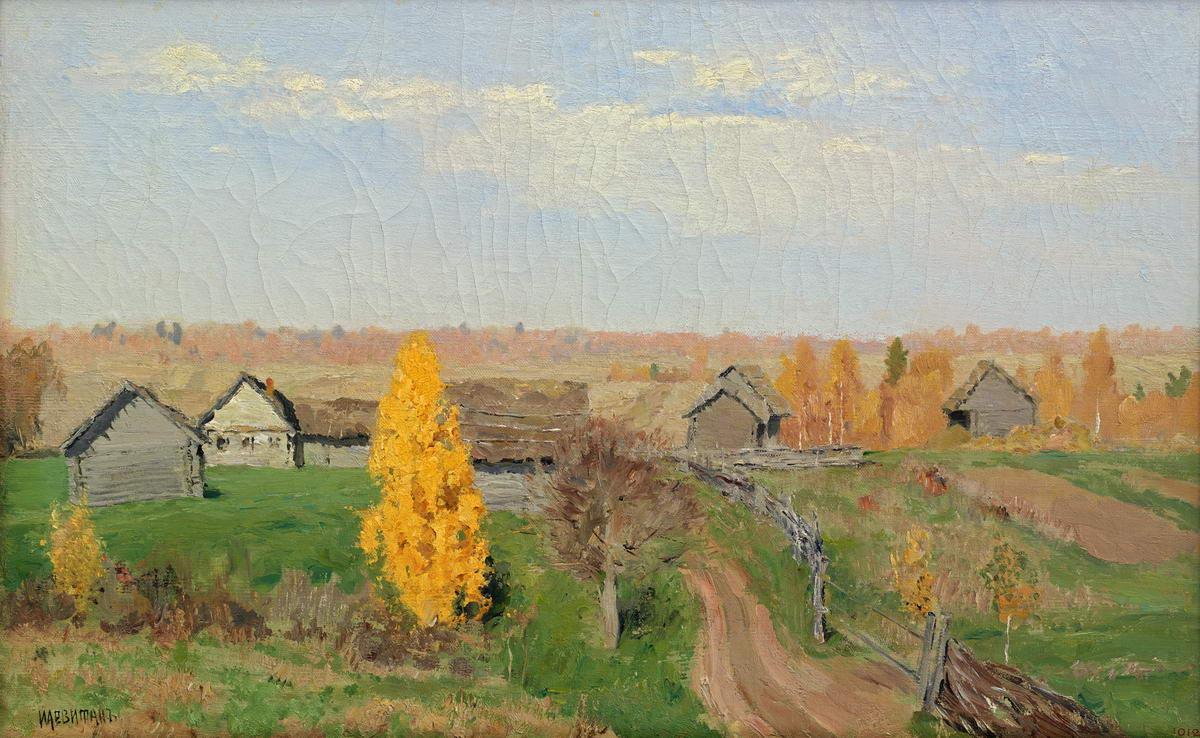
Isaac Levitan1860–1900
Картина. "Солнечный день" Этюд
Megnézhető?
Nem tudjuk
Hol van most a(z) „Картина. "Солнечный день" Этюд”? Gyűjtemény: Tatarstan State Museum of Fine Arts, Kazany. Nem tudjuk.
Kazany, Oroszország
A tulajdonos ismert; azt nem tudjuk, hogy ma ki van-e állítva.
- Ebben az állapotban ettől kezdve
- Forrás
- A múzeum
A festményről
Múzeumi szöveg, nyelv: orosz
Летний пейзаж. На первом плане, в центре картины, на ровной площадке, три березы, покрытые ярко - зеленой листвой. Слева от них - фасад бревенчатого домика в три окна. На втором плане - колодец и лежащее на траве бревно. За ними длинная каменная стена с дверью и справа часть дома. Около стены три дерева. Сквозь листву просвечивает голубое небо. Б/П.
Tatarstan State Museum of Fine Arts
Adatok
- Leltári szám
- Ж-1171
A katalógusban
Források
- Oroszország múzeumi állományának állami katalógusa
- Kép: Tatarstan State Museum of Fine Arts — © Государственный музей изобразительных искусств Республики Татарстан · Госкаталог музейного фонда РФ
Isaac Levitan életében
A teljes életút1860. augusztus 18.
Born
autumn 1873
Admitted to the Moscow School of Painting, Sculpture and Architecture
At thirteen he enters the school where his elder brother Abel-Leib has studied since 1871; his teachers are Vasily Perov, Alexei Savrasov and Vasily Polenov.
1875
The death of his mother and his father's illness
His mother dies; his seriously ill father has to give up his work on the railway and cannot support four children by tutoring. The family's position is such that the school gives the brothers material help from time to time.
1877
Savrasov takes him into his landscape class
Alexei Savrasov, a friend of Perov, notices Levitan's talent and takes him into his own landscape class.
spring 1888
He discovers Plyos on the Volga
In spring 1888 he sails by steamer along the Oka to Nizhny Novgorod and on up the Volga with the artist Alexei Stepanov and Sofia Kuvshinnikova; to their own surprise they discover the small, quiet town of Plyos and decide to stay on for a while. The three summer seasons there (1888–1890) prove extremely productive: some two hundred works bring Levitan wide fame.
1900. július 22.
Died