Edgar DegasFrance, 1834–1917
Washerwomen
Peut-on la voir ?
Inconnu
Où est « Washerwomen » aujourd’hui ? Collection: Musée d'Orsay, Paris. Inconnu.

Paris, France
Le propriétaire est connu ; on ignore si l’œuvre est exposée aujourd’hui.
- Dans cet état depuis
- Source
- Le musée
À propos du tableau
Les Blanchisseuses est un tableau réalisé par le peintre français Edgar Degas vers 1870-1872. Cette huile sur toile de petit format représente deux visages féminins tournés l'un vers l'autre, le regard vers le bas. L'une des figures se tenant le menton et la coiffe de l'autre pouvant être comprise comme un bandage, elle a pu être interprétée comme le portrait de deux lavandières victimes de douleurs à la bouche et elle figure ainsi dans le catalogue raisonné de l'œuvre de l'artiste dressé par Paul-André Lemoisne sous le titre alternatif de Blanchisseuses souffrant des dents.
Lire plus
Un temps la propriété d'un compagnon d'armes de Degas pendant la guerre de 1870, la peinture est léguée à l'État en 1953. Puis, par un arrêté du 26 juin 1961, elle est placée en dépôt au musée d'art moderne André-Malraux, au Havre, deux jours après son inauguration. Mais elle y fait l'objet d'un vol en 1973 avant d'être finalement retrouvée à l'occasion d'une vente chez Sotheby's à New York en 2010, ce qui permet sa restitution l'année suivante par l'ambassadeur des États-Unis en France Charles Rivkin. Entre temps affectée aux collections du musée d'Orsay, à Paris, elle est à nouveau déposée dans le musée d'art havrais par un arrêté du 19 septembre 2011.
Notice
- Numéro d’inventaire
- RF 1953 8
Au catalogue
Sources
- Wikidata
- Image : Musée d'Orsay — Edgar Degas · Public domain · Wikimedia Commons
Dans la vie de Edgar Degas
La vie entière1870
A volunteer in the war; a flaw in his eyesight
When the Franco-Prussian War broke out Degas volunteered; at the first shooting practice it turned out that he saw poorly with his right eye. It was the first sign of the macular degeneration that left him almost blind at the end of his life; he was transferred to the artillery and served there to the end of the war.
early 1870s
Meets Durand-Ruel
Degas met the dealer Durand-Ruel, later the most prominent of the trusted dealers with whom he planned his strategy at auctions.
octobre 1872 – mars 1873 · Résidence
New Orleans
1873–1874
His brother's debts: he sells his house and collection
After his father's death Degas learned that his brother René had run up enormous business debts. To save the family's reputation he sold his house and an inherited art collection and for the first time in his life depended on sales of his own work.
1874
The first Impressionist exhibition
Disenchanted with the Salon, Degas joined a group of young artists organizing an independent exhibiting society. He took a leading role in organizing the eight shows of 1874–1886 and exhibited in all but one, despite constant conflicts with the group.
1881
“The Little Dancer of Fourteen Years” on show
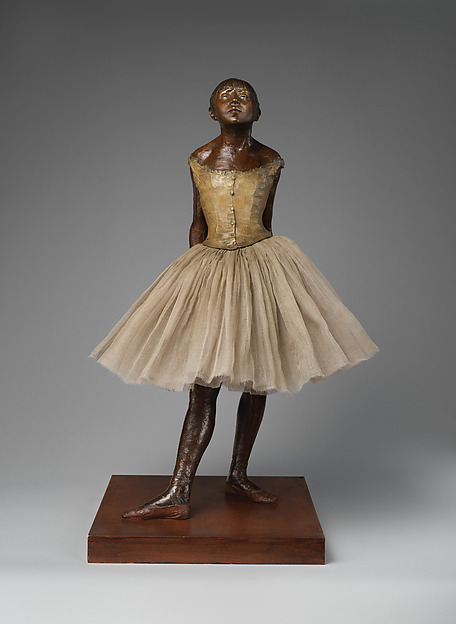
The nearly life-size wax figure with real hair and a cloth tutu, modelled on Marie van Goethem, provoked a strong reaction: critics found its realism extraordinary, but many denounced the dancer as ugly. It was the only sculpture Degas showed in his lifetime.