 Viktor Vasnetsov1848–1926
Вятские места
Peut-on la contempler ?
Inconnu

Galerie Tretiakov
Moscou, Russie
Le propriétaire est connu ; on ignore si l’œuvre est exposée aujourd’hui.
- Source
- Le musée
À propos du tableau
Selon le musée — en russe
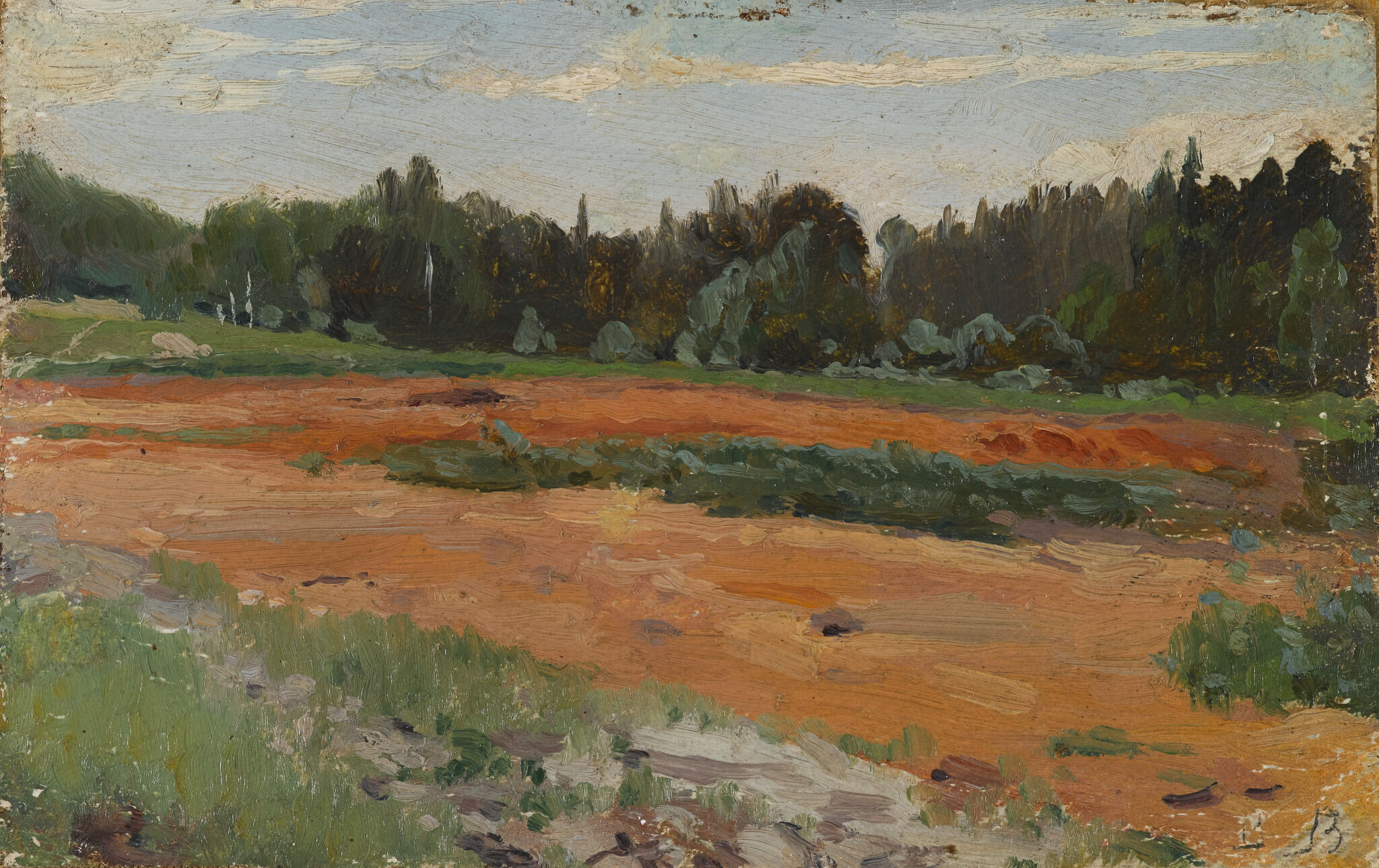
Детство и юность Виктора Васнецова прошли в селе Рябово Вятской губернии. Северная природа вятских земель сформировала у него интерес к пейзажу. Его младший брат, художник Аполлинарий Васнецов, так характеризовал окружавшие их в детстве места: природа «была живописна и разнообразна. Ряд довольно высоких холмов с долинами рек Кордяги и впадавшей в нее Рябовки, с оврагами, покрытыми хвойным лесом и пашнями». Васнецов неоднократно обращался к пейзажам этого края, стремясь «увидеть своеобразную прелесть родной ему природы». Сохранилось большое количество рисунков 1860-х – начала 1870-х годов. Однако живописных этюдов с изображением вятской земли сохранилось немного.
Lire la suite
В пейзажных рисунках Васнецов обращался к разнообразным мотивам – реки с высокими берегами, старый могучий лес, поваленные деревья и огибающие их тропинки. Часто композиции были дополнены фигурами крестьян. Однако вдохновением для этого этюда послужил очень камерный пейзажный мотив: огибающая овражек глинистая дорога, ведущая к опушке леса. Этюд относится к 1870-м годам, и был выполнен, вероятнее всего, во время обучения Васнецова в Императорской Академии художеств в Петербурге. Возможно, этот этюд стал одной из первых проб Васнецова в области пленэрной живописи.
Воспоминания о природе родного края Васнецов пронес через всю творческую жизнь. В сказочных лесах его фольклорных произведений, в просторах абрамцевских и даже французских пейзажей чувствуется величественный дух и прохлада северных земель.
Galerie Tretiakov
Notice
- Numéro d’inventaire
- ДМВ Ж-228
Au catalogue
Sources
- Galerie Tretiakov
- Image : Galerie Tretiakov — © State Tretyakov Gallery
Pendant ce temps, chez Viktor Vasnetsov
La vie entière1867–1868 · Formation
Risovalnaya shkola Imperatorskogo obshchestva pooshchreniya khudozhestv
August 1868
Admitted to the Academy of Arts
In August 1868, at the second attempt, he was admitted to the Imperial Academy of Arts; the attempt a year earlier had not worked out.
1870
He meets Pavel Chistyakov
Pavel Chistyakov, back from Rome, saw Vasnetsov’s drawing “A Prince’s Icon-painting Workshop” at an Academy exhibition, asked to be introduced to its author and soon made him a regular pupil; Vasnetsov remembered his teacher as “an enemy of the formula” who could show each pupil the road to his own development.
summer 1871
He meets his future wife, Alexandra Ryazantseva
In the summer of 1871, home in Vyatka on academic leave, he met Alexandra Ryazantseva in the local library — a merchant’s daughter who would become one of the first women from Vyatka with a higher medical education; he was struck by “her eyes — stern and extraordinarily kind”.
1873–1875
He leaves the Academy before graduating
In 1873, a year before the end of the course, he almost stopped attending the Academy and went only to Chistyakov’s studio: Chistyakov told him he had already got from the Academy all it could give, and Kramskoi advised the same; on 4 (16) February 1875 he was formally discharged, receiving a certificate that listed two small silver medals and one large one.
1878
He moves to Moscow, the city of his life’s work
In 1878, his resolve strengthened by Mamontov’s letter, he moved to Moscow, the city to which most of his creative life would be tied: he settled in a small flat in 3rd Ushakovsky Lane near Ostozhenka, walked the city for hours admiring the Kremlin and St Basil’s, and until 1885 the family changed rented flats in Moscow six times.